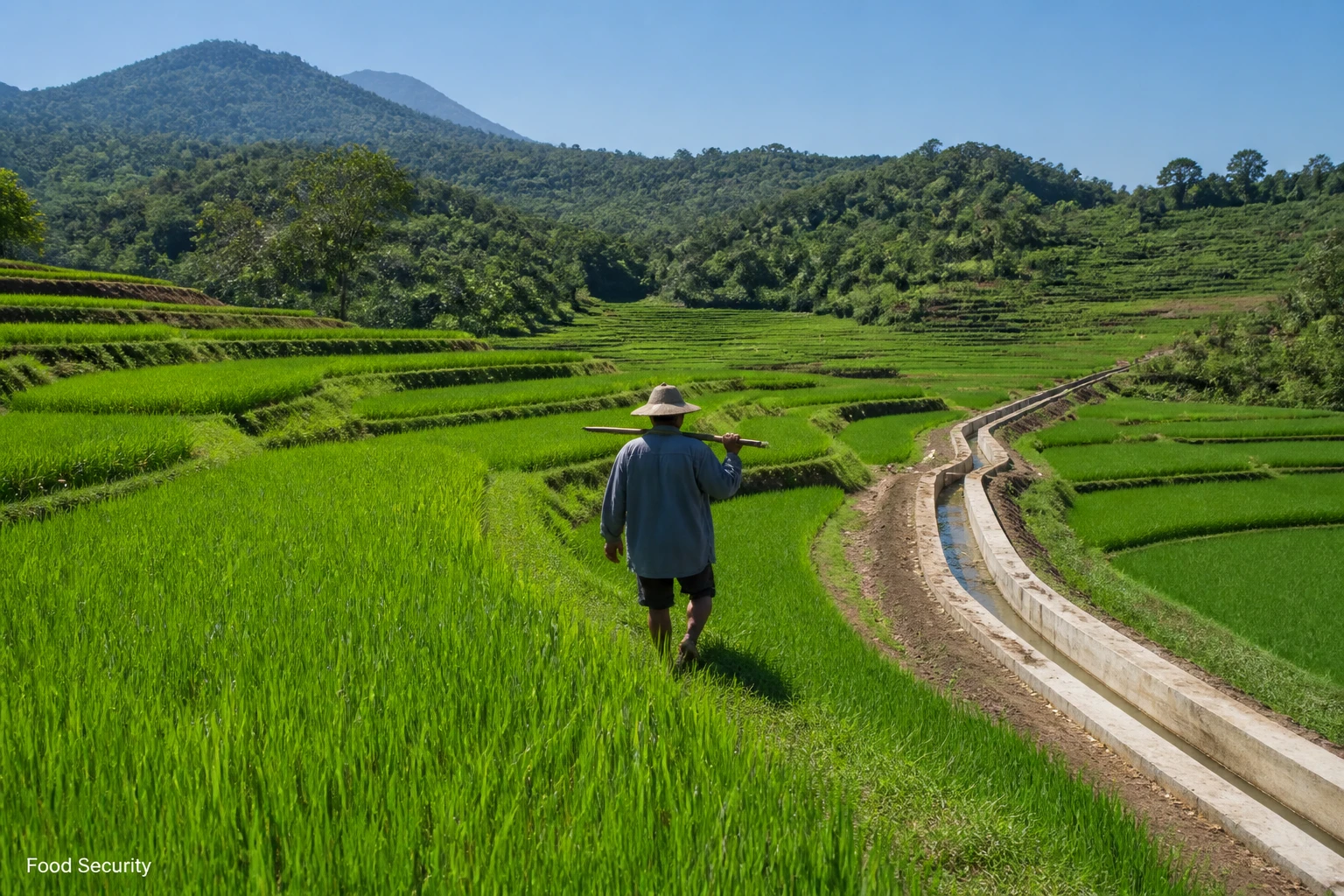
Food Security Policy and Property: How Bulog Investment Reshapes Lombok Land Values
Prabowo's food security mandate to Bulog signals agricultural infrastructure investment. Here's how domestic food prioritization creates property appreciation in rural zones.
Lombok Notebook: When Food Policy Becomes Property Strategy
President Prabowo Subianto's directive to state food agency Bulog to prioritize domestic food stocks over export or commercial considerations might seem purely administrative, a matter of national supply chain management. But for investors tracking the intersection of infrastructure development and property valuations, it's a policy signal with concrete implications: sustained rural investment, agricultural infrastructure expansion, and property appreciation in Lombok's food-producing zones.
The Context
Bulog (Badan Urusan Logistik) is Indonesia's state food logistics agency. Its mandate spans strategic food reserves, price stabilization, farmer support programs, and domestic supply chain infrastructure. When a president instructs Bulog to "prioritize domestic food stocks," it's a reorientation of resource allocation: away from export-oriented commercial operations toward domestic procurement, farmer support, and infrastructure investment at the production end of the supply chain.
This shift has cascading effects:
- Increased domestic procurement: Bulog will buy more domestically produced rice, corn, and other staples, supporting farmer prices and incomes
- Infrastructure investment: Bulog expands storage, processing, and distribution facilities in production zones to reduce losses and improve efficiency
- Farmer support programs: Direct assistance, input subsidies, and equipment programs to boost productivity
- Supply chain development: Investment in cold chains, rural markets, and logistics infrastructure
For Lombok, which sits within Indonesia's food-production geography and lacks mature supply chain infrastructure, this represents a 3–5 year window of federal investment in rural areas.
How Food Security Infrastructure Drives Property Value
Property investors typically think of real estate as end-consumer assets: villas, resorts, commercial buildings. But supply chain and agricultural infrastructure properties represent an underexplored asset class with strong cash flows and appreciation drivers.
Direct Infrastructure Property Opportunities Bulog's domestic prioritization requires:
- Storage facilities: Climate-controlled warehouses for rice, corn, and staples. Bulog typically builds these in production zones, rural Lombok qualifies.
- Processing centers: Milling, drying, and packaging facilities. These create permanent employment and attract supporting businesses.
- Distribution hubs: Logistics centers connecting production zones to markets.
- Market facilities: Farmer markets and collection points for smallholder aggregation.
These aren't glamorous assets, but they generate 8–12% cap rates through long-term government leases or operational contracts. A 500 sqm storage facility on Lombok agricultural land might cost $50–100K USD to develop and lease for $5–8K annually to Bulog or agricultural cooperatives, a 5–8% yield with government tenant security.
Indirect Land Value Appreciation Bulog infrastructure projects in rural zones create demand for adjacent land and property:
- Land for equipment staging areas and service facilities
- Staff housing and worker accommodations
- Small business properties (restaurants, repair shops, trade services)
- Transportation and vehicle facilities
When major infrastructure projects land in rural areas, surrounding property values typically appreciate 30–50% within 2–3 years as secondary development follows and local economies strengthen.
 Food Security Policy and Property · Photo by Arif Baroya on Pexels
Farmer Income Stabilization When Bulog prioritizes domestic procurement and offers farmer support programs, farm incomes stabilize and rise. Stable farm incomes support:
- Rural property demand for housing and business spaces
- Construction and home improvement spending
- Investment in agricultural property and land expansion
- Rural service sector growth
These dynamics create a multiplier effect where agricultural infrastructure investment lifts rural property valuations across multiple property classes.
Lombok's Agricultural Infrastructure Window
Lombok's agricultural sector has historically lacked modern infrastructure. Smallholder farmers manage roughly 70% of productive land, but access to Bulog programs, modern storage, and efficient markets remains limited. This gap represents an investment opportunity.
Current State:
- Limited modern storage facilities
- Weak farmer aggregation infrastructure
- Inefficient rural distribution
- Unmet demand for supply chain property
Post-Bulog Prioritization Scenario: Federal food security commitments typically trigger:
- Regional assessment of production capacity
- Infrastructure gap analysis
- Development of facilities in high-potential zones
- Loan programs for private sector infrastructure
Lombok, with significant corn, rice, and coconut production capacity and a location advantageous for supplying Eastern Indonesia, is positioned for infrastructure focus.
Geographic Zones for Infrastructure Investment: | Zone | Current Status | Infrastructure Potential | Property Opportunity | |------|---|---|---| | North Lombok | Moderate productivity | Corn processing, storage | Mid-level | | Central Lombok | High proximity to market | Distribution hub potential | High | | East Lombok | Developing, underutilized | Production aggregation | High |
The Timeline:
- 2026 H2: Bulog assessments and planning for regional facility expansion
- 2027: Ground-breaking on priority storage and processing facilities
- 2027-2028: Infrastructure operational; secondary property development follows
- 2028+: Sustained agricultural infrastructure maturity; property values stabilize at higher levels
Investors entering Lombok agricultural property or infrastructure land now position ahead of the visible development curve.
What This Means for Investors
Agricultural Infrastructure Development Play Investors with 3–5 year horizons can acquire land parcels in North or East Lombok (where infrastructure gaps are largest) in anticipation of Bulog facility development. Expected appreciation: 30–50% within 24–36 months if a major facility lands within 5km of your holding.
Entry prices remain modest: $20–50K USD for 0.5–1 hectare parcels in rural areas, compared to €95–350K for South Lombok tourism property.
Hybrid Infrastructure-Agriculture Properties Develop 1–3 hectare parcels combining:
- Productive agricultural land
- Small-scale processing or storage facility (corn drying, spice processing)
- Farm-stay accommodation
- Direct-to-consumer or B2B sales channels
These properties capture both agricultural productivity income and supply chain service revenue, yielding 12–18% combined returns.
Supply Chain Real Estate Opportunity For developers with stronger capital, partner with Bulog or agricultural cooperatives to develop modern storage, processing, or distribution facilities. Government lease agreements provide 8–12% cap rates with minimal tenant risk. These assets are less sexy than South Lombok villas, but cash flows are more stable and yields are competitive.
Risk Management:
- Government policy changes. If food security focus shifts, Bulog investment could stall.
- Land titling risks. Rural agricultural land can have unclear ownership. Thorough due diligence is essential.
- Infrastructure timing uncertainty. Bulog announcements don't always translate to rapid construction. Expect 18–24 month delays from announcement to groundbreaking.
- Agricultural commodity volatility. Food security investment doesn't insulate farmers from price swings in global commodity markets.
The Larger Pattern
Prabowo's instructions to Bulog follow a pattern: agricultural support, rural cooperatives, food security, harvest festivals. Each signal individually matters; collectively, they indicate a sustained multi-year federal commitment to rural development and agricultural infrastructure.
Lombok, positioned at the intersection of food production, tourism demand, and infrastructure gaps, is early in the cycle. South Lombok's tourism property market is mature and widely known, entry prices reflect that maturity (€95–350K, 12–22% yields). Agricultural infrastructure and rural property remain in early innings, with lower valuations and higher upside if federal investment materializes.
The question for Lombok investors isn't whether food security policy will drive rural development, the policy commitment is visible and sustained. The question is whether you'll position before infrastructure projects announce, land values shift, and the agricultural-infrastructure opportunity becomes conventional wisdom.
Prabowo's mandate to Bulog isn't just policy. It's a timer on rural property appreciation in Lombok's developing zones.
Stay informed, subscribe to the free Lombok Briefing for market intelligence like this, published twice a month.
How does Indonesia's Bulog food security policy affect property values in Lombok?
President Prabowo Subianto's directive to Bulog to prioritise domestic food stocks triggers rural infrastructure investment: storage facilities, processing centres, and distribution hubs in production zones. For Lombok, this creates a 3 to 5 year window of federal spending in rural areas. Surrounding property values near major infrastructure projects typically appreciate 30 to 50 percent within 2 to 3 years as secondary development follows.
What returns can a foreign investor expect from agricultural infrastructure property in Lombok?
Bulog-linked infrastructure assets such as climate-controlled warehouses generate 8 to 12 percent cap rates through long-term government leases or operational contracts. A 500 sqm storage facility on Lombok agricultural land may cost 50,000 to 100,000 USD to develop and lease for 5,000 to 8,000 USD annually to Bulog or agricultural cooperatives, representing a 5 to 8 percent yield with a government-backed tenant.
Which zones in Lombok offer the strongest property opportunity from Bulog infrastructure investment?
Central Lombok and East Lombok are rated highest for infrastructure-driven property opportunity. Central Lombok has high proximity to market and distribution hub potential, while East Lombok is developing and underutilised with strong production aggregation prospects. North Lombok ranks mid-level, focused on corn processing and storage. Bulog facility assessments are expected in the second half of 2026, with ground-breaking in 2027.

The Lombok Buyer's Field Guide
Legal structures ranked by risk, the honest ROI math line by line, all six zones ranked, and the 24-point due-diligence checklist. The whole book, free in your inbox.
See what's inside