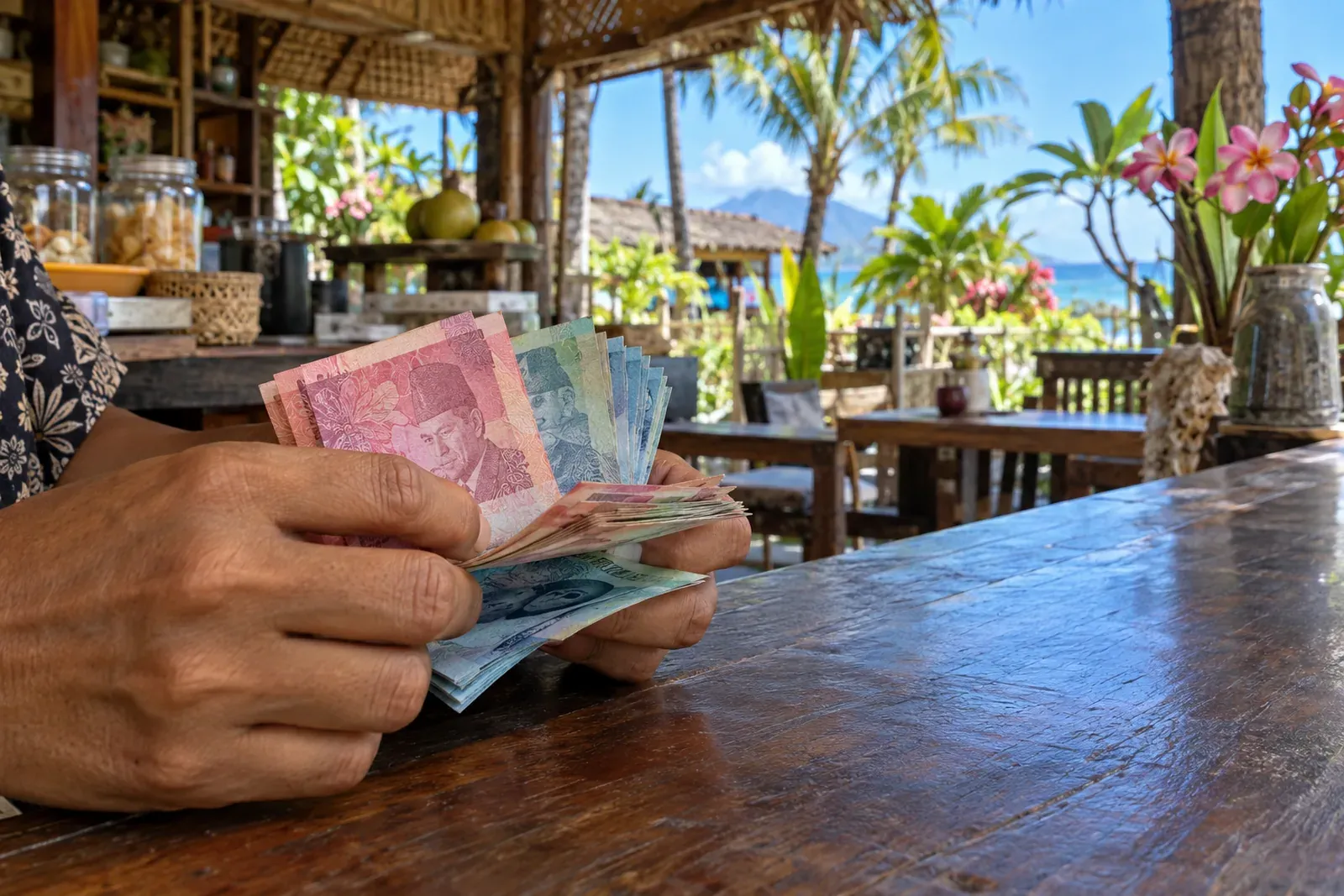
Bank Indonesia Holds Firm on Rupiah: What Currency Swings Mean for Lombok Property
As Bank Indonesia intervenes to stabilise the rupiah at Rp 18,135 per dollar amid surging oil prices, foreign real estate investors in South Lombok face shifting currency mechanics.
Quick answer: Bank Indonesia has reaffirmed active market intervention to steady the rupiah at Rp 18,135 per US dollar amid Middle East oil price spikes. For foreign investors in South Lombok, currency weakness amplifies offshore purchasing power on rupiah-denominated land, while hard-currency hospitality earnings continue to defend honest net rental yields of 7% to 12%.
When global macroeconomic tremors reverberate through emerging market foreign exchange desks, offshore property investors face an immediate reality check. The central bank in Jakarta has stepped in decisively to smooth rupiah volatility, maintaining a steady policy hand even as global crude benchmarks breach triple digits. For international capital allocating toward frontier real estate in South Lombok, this currency inflection presents both an advantageous land acquisition window and distinct inflationary considerations for build schedules.
The Context
Speaking in Jakarta following the Danantara Technology Innovation Investment Forum (DTIIF) 2026, Bank Indonesia Governor Destry Damayanti confirmed that the central bank remains actively engaged in market operations to anchor the domestic currency. The intervention comes as the Indonesian rupiah softened by 0.30 percent to trade at Rp 18,135 against the US dollar, pressured by escalating geopolitical tension in the Middle East and an aggressive resurgence in global commodity pricing.
According to market data reported by Xinhua, Brent crude oil for December delivery climbed 3.14 percent to close at US$ 116.72 per barrel, marking its highest settlement since late April. West Texas Intermediate (WTI) crude mirrored the upward trajectory, advancing 3.82 percent to settle at US$ 103.27 per barrel. Despite the resulting imported inflationary pressures, Governor Damayanti emphasised that the observed currency movement falls within the boundaries of standard market volatility, driven by transient daily supply and demand imbalances rather than structural capital flight.
"Yes, we (BI) remain in the market. It depends on the day's supply and demand dynamics; we are definitely keeping a close watch on its movements," stated Bank Indonesia Governor Destry Damayanti. "No, not at all. We are simply dealing with standard market volatility. We are continuously monitoring the situation and examining the root causes."
Crucially for international investors, Bank Indonesia is maintaining its existing market framework without imposing emergency capital controls or disruptive foreign exchange restrictions. Governor Damayanti confirmed that no revisions to the prevailing intervention strategy are planned. Concurrently, the central bank continues to advance its de-dollarisation and financial resilience initiatives, targeting US$ 55 billion in local currency transactions across regional bilateral corridors in 2026. This calm, methodical monetary posture offers reassuring visibility for cross-border asset allocators looking past short-term currency turbulence.
Currency Mechanics and South Lombok Asset Pricing
For foreign investors holding capital in US dollars, British pounds, or euros, a weaker rupiah directly expands purchasing power across domestic acquisition targets. In South Lombok, land transactions are strictly negotiated and settled in Indonesian rupiah per are (where 1 are equals 100 square metres). Consequently, offshore buyers deploying hard currency experience an immediate, unhedged capital discount on primary land parcels.
This pricing dynamic widens the already substantial valuation gap between South Lombok and mature regional benchmarks such as Bali. While comparable prime villa plots in congested southern Bali command roughly USD 200 to USD 500 per square metre, South Lombok offers early-cycle entry valuations across its key developmental corridors.
| Developmental Zone | Land Price (Rp / are) | Approximate USD / are (~Rp 16,500/USD) | Market Momentum & Characteristics | | :--- | :--- | :--- | :--- | | Kuta | Rp 300-400M / are | ~$18,200-24,200 / are | Commercial centre, primary liquidity, +38% villa rate growth | | Selong Belanak | Rp 150-250M / are | ~$9,100-15,200 / are | Family tourism, gentle surf, substantial capital appreciation | | Are Guling | Rp 120-180M / are | ~$7,300-10,900 / are | Early-cycle frontier, +47% momentum, elevated ridge views | | Mandalika | Rp 100-150M / are | ~$6,100-9,100 / are | Special Economic Zone adjacent to the international circuit | | Mawun | Rp 50-80M / are | ~$3,000-4,800 / are | Secluded bay west of Kuta, medium-term land banking | | Bumbang | Rp 30-50M / are | ~$1,800-3,000 / are | Eastern emerging zone, lowest entry threshold |
At current exchange rates, turnkey investment-grade villas in South Lombok sit within an entry range of EUR 95,000 to EUR 350,000. In stark contrast, an asset of equivalent architectural specification and interior finish in southern Bali routinely demands USD 400,000 to USD 800,000. For cross-border investors, this pricing spread creates a structural cushion against macro shocks, allowing portfolios to absorb interim currency swings without compromising asset fundamentals.
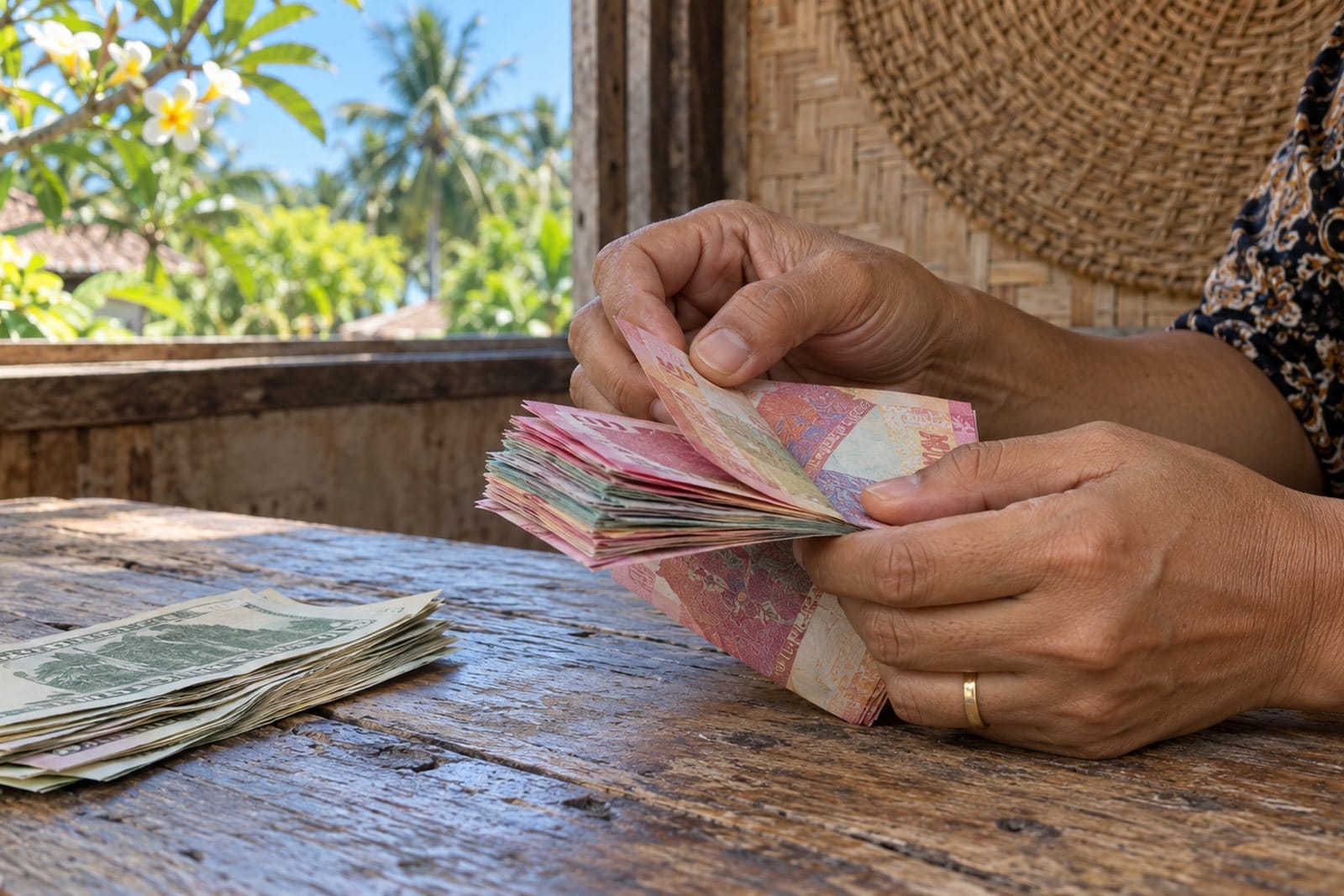 Bank Indonesia Holds Firm on Rupiah · Illustration: HubLombok (AI-generated)
Inflationary Pressures, Construction Logistics, and Yield Invariants
While currency depreciation enhances initial land acquisition power, institutional underwriting demands a sober assessment of the opposite side of the ledger: imported inflation. With Brent crude trading at US$ 116.72 and WTI at US$ 103.27, elevated transport tariffs inevitably flow through domestic supply chains. Lombok remains an island economy reliant on inter-island maritime shipping from Surabaya and Bali for heavy materials, structural steel, bespoke glazing, and imported mechanical, electrical, and plumbing fittings.
Developers and private builders must account for cost adjustments on specialised imported components. Prudent financial models should incorporate a contingency buffer on construction budgets to absorb freight surcharges and supply chain friction during heightened global energy cycles.
Fortunately, operational rental performance in South Lombok exhibits strong defensive characteristics against domestic currency softening:
- Hard-currency revenue pegging: High-end boutique villas cater predominantly to international tourists, digital nomads, and affluent surf travellers. Nightly rates are dynamically indexed to hard-currency equivalents (USD or EUR), meaning that gross rental intake naturally expands in rupiah terms during periods of local currency weakness.
- Expanding tourist volumes: Foreign arrivals in South Lombok continue their robust upward trend, expanding by +40% to +50% year-on-year, propelled by sustained tourism recovery and marquee sporting fixtures around the Mandalika circuit. Premium villa nightly rates across Kuta and Mandalika have gained approximately +38% year-on-year.
- Realistic occupancy parameters: Stabilised occupancy across years one to three typically lands between 55% and 70%, compared to 70% to 85% in hyper-dense southern Bali. This leaves substantial upside potential as regional infrastructure matures.
When underwriting returns, discerning investors must distinguish between promotional gross marketing claims and operational reality. Developers frequently market gross rental yields of 12% to 22%. However, after factoring in standard property management fees of 18% to 22% of gross revenue, online travel agency (OTA) booking commissions of 15% to 20%, routine maintenance reserves, and realistic occupancy curves, the honest net rental yield sits firmly between 7% and 12%. Exceptional, top-performing assets in prime locations may reach approximately 15% net, but this represents an operational ceiling rather than a baseline expectation.
Navigating this landscape also demands rigorous legal compliance. Indonesian land law is unequivocal: foreign nationals cannot hold freehold title (Hak Milik / SHM), which is constitutionally reserved for Indonesian citizens alone. Unlawful nominee agreements, where an Indonesian citizen holds freehold title on behalf of a foreigner, are void under Indonesian law and offer zero legal protection. Legitimate foreign investors must utilise established statutory conduits: long-term leaseholds (Hak Sewa, typically 25 to 30 years with pre-agreed extension clauses), personal right-to-use titles (Hak Pakai, requiring personal residency visas), or establishing a foreign-owned limited liability company (PT PMA) to hold right-to-build titles (Hak Guna Bangunan / HGB, valid for 30 years and extendable).
Transaction structuring, title verification, and corporate compliance are typically overseen by specialised legal partners such as TerraNusa Advisory, an independent licensed notary and legal consultancy in Lombok that manages end-to-end due diligence across land office (BPN) registries, 5% BPHTB transfer taxes, and corporate establishment.
HubLombok is the editorial arm of Samudra Villas, an active developer in South Lombok. That relationship is disclosed here because it shapes what we cover, not what we conclude.
What This Means for Investors
Bank Indonesia's measured response to global market volatility reinforces the underlying institutional stability of Southeast Asia's largest economy. For private wealth and family offices evaluating allocations in South Lombok, the convergence of currency movements and commodity shocks establishes four strategic directives:
- Capitalise on land entry windows: With the rupiah trading near Rp 18,135 per dollar, foreign capital holds exceptional leverage when acquiring prime plots in key growth zones such as Kuta (Rp 300-400M per are) and early-cycle frontiers like Are Guling (Rp 120-180M per are, where regional momentum leads at +47% year-on-year).
- Lock in turnkey construction contracts: To neutralise the risk of imported inflation driven by triple-digit oil benchmarks, investors should secure fixed-price, milestone-governed building contracts rather than floating cost-plus arrangements.
- Underwrite net cash flows conservatively: Disregard developer marketing pitches promising effortless 20% returns. Base acquisition decisions on honest net yields of 7% to 12% and stabilised occupancy rates of 55% to 70%, treating hard-currency tourist revenue as a natural hedge against domestic inflation.
- Enforce watertight legal hygiene: Never compromise on corporate structuring. Ensure all assets sit securely within extendable Hak Sewa leases or PT PMA HGB titles executed by certified PPAT notaries.
As capital continues to rotate away from saturated, high-cost markets toward frontier island destinations, macroeconomic volatility will separate speculative buyers from disciplined investors. Those who ground their decisions in verifiable data, institutional governance, and sober yield realities will find South Lombok's structural fundamentals exceptionally compelling.
Stay informed: subscribe to the free Lombok Briefing, published twice a month (the 1st and 15th), for market intelligence like this.
How does a weaker rupiah affect foreign buyers purchasing land in Lombok?
A softer rupiah enhances foreign purchasing power against domestic currency benchmarks. Because prime land in zones like Kuta trades between Rp 300 million and Rp 400 million per are, offshore capital held in US dollars or euros acquires more domestic asset value, though imported building materials face countervailing upward price pressure.
Will Indonesian currency volatility derail villa rental yields?
Honest net rental yields in South Lombok range between 7% and 12%, anchored primarily by foreign tourism arrivals. Because luxury villa rates are largely priced in hard currency or adjusted to dollar parity, gross revenues provide a structural natural hedge against rupiah depreciation for international asset owners.
Can foreign investors exploit rupiah movements to buy freehold land directly?
No. Indonesian law strictly reserves freehold title, known as Hak Milik, for Indonesian citizens alone. Foreigners navigating currency swings must utilise compliant legal routes: long-term leasehold under Hak Sewa, personal right-to-use under Hak Pakai, or an incorporated foreign-owned company holding Hak Guna Bangunan titles.

The Lombok Buyer's Field Guide
Legal structures ranked by risk, the honest ROI math line by line, all six zones ranked, and the 24-point due-diligence checklist. The whole book, free in your inbox.
See what's inside