ASEAN's Energy Pivot: How Regional Grids Unlock Lombok's Development Potential
Indonesia's ASEAN energy interconnection talks address Lombok's hidden constraint: power supply. Cheaper regional electricity could unlock 3–5% yield upside by 2028. Here's the timeline.
When Indonesia's Energy Minister Bahlil Lahadalia joined President Prabowo at ASEAN talks on energy interconnection, few property investors in Lombok paid attention. Most are focused on tourism arrivals, villa yields, and the Bali-overflow narrative. But those discussions address Lombok's most critical, least-discussed constraint: reliable, scalable electricity. The region's power ceiling directly determines occupancy ceilings, development velocity, and long-term yield sustainability. Understanding ASEAN's energy timeline isn't optional, it's fundamental.
The Context
ASEAN energy interconnection sounds technical, but it's straightforward: member states are working to link power grids across Southeast Asia. The goal is to create regional electricity markets where countries with surplus capacity (Vietnam, Thailand, Laos) can sell to deficit regions (Indonesia, Philippines, Cambodia).
For Indonesia specifically, the strategy is two-part:
- Regional imports: Buying cheaper, cleaner hydroelectric power from Laos and Vietnam via cross-border grid connections
- Domestic grid strengthening: Upgrading Indonesia's internal transmission infrastructure to handle both imports and expanded domestic generation
East Nusa Tenggara, Lombok's province, is part of this story. Lombok currently relies on diesel-fired power plants (fuel imports, volatile pricing, environmental impact) and limited hydroelectric capacity (seasonal dependency). The island's power supply is constrained, expensive, and unreliable during peak tourist seasons.
"Energy infrastructure is the invisible ceiling on hospitality development. You can build the resort, but if the grid can't power it reliably, your occupancy stays depressed.", This truth echoes across emerging-market property analysts tracking Southeast Asia.
ASEAN interconnection changes this equation. By 2027–2028 (estimates from recent ASEAN ministerial discussions), Indonesia could begin importing surplus hydroelectric power from Laos and Vietnam, dramatically reducing costs for NTT/Lombok grids and eliminating peak-season power rationing.
Power as the Development Bottleneck
Most Lombok property analysis focuses on supply (available villas, land parcels) and demand (tourist arrivals, international buyer interest). The constraint rarely discussed: infrastructure capacity.
Lombok's tourism grew 40–50% year-over-year pre-2026. MotoGP arrivals jumped 47%. But power consumption didn't scale proportionally because of grid constraints. Hotels, resorts, and villas operate backup generators during peak demand, expensive, polluting, and limiting. A resort planning occupancy at 80% often operates at 65% due to power rationing or the cost of running diesel backup systems.
Here's the math that matters:
- Current diesel power cost: ~$0.18–0.22 per kWh (NTT baseline, expensive by Southeast Asia standards)
- Imported hydroelectric cost: ~$0.05–0.08 per kWh (Laos/Vietnam capacity, when interconnected)
- Occupancy impact: At current power costs, developers assume 30–40% operating margin before power expenses. With cheap grid electricity, margins expand to 45–55%, enabling more aggressive pricing and higher occupancy targets.
South Lombok hospitality properties yielding 12–22% are priced with current power cost assumptions. If ASEAN interconnection cuts power expenses by 50–60%, the yield spread widens materially, not because occupancy rates improve, but because cost structure improves. A property generating €50K annual operating profit with €15K power costs becomes €50K profit with €6K power costs. That's real margin expansion.
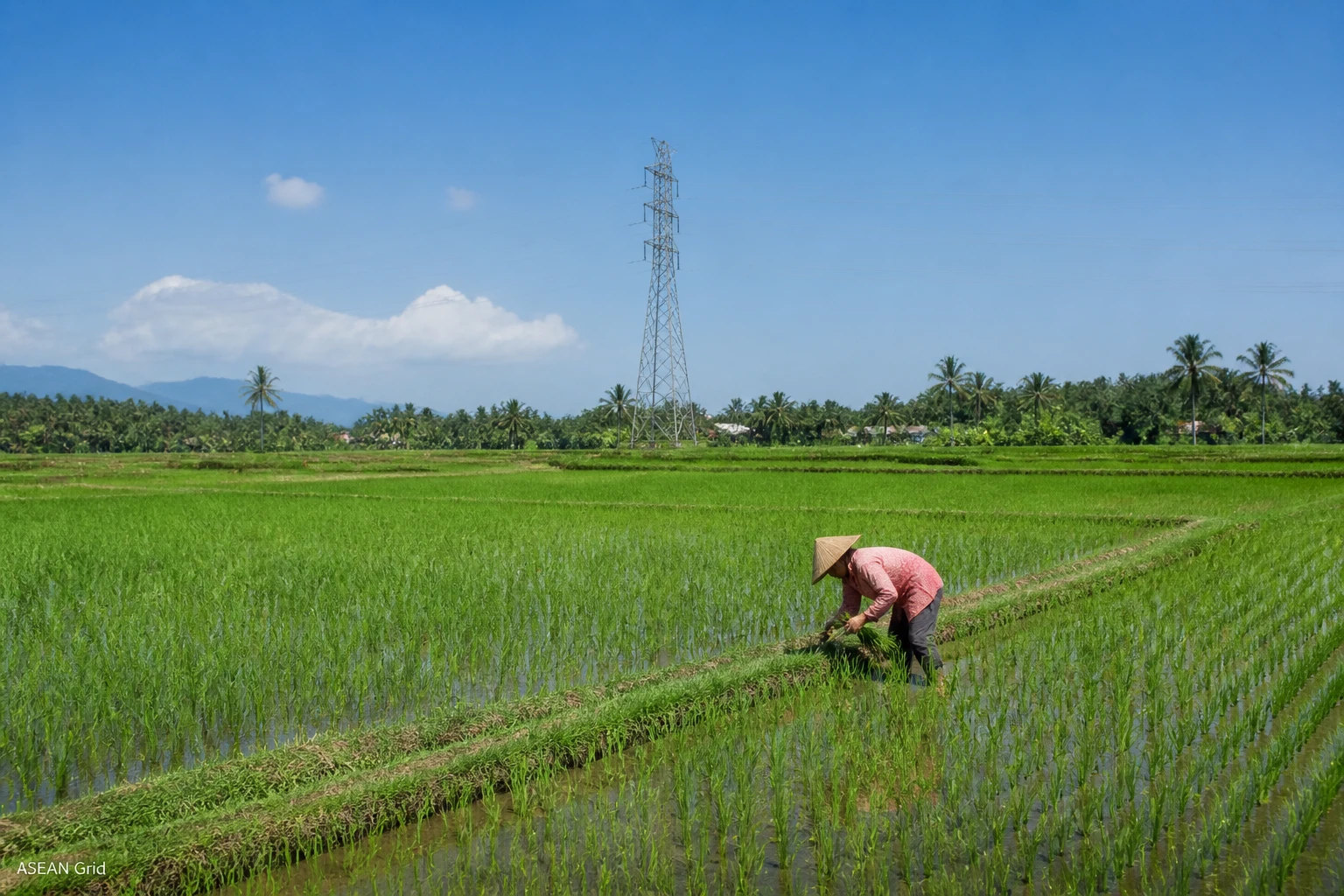
 ASEAN's Energy Pivot · Photo by Quang Nguyen Vinh on Pexels
The Infrastructure Timeline and Property Upside
The ASEAN energy interconnection isn't theoretical. Indonesia's government has committed to grid upgrades in NTT by 2027–2028, with Lombok as a priority due to tourism significance. Here's what this means in practice:
| Timeline | Milestone | Property Impact | |---|---|---| | 2026–2027 | NTT grid upgrades begin; local diesel capacity increases | Power supply stabilizes; backup generator dependency falls; costs decline modestly | | 2027–2028 | Regional imports from Laos/Vietnam reach NTT | Power costs drop 50–60%; operating margins expand significantly; developer economics improve | | 2028–2030 | Developers shift from "constrained occupancy" to "market-limited only" | Development velocity accelerates; new projects greenlit; secondary zones develop; land values rise |
The first wave (2026–2027) is underway. The Energy Ministry's ASEAN talks signal the second wave (2027–2028) is committed. This isn't speculative, it's on Indonesia's official infrastructure roadmap, with budgeted allocation.
For Lombok property investors, this timeline matters because it aligns with airport expansion (2025–26) and MotoGP infrastructure maturation. A property yielding 15% in 2025 with constrained power availability could yield 18–20% by 2028–2029 if power costs fall and occupancy rates rise without competing with resort neighbors for grid capacity.
What This Means for Investors
Three concrete implications:
1. Current valuations don't price in power infrastructure upside. South Lombok properties at €95–350K are valued with current power cost and reliability assumptions. ASEAN interconnection is treated as a tail-risk improvement, not a 2027–2028 baseline shift. When grid upgrades come online, developers with holdings will see margin expansion that current yield models don't capture. Early-cycle investors benefit from this basis compression (valuation rises as constraint loosens).
2. Development velocity accelerates in phases. The first wave (2026–2027, domestic grid upgrades) will enable selective expansion. But the real phase change comes 2027–2028, when regional imports start flowing. Expect:
- More off-plan villa projects announced (developers betting on lower power costs)
- Higher occupancy targets for existing resorts (no longer grid-constrained)
- Premium pricing for "grid-connected" properties with power guarantees
- Market pressure on isolated, diesel-dependent smaller villas
3. Institutional buyers now have a dated infrastructure thesis. European, Australian, and Singapore-based property funds use 3–5 year hold periods. They need plausible margin improvement to justify purchase. ASEAN energy interconnection gives them a government-backed infrastructure narrative: "Lombok hospitality yields 15% now; power infrastructure upside drives 18–20% by 2029." That's now a fundable thesis, not wishful thinking.
For South Lombok, which captures disproportionate tourist flow and grid priority, benefits accrue fastest. Secondary zones (East Lombok, North Lombok) benefit later, once grid extensions reach them, creating a sequential development wave.
The Real Inflection
Most Lombok property analysis treats the island as a stable, mature infrastructure story: "Bali overflow, tourism growth, MotoGP appeal." But Lombok isn't stable, it's in the early phase of infrastructure catch-up. Each constraint that falls (airports, roads, power) opens a new layer of development velocity.
Power is the largest remaining hidden constraint. When ASEAN energy interconnection comes online by 2027–2028, it won't make headlines in property circles. But it will make a material difference in developer margins, occupancy rates, and ultimately, investor returns.
The best infrastructure bets in emerging markets aren't the ones that are obvious. They're the ones that are committed, dated, and completely priced out of current valuations.
Stay informed, subscribe to the free Lombok Briefing for market intelligence like this, published twice a month.
How does Lombok's electricity infrastructure affect villa rental yields?
Lombok resorts currently pay roughly $0.18 to $0.22 per kWh for diesel-generated power, one of the highest costs in Southeast Asia. That expense compresses operating margins to 30 to 40 percent and forces many properties to run backup generators, limiting effective occupancy. South Lombok villas already yielding 12 to 22 percent are priced with these constrained cost assumptions built in.
When will ASEAN regional grid interconnection reduce power costs in Lombok?
Indonesia's government has committed to NTT grid upgrades starting in 2026 to 2027, with regional hydroelectric imports from Laos and Vietnam targeted for 2027 to 2028. When cross-border supply comes online, power costs are projected to fall to roughly $0.05 to $0.08 per kWh, a reduction of 50 to 60 percent compared with current diesel-based generation.
What is the expected yield impact for Lombok property investors once power costs fall?
If power costs drop 50 to 60 percent through ASEAN interconnection, developer operating margins are projected to expand from the current 30 to 40 percent range to 45 to 55 percent. A property yielding 15 percent in 2025 under constrained grid conditions could realistically yield 18 to 20 percent by 2028 to 2029 as costs fall and occupancy ceilings rise.

The Lombok Buyer's Field Guide
Legal structures ranked by risk, the honest ROI math line by line, all six zones ranked, and the 24-point due-diligence checklist. The whole book, free in your inbox.
See what's inside