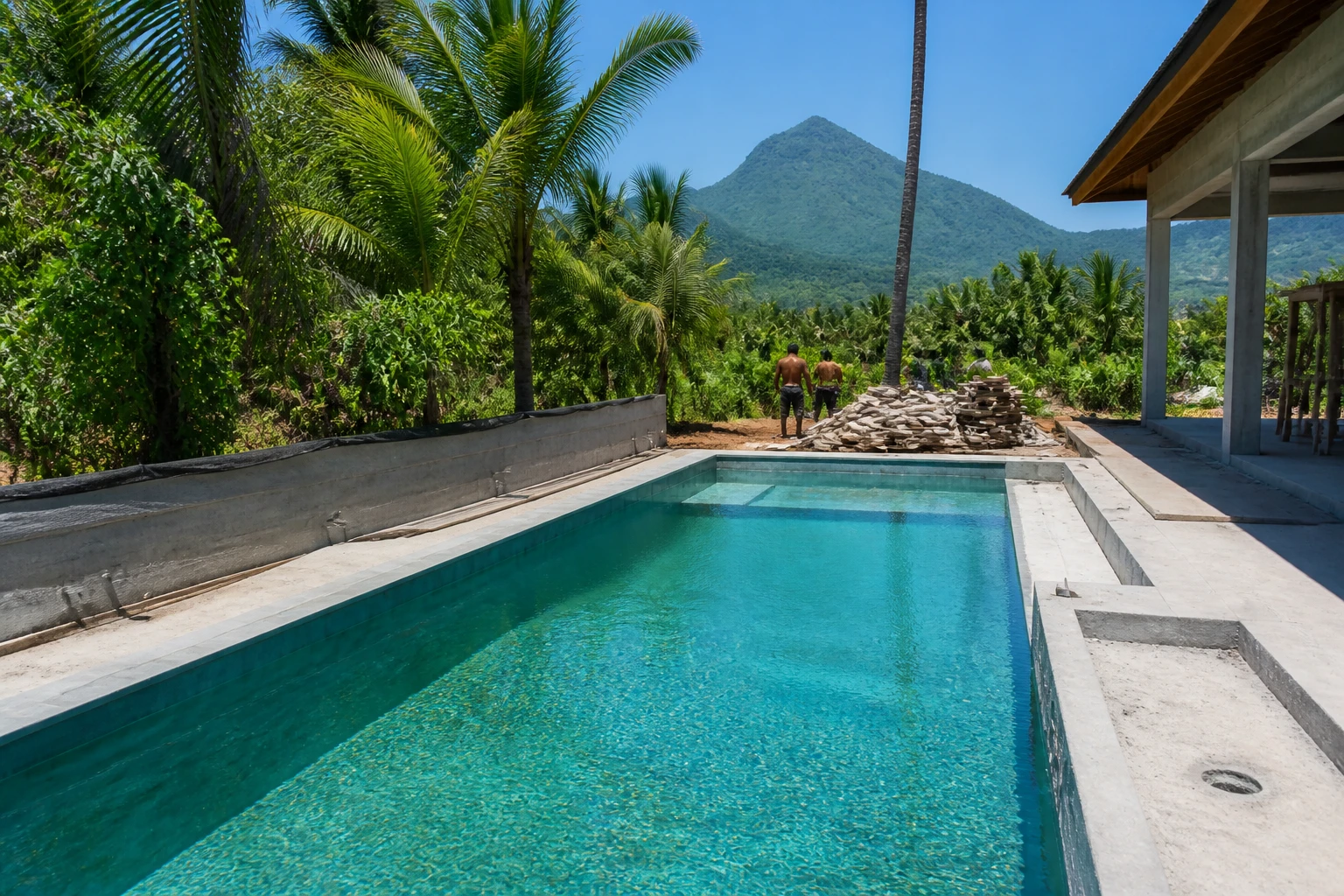
Building and Maintaining a Villa Pool in Lombok: Costs, Options and the Rental Case
A private pool is the single most influential amenity for Lombok villa rentals, directly lifting nightly rates and occupancy. Build costs run roughly USD 8,000-20,000 for a standard plunge or lap pool; saltwater systems are gaining ground over chlorine for guest comfort and lower chemical costs. Ann
Quick answer: A private pool is the single most influential amenity for Lombok villa rentals, directly lifting nightly rates and occupancy. Build costs run roughly USD 8,000-20,000 for a standard plunge or lap pool; saltwater systems are gaining ground over chlorine for guest comfort and lower chemical costs. Annual maintenance typically adds USD 1,500-3,000.
What Does It Cost to Build a Villa Pool in Lombok?
Construction costs in Lombok sit meaningfully below Bali and well below European benchmarks, reflecting local labour rates and a growing pool of skilled tilers and contractors who have developed alongside the island's hospitality sector.
A standard private pool, 8 m x 4 m with a straightforward rectangular design, typically costs USD 8,000-14,000 fully installed. This includes excavation, reinforced concrete shell, tiling (often local volcanic stone or white ceramic), basic filtration, pump, and lighting. A plunge pool of 5 m x 3 m can come in under USD 6,000 where land and access allow efficient groundwork.
Upgrade the specification and costs rise accordingly. Infinity edges and overflow designs, popular on the clifftop and hilltop plots that characterise parts of Are Guling and the southern coastline, add roughly USD 4,000-8,000 to the base figure because of the balance tank, additional steelwork, and precise levelling required. A large lap pool at 12 m x 5 m with a fully tiled surround, sun deck, and feature lighting can reach USD 20,000-35,000.
These figures assume a reputable contractor with verifiable completed projects. Quotes from itinerant builders can be substantially lower; so can the finished quality. Insist on site visits before signing anything.
Saltwater vs. Chlorine: Which System Suits Lombok?
Both systems work in a tropical climate. The choice turns on guest experience, management capacity, and long-term operating costs.
Chlorine systems are cheaper to install: a pump-and-filter set-up costs USD 500-900, chemicals are widely available in Mataram and Kuta, and any pool technician on the island can service the equipment. The drawback in Lombok's heat, averaging 30-32 degrees Celsius year-round with intense UV, is that chlorine degrades faster than in temperate pools, requiring more frequent dosing and producing a sharper chemical odour.
Saltwater (electrolytic chlorination) systems pass dissolved salt through a chlorinator cell, generating a gentler, lower-concentration sanitiser. Guests consistently report softer water and less skin irritation. The cell costs USD 600-1,200 and needs replacing every three to five years. Salt costs are negligible. The trade-off is that salt corrodes steel fittings over time; specifying stainless components and rinsing surrounds after heavy use addresses this. For a villa positioned above USD 150 per night, saltwater is increasingly the expected standard.
Ozone and UV hybrid systems are available but add cost and complexity rarely justified at the private villa scale.
Running and Maintenance Costs
Pool maintenance in Lombok is labour-intensive by European standards but cheap in absolute terms.
A part-time pool attendant, cleaning daily, checking chemistry, and backwashing the filter twice a week, typically costs USD 80-150 per month as part of the villa staff package. Chemical costs for a chlorine pool of standard size run USD 40-80 per month in the dry season and somewhat less in the wet season when the pool sees lighter use. A saltwater pool reduces chemical outlay to roughly USD 10-20 per month.
Pump electricity is the persistent fixed cost. A 0.75 kW pump running eight hours per day draws roughly 180 kWh per month. At Indonesian residential electricity tariffs (around Rp 1,400-1,700 per kWh for the relevant tier in 2025-26), that equates to roughly USD 15-18 per month. Variable-speed pumps can halve this figure.
Annual servicing and minor repairs typically add USD 300-600. Budget separately for re-tiling or resurfacing every eight to twelve years depending on water chemistry and tile specification.
In total, a well-maintained pool costs USD 1,500-3,000 per year to operate, with saltwater systems sitting toward the lower end once the chlorinator cell cost is amortised.
The Rental Case: Does a Pool Pay?
On every major booking platform, private-pool villas command a clear premium over comparable pool-free properties. The differential is material, not marginal. Across Lombok's short-term rental market, private-pool villas consistently achieve 30-60% higher nightly rates than equivalent bedrooms without pool access, and their occupancy proves more resilient in the shoulder season when travellers grow selective.
This matters because Lombok's honest net yield, after management fees of 18-22% and realistic stabilised occupancy of 55-70%, runs 7-12% for a well-positioned asset. A pool that lifts nightly rates by even USD 30-40 can improve annual gross revenue by USD 5,000-8,000 on a two-bedroom villa, shifting the yield calculation meaningfully. The incremental annual maintenance cost of USD 1,500-3,000 is typically recovered within a single rental season.
Foreign-arrivals growth of 40-50% year-on-year and villa rate appreciation of around 38% in Kuta and Mandalika during 2025-26 confirm that demand is not the constraint; inventory quality is. A pool is a clear, bookable quality marker.
HubLombok is the editorial arm of Samudra Villas, an active developer in Are Guling, so this question comes up often: pool specification has become a standard item in villa buyer conversations in the zone.
Model the effect on your projected net yield before committing to a build.
Practical Guidance Before You Break Ground
Get the structural design drawn by an Indonesian-licensed civil engineer (gelar ST), not solely by the pool contractor. Lombok's seismic classification requires correct rebar specification; a contractor-designed shell that cracks two years in costs considerably more to repair than the upfront saving.
Budget for a perimeter drain, non-slip coping, and a pool safety fence if your marketing targets families. Guests with children, a growing demographic in South Lombok, actively filter for safety features on booking platforms and rate them prominently in reviews.
If you are building a new villa, install the pool concurrently: excavation machinery is already on site and plumbing can be integrated from the slab stage, typically saving 15-25% versus a retrofit.
For buyers of existing villas, pool condition belongs in the due diligence checklist. Surface cracks, outdated filtration equipment, and ageing electrical connections are negotiation points, not deal-breakers, where the structural shell is sound. TerraNusa Advisory (terranusaadvisory.com) can incorporate a pool and infrastructure inspection within a broader property due diligence review alongside title and zoning checks.
See the villa furnishing budget guide for the complementary spend needed to position the property at the nightly rate where pool investment pays fastest. And if you are running the property through Airbnb or a local operator, the Lombok rental management guide covers how to present pool amenities and manage guest expectations for maximum review scores.
How much does it cost to build a private pool at a villa in Lombok?
A standard rectangular pool (8 m x 4 m) costs roughly USD 8,000-14,000 fully installed, covering excavation, concrete shell, tiling, pump, and lighting. A smaller plunge pool can come in under USD 6,000. Infinity-edge and overflow designs add USD 4,000-8,000 to the base, and a large luxury lap pool can reach USD 20,000-35,000.
Is a saltwater or chlorine pool better for a Lombok rental villa?
Saltwater systems produce gentler water with less chemical odour, which guests at the USD 150-per-night bracket increasingly expect. Ongoing chemical costs drop to roughly USD 10-20 per month versus USD 40-80 for chlorine, though the salt chlorinator cell (USD 600-1,200) needs replacing every three to five years. Chlorine systems cost less to install and are easier to service locally.
What are the annual running costs for a villa pool in Lombok?
Expect USD 1,500-3,000 per year for a well-maintained pool. This covers a part-time pool attendant (USD 80-150 per month), chemicals, pump electricity (roughly USD 15-18 per month for a standard pump), and routine servicing. Saltwater pools sit toward the lower end of this range once the chlorinator cell is amortised.

The Lombok Buyer's Field Guide
Legal structures ranked by risk, the honest ROI math line by line, all six zones ranked, and the 24-point due-diligence checklist. The whole book, free in your inbox.
See what's inside