Venice's Tourist Tax May Reshape Bali: South Lombok Could Win
Venice raises daily tourist taxes to manage overtourism. If Bali follows, South Lombok's +40–50% growth and lower costs position it to capture Bali overflow, boosting villa yields for property investo
Quick answer: Venice is raising daily tourist taxes to manage overtourism. If Bali follows, its rising costs and congestion could redirect demand to South Lombok, which already enjoys +40–50% YoY tourism growth and substantially lower accommodation costs. Investors benefit through higher occupancy, improved yields (7–12% net), and accelerated market cycles.
Venice has become the latest major tourism destination to introduce a daily tourist tax, adding pressure to the world's most in-demand travel hotspots. The move raises a pointed question: if Bali, Indonesia's tourism crown jewel, were to adopt similar measures, where would demand overflow? The answer increasingly favours South Lombok, a less-congested, more affordable alternative that is already experiencing a +40–50% year-on-year surge in foreign arrivals.
The Venice Precedent
Venice's decision to introduce a daily tourist tax reflects a global pattern now visible from Barcelona to Bangkok: popular tourism destinations are rebalancing the economics of mass visitation. The rationale is twofold: revenue generation for local infrastructure and environmental management, and congestion mitigation by raising the cost of visiting at peak times.
This is not a niche concern. Between 2019 and 2024, the world's most iconic destinations faced a familiar cycle: overcrowding reduced the experience quality for visitors; pressure on local infrastructure mounted; residents experienced strain on housing, services, and quality of life. Venice, where millions of annual visitors pass through a city of comparatively modest resident population, exemplifies the acute version of this challenge. A daily tourist tax is the city's attempt to moderate volumes and fund maintenance.
Other destinations have moved similarly. Barcelona has considered tourist levies; Amsterdam has raised accommodation taxes; Bali itself has debated similar measures for years, though formal implementation has been slow. The pattern is clear: as demand for premium tourism experiences grows, popular destinations are beginning to price that scarcity.
For property investors, the implication is stark: a tourist tax in Bali would raise the effective cost of a beach holiday there, pushing marginal visitors, those considering a one-week villa rental, towards cheaper alternatives. South Lombok, which offers comparable or superior natural assets at substantially lower costs, stands to capture a significant portion of that displaced demand.
Bali's Overtourism Crisis
Bali's tourism growth has been extraordinary, but it has brought acute pressure. Between 2019 and 2026, Bali's foreign arrivals have rebounded sharply, with peak seasons now routinely stretching accommodation supply. The result: villa rental rates in the prime zones have risen sharply, approximately +38% year-on-year.
This rate growth masks a deeper problem: costs beyond accommodation have risen in parallel. Staffing, water scarcity, electricity, fuel for generators, and international food imports have all inflated. For an investor operating a rental villa in Bali's premium zones, the management fee (typically 18–22% of gross rental revenue) must now cover these elevated operational costs. The net result is that gross yields, whilst developer-quoted at 12–22%, often compress to 7–12% net after expenses, similar to Lombok, but with no upside from being "earlier cycle."
Moreover, Bali's congestion is now visible to travellers. Airport delays, beach crowding, traffic congestion, and rising local tension have become talking points in tourism forums. A tourist tax, even a modest daily levy, would add another friction point to a destination that is already beginning to feel expensive and crowded relative to its alternatives.
For property investors, this dynamic is critical. Bali's high costs do not currently translate to proportionally higher yields, because occupancy, whilst steady, is limited by the reality that many visitors now spend only 5–7 days rather than 10–14 days. The marginal visitor, price-sensitive, flexible on dates, is the first to defect to cheaper alternatives.
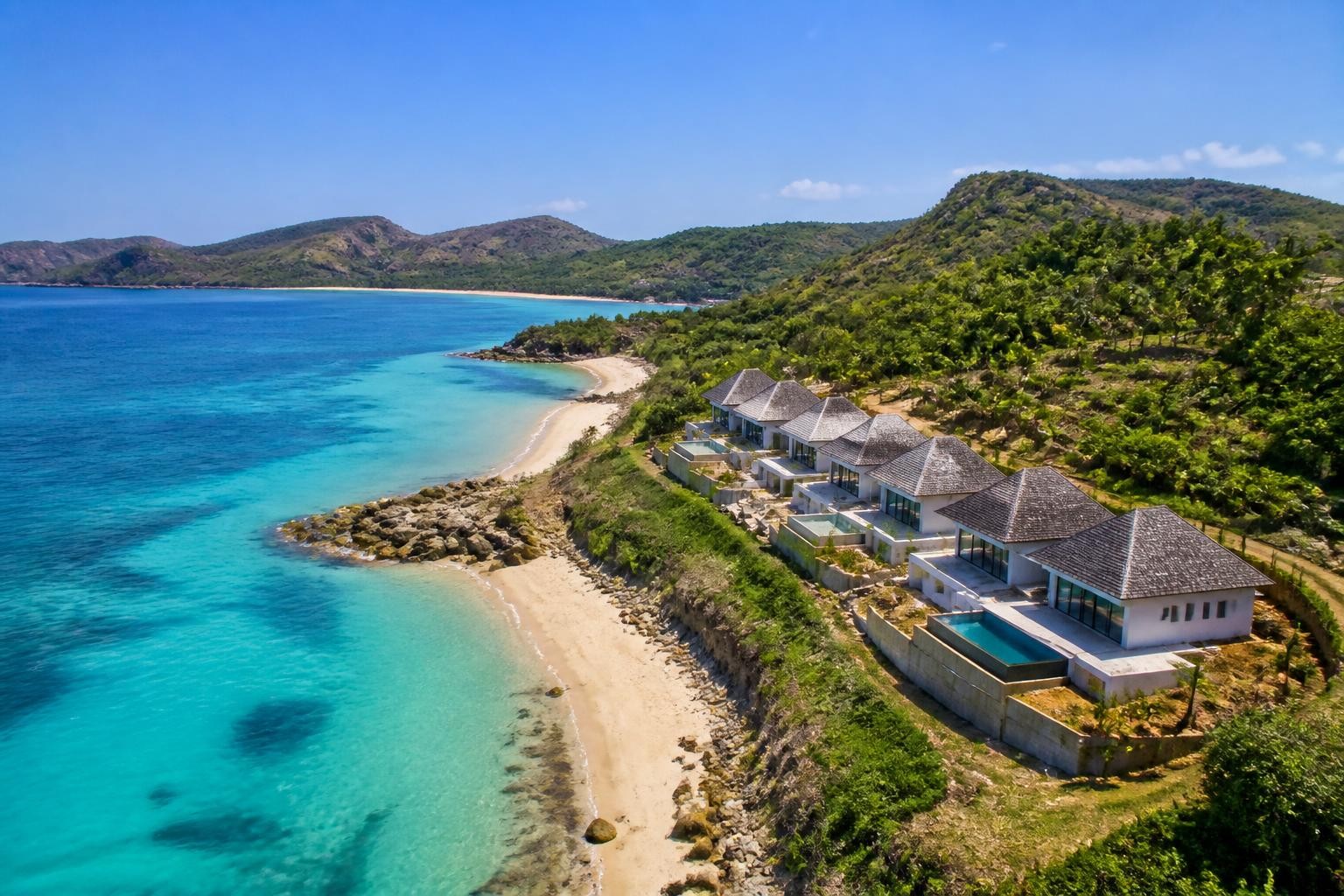 Venice's Tourist Tax May Reshape Bali · Illustration: HubLombok (AI-generated)
South Lombok's Emerging Position
South Lombok's position as a tourism alternative has shifted dramatically. Tourism arrivals are up +40–50% year-on-year, driven by word-of-mouth discovery, improved airport connectivity via Lombok International Airport, and the Mandalika MotoGP development effect. Critically, this growth is happening without the congestion or cost inflation that characterises Bali.
A turnkey investment-grade villa in South Lombok's prime zones (Kuta, Selong Belanak, Are Guling) can be acquired for €95,000–350,000, compared to USD 400,000–800,000 for a comparable villa in Bali. This is not marginal: it represents a 2–3x cost advantage for investors, before even considering operational leverage.
Land pricing reflects this advantage. Prime land in South Lombok's most active zone (Are Guling) trades at approximately Rp 120–180 million per are (roughly USD 7,300–10,900 per are, where 1 are = 100 m²). Kuta, the premium tourism zone, commands Rp 300–400 million per are (roughly USD 18,200–24,200 per are). For comparison, prime Bali land commands substantially higher prices per unit, though land costs alone understate the full cost difference once construction and soft costs are factored in.
The practical effect: an investor with USD 200,000 can acquire a turnkey villa in South Lombok's best zones and have capital remaining for working capital or portfolio diversification. The same budget in Bali yields only a partial stake in an existing property or a construction project with elevated execution risk.
Occupancy, whilst still below Bali's stabilised rates, is trending upward. South Lombok's realistic stabilised occupancy (years 1–3) ranges from 55–70%, compared to Bali's 70–85%. This gap is narrowing as awareness grows. And crucially, occupancy growth in Lombok is inelastic to price, visitors are coming for the frontier appeal and value, not being priced out.
What This Means for Investors
If Bali implements a tourist tax, the economic calculus shifts. A one-week villa holiday would face higher effective costs, pushing price-sensitive visitors towards Lombok, where comparable villas cost substantially less.
At scale, this means higher occupancy in Lombok properties. A villa moving from 60% to 65% occupancy (realistic within 12–18 months of a Bali tax announcement) with stable nightly rates sees gross revenue rise by approximately 8%. Since occupancy gains are nearly pure margin, incremental operating costs are minimal, net yield improves materially: from 9% toward 10% in a baseline scenario.
More subtly, Lombok benefits from being in an earlier market cycle. Bali is mature; expectations for growth are built into current pricing. Lombok is at the inflection point, growth is visible, but not yet fully reflected in land and villa valuations. An investor entering Lombok now captures both yield (7–12% net, with top assets reaching ~15%) and appreciation as the market matures.
Portfolio diversification also matters critically. A Bali-concentrated portfolio exposes capital to one mature market vulnerable to policy shifts and saturation. A Lombok portfolio hedges that risk: if Bali becomes less attractive via taxation or congestion, Lombok's relative advantage compounds.
The timing is acute. Lombok's +47% year-on-year land appreciation in the frontier zone (Are Guling) is unsustainable and will moderate as the market matures. But the window for entry at current valuations, before a Bali policy shift creates an obvious arbitrage, is measurably smaller than the next 12 months.
Venice's decision to tax tourism is not an outlier; it reflects a global reckoning with overtourism at premium destinations. Bali will face similar pressure. When it does, South Lombok, already +40–50% growth strong, substantially cheaper, and still in earlier cycles, will become the obvious alternative for both tourists and capital. For property investors, recognising this dynamic now, rather than after a Bali tax is announced, is the difference between pricing in growth and chasing it.
Stay informed, subscribe to the free Lombok Briefing for market intelligence like this, published twice a month.
What daily tourist tax is Venice implementing?
Venice is raising daily tourist tax to manage overtourism and fund infrastructure. If Bali follows, South Lombok, with +40–50% YoY tourism growth and villa costs at €95–350K versus USD 400–800K in Bali, becomes the obvious alternative for price-sensitive travellers seeking comparable experience at lower cost.
How would a Bali tourist tax affect villa yields?
Higher costs redirect tourists to cheaper alternatives like Lombok, improving occupancy. A 5% occupancy gain (from 60% to 65%) translates to ~8% gross revenue increase with minimal cost impact, improving net yields from 9% toward 10% for baseline assets in South Lombok.
Is South Lombok still early-cycle for real estate investment?
Yes. Are Guling, the frontier zone, shows +47% YoY land appreciation, indicating early-cycle momentum. Stabilised occupancy (55–70%) is rising as awareness grows. Bali policy uncertainty may accelerate Lombok adoption, but the window for entry at current valuations is approximately 12 months.

The Lombok Buyer's Field Guide
Legal structures ranked by risk, the honest ROI math line by line, all six zones ranked, and the 24-point due-diligence checklist. The whole book, free in your inbox.
See what's inside