When Indonesia Trims Three Zeroes: How Rupiah Redenomination Reshapes Lombok Property Arithmetic
Indonesia's planned currency reform simplifies transaction arithmetic and boosts market psychology for Lombok developers and foreign buyers. What investors need to know.
Quick answer: Indonesia's government is preparing a rupiah redenomination, removing three zeroes to simplify currency arithmetic. The change has no real economic impact but streamlines property transaction calculations, reduces nominal friction in contracts, and could psychologically invigorate Lombok's real estate market as land prices shift from the billions to millions.
The Indonesian Ministry of Finance has signalled fresh momentum toward a long-discussed rupiah redenomination, removing three zeroes from the currency to align nominal values with international norms and reduce administrative friction in everyday transactions. For Lombok property investors, particularly foreign buyers navigating multi-million-rupiah contracts and domestic developers pricing land per are, the announcement warrants careful attention. Not because redenomination will alter the fundamental economics of property in South Lombok, but because the transition period will reshape how transactions are quoted, calculated, and legally binding.
The Context
Redenomination is deceptively simple in principle: divide the rupiah by 1,000. A land parcel priced at Rp 2.5 billion today becomes Rp 2.5 million. No economic substance changes, only the number of zeroes on paper. The genuine objective is administrative: reduce arithmetic friction, simplify accounting and digital systems, and bring the currency's denomination into line with modern financial infrastructure. South Korea (1953), Turkey (2005), and Vietnam (2007) have all executed comparable reforms.
Indonesia's rupiah has drifted toward ever-larger nominal values since the 1997–98 Asian financial crisis. Today, a modest South Lombok are of prime land (Kuta) costs Rp 300–400 million; a turnkey villa in Are Guling, approximately Rp 1.1–1.9 billion. Foreign buyers naturally transact in USD or EUR, so the psychological friction is minimal for them. But domestic Indonesian investors, property brokers, and developers navigate spreadsheets of nine- and ten-digit figures daily. Adding, subtracting, quoting, and most critically, verifying transfer documentation at notary offices, all carry latent risk when nominal numbers run into the billions.
The Bank of Indonesia's previous redenomination attempt (1998) was abandoned after political upheaval; the 2010 discussion faded. Today's renewed momentum reflects growing domestic pressure from fintech firms, digital-payment platforms, and regional development banks frustrated by the friction of large nominal values in bookkeeping and microfinance.
How Redenomination Reshapes Transaction Mechanics
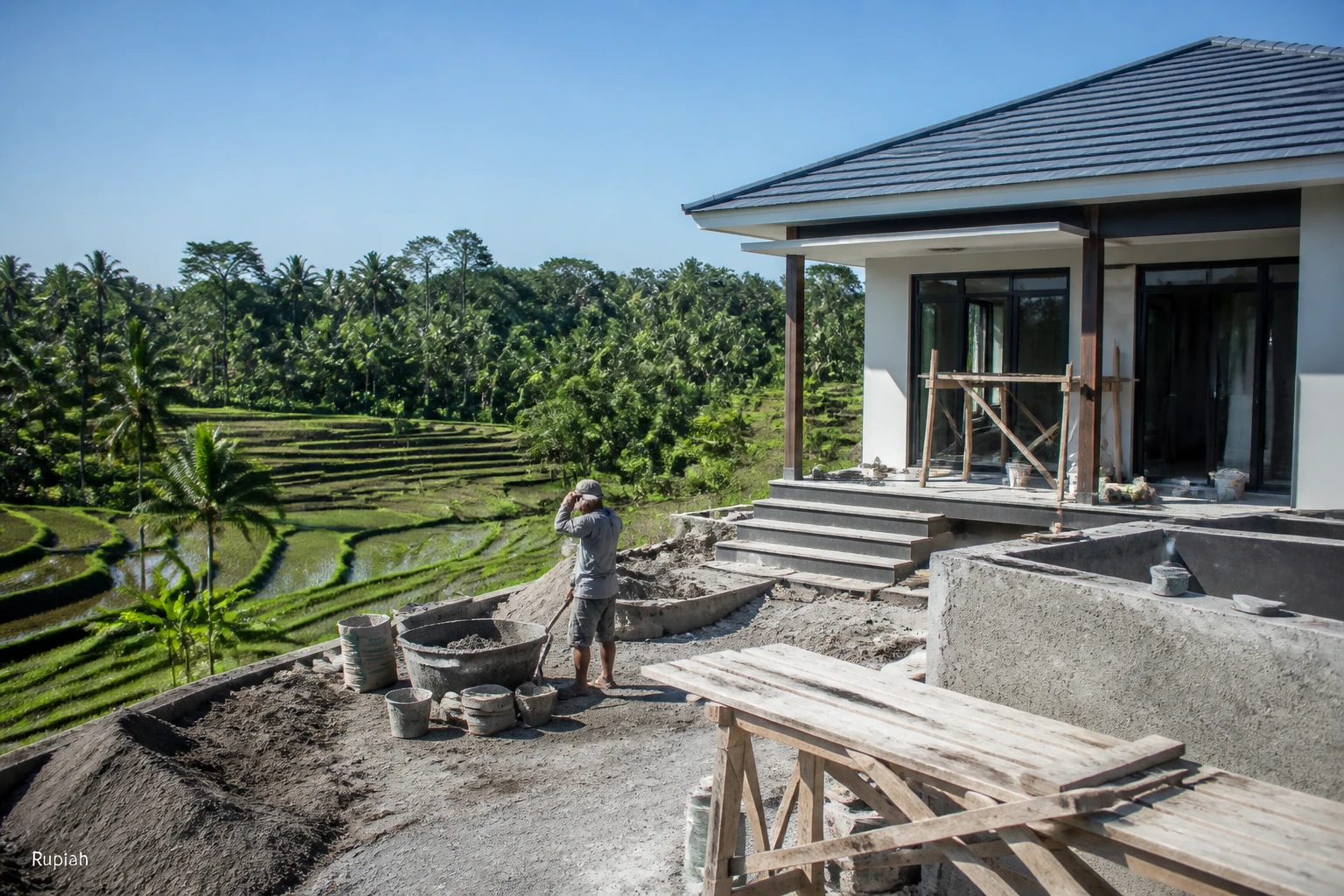
 When Indonesia Trims Three Zeroes · Illustration: HubLombok (AI-generated)
Consider a typical Lombok villa transaction today. A buyer's agreement might read: "Land and improvements: Rp 3,800,000,000 (three billion eight hundred million rupiah), payable in tranches as follows." Post-redenomination, the identical contract would state: "Land and improvements: Rp 3,800,000 (three million eight hundred thousand rupiah)." The buyer's actual cost in USD remains unchanged; only the quotation simplifies.
The mechanics of a South Lombok property sale involve cascading calculations, each expressed in rupiah:
| Item | Example (pre-reform) | Illustrative simplification | |------|----------------------|----------------------------| | Gross purchase price | Rp 4 trillion | Rp 4 million | | Transfer duty (BPHTB, ~5%) | Rp 200 billion | Rp 200,000 | | Notary and deed fees | Rp 80–120 billion | Rp 80–120,000 | | Annual land-and-building tax (PBB) | Rp 10–20 million | Rp 10–20,000 |
Today, errors in these calculations, transposed zeroes in contract language, typos in digital title records, ambiguity in verbal quotations, carry material financial consequences. Redenomination compresses this friction by shrinking the nominal magnitude of each figure, reducing the cognitive load on notaries, BPN (Indonesia's land office) staff, and contract drafters alike.
Psychological and Market Implications
For foreign investors purchasing property in Are Guling (land entry point Rp 120–180 million per are, or approximately USD 7,300–10,900) or Selong Belanak (Rp 150–250 million per are, ~USD 9,100–15,200), redenomination has negligible practical impact. USD and EUR prices remain constant; exchange-rate risk, yield calculations (honest net yields in South Lombok range 7–12% after management and occupancy allowances), and tax liability in the buyer's home jurisdiction are untouched.
But for domestic Indonesian investors, and for speculative interest from Jakarta, Surabaya, and other urban centres, redenomination carries surprising psychological weight. A land parcel "costing Rp 180 million" (Are Guling, typical entry) sounds psychologically more accessible than "Rp 180 billion." The headline figure's magnitude influences perceived risk and feasibility, particularly among first-time property investors or middle-class savers comparing Lombok plots to urban apartment units in metropolitan Java.
For developers operating in South Lombok, this is quietly significant. Off-plan villa projects marketed to domestic Indonesian investors currently require careful calibration to navigate the psychological friction of billion-rupiah headline prices. Redenomination removes that barrier. A villa marketed post-reform at "Rp 255 million" (the post-reform nominal equivalent of today's Rp 255 billion, or approximately USD 15,500) would compete more favourably with urban condominium developments in tier-one cities, potentially expanding the addressable market among retail investors who view Lombok as an aspirational, higher-yielding alternative to Jakarta property.
What This Means for Investors
The timeline for redenomination remains unconfirmed, the government has not announced a firm effective date, though 2026–27 is frequently speculated. Foreign buyers should monitor three critical areas:
Contract language and notary practice. Any purchase agreement signed now or during the transition should include an explicit redenomination clause: "All monetary amounts expressed in Indonesian Rupiah shall be adjusted by a factor of 1 to 1000 upon official redenomination, with no change to economic substance or payment schedule." Experienced notaries, particularly TerraNusa Advisory, an independent legal practice specialising in foreign-buyer due diligence and PT PMA (foreign-company) structure in Lombok, are already embedding such provisions as standard to eliminate ambiguity during title transfer and tax calculation.
Timing risk for off-plan commitments. If a buyer has committed to a fixed rupiah price today (say, Rp 3.8 billion for 2027 completion), redenomination before handover could introduce contractual ambiguity unless explicitly addressed. Early clarification with the developer and notary eliminates friction downstream.
Domestic-market competition. As redenomination lowers the psychological barrier for Indonesian investors, South Lombok's property market may experience a surge in domestic speculative interest, potentially accelerating price appreciation and reducing land availability in prime zones such as Kuta (Rp 300–400 million per are) and frontier zones such as Are Guling (Rp 120–180 million per are). Investors seeking entry should monitor market liquidity closely over the next 18 months.
Redenomination is not a currency crisis or a source of macroeconomic instability. Nor does it alter Lombok's core investment thesis, which rests on tourism recovery (foreign arrivals up 40–50% year-on-year), the Mandalika SEZ and MotoGP momentum, and capital appreciation as Bali congestion drives capital-seeking investors to earlier-cycle neighbouring markets. But it is a significant administrative event that will reshape how transactions are quoted, how domestic investor confidence coheres, and how Lombok property is framed in the retail Indonesian investor psyche. For foreign buyers, the task is straightforward: ensure purchase agreements contain redenomination clauses. For developers and brokers, the challenge is operationally preparing marketing, contract templates, and accounting systems for a cleaner nominal currency.
Stay informed, subscribe to the free Lombok Briefing for market intelligence like this, published twice a month.
Will rupiah redenomination change South Lombok property prices?
No. Redenomination is purely technical, it removes three zeroes but preserves all real values. A villa worth Rp 3.8 billion today will be worth Rp 3.8 million post-reform, but its USD/EUR equivalence and actual market price remain unchanged.
How should contracts address redenomination risk?
Any purchase agreement should include a redenomination clause specifying that all Rupiah amounts adjust proportionally by 1:1000 upon official implementation, with no change to economic substance. Independent notaries like TerraNusa Advisory now include this as standard provision.
Does redenomination boost Lombok's domestic investor appeal?
Indirectly yes. Smaller headline numbers (Rp 150 million instead of Rp 150 billion) reduce psychological friction for Indonesian retail investors comparing Lombok land to urban apartments, potentially expanding the addressable market for developers and accelerating domestic speculative interest.

The Lombok Buyer's Field Guide
Legal structures ranked by risk, the honest ROI math line by line, all six zones ranked, and the 24-point due-diligence checklist. The whole book, free in your inbox.
See what's inside