The Rupiah's Anchor: Why Bank Indonesia's Rate Hike Strengthens Your Lombok Thesis
Bank Indonesia's bold rate hike to 5.50% signals rupiah stabilization ahead. For foreign Lombok investors, that means lower currency risk and protection of hard-currency returns. Here's what changed, a
Bank Indonesia's decision to raise its benchmark rate by 25 basis points to 5.50% on 5 June represents far more than a routine monetary tightening. For the international property investor considering Lombok, this move by Indonesia's most important central bank signals something critical: Indonesia is doubling down on rupiah stability. And in a market where European, Australian and American buyers are committing €95,000 to €350,000 for rental villas promising 12–22% annual returns, currency stability is not a peripheral concern, it is the bedrock upon which those returns rest. This note explains what changed, why it matters, and how to think about currency risk in the context of Indonesia's broader economic credibility.
The Context
Bank Indonesia's rate decision emerged in response to mounting pressures on the rupiah and a requirement to anchor inflation expectations. The Indonesian currency has faced intermittent weakness over the past 18 months, squeezed by a combination of forces: elevated US interest rates that pull capital toward dollar assets, periodic risk-off sentiment in global financial markets, and Indonesia's structural current-account deficit (hovering around 2.4% of GDP as of late 2025).
A sustained weak rupiah creates a pernicious cycle: imported goods become more expensive (inflation rises), consumers and businesses lose purchasing power, and capital inflows slow. To break that cycle, BI has few levers. The most direct is the policy rate. By raising the cost of rupiah borrowing relative to the dollar, BI makes rupiah assets more attractive to international investors. Capital flows stabilise. The currency firms. Inflation expectations anchor.
The new benchmark rate of 5.50% reflects careful calibration. It is not, in global terms, an aggressive level, the US Federal Reserve holds rates in the 5.0–5.5% band, and other Southeast Asian economies operate in comparable territory. What matters is the message. BI Governor Enny Suprayitno and her team have spent two years rebuilding institutional credibility. This latest move, methodical, data-driven, announced with supporting economic analysis, reinforces that BI is serious about its inflation mandate and currency defence. For investors, that consistency is everything.
What a Stronger Rupiah Means for Your Costs
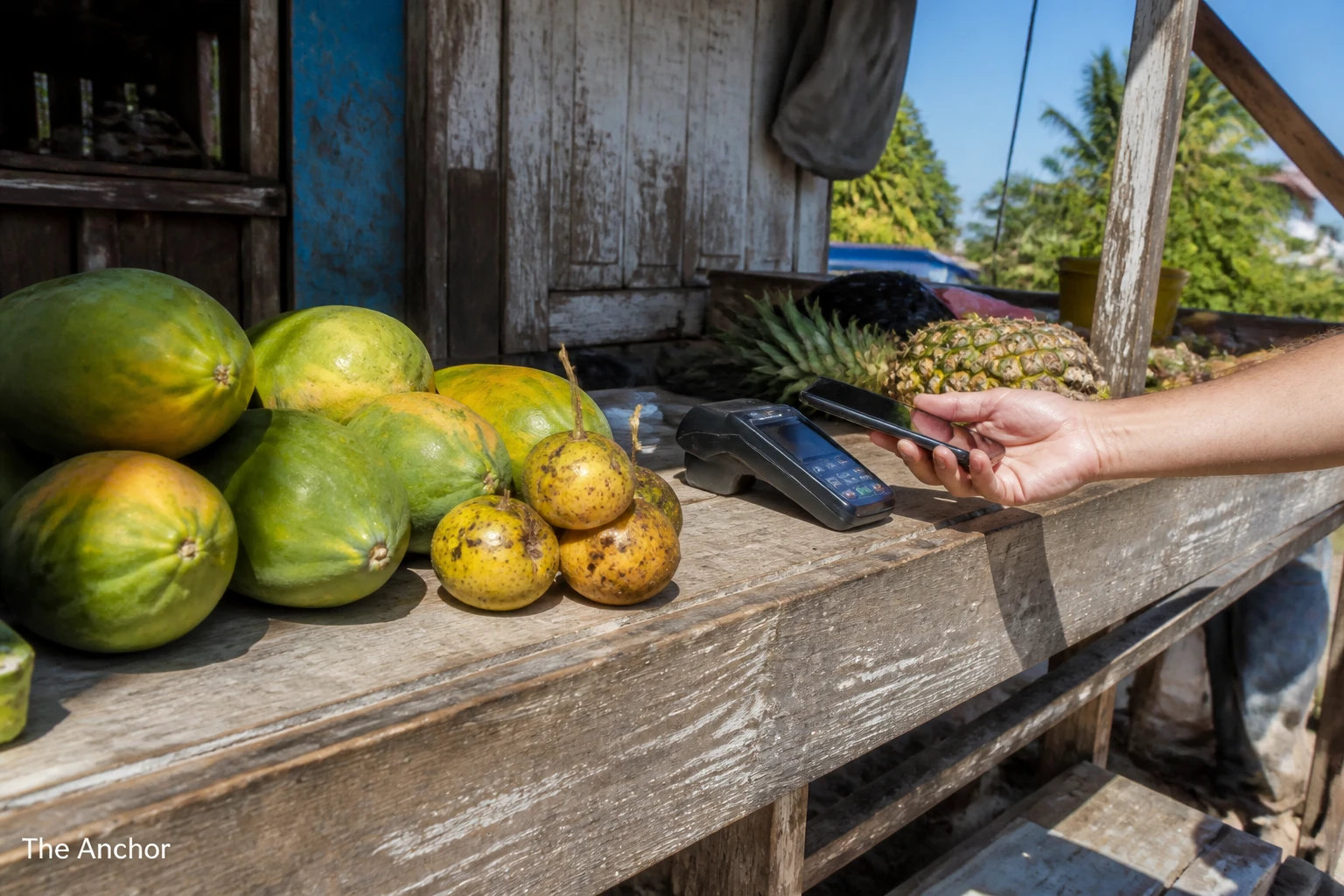
 The Rupiah's Anchor · Photo by Tom Fisk on Pexels
The connection between interest rates and property investment costs is not intuitive, so it is worth spelling out. Most South Lombok villas marketed to foreign investors are quoted in hard currency: €95,000 to €350,000 for a turnkey rental-ready property, depending on size, location (Are Guling coastal villas command premiums), and finishes. When a developer quotes €150,000, she is implicitly anchoring that price in euros to avoid currency risk. But the actual construction, materials, skilled labour, permits, happens in Indonesia and is priced in rupiah.
Here is where interest rates matter. If the rupiah is depreciating against the euro, a developer faces two unpleasant choices:
- Absorb the cost creep herself, compressing her margin as labour and material costs rise in rupiah terms.
- Renegotiate the price with the buyer, pushing that cost burden onto you.
This dynamic is not theoretical. During periods of rupiah weakness, South Lombok developers have quietly renegotiated pricing with international buyers, particularly on off-plan purchases unfolding over 18 months or more. By handover, developers have absorbed 7–12% cost inflation in rupiah terms.
BI's rate hike reduces this tail risk. A stronger rupiah (supported by higher returns on rupiah assets) means construction costs stabilise in hard-currency terms. A developer quoting €150,000 can commit to that price and complete construction without unexpected rupiah headwinds.
Consider two scenarios over the next two years:
| Scenario | Rupiah Move | Developer Cost Inflation | Your Risk | |---|---|---|---| | Rupiah weakens (5% depreciation) | 16,500 → 17,325 IDR/EUR | ~8% local cost inflation | Renegotiation or margin squeeze | | Rupiah stable/stronger (BI holds line) | 16,500 → 16,400 IDR/EUR | Minimal inflation | Your price stays fixed |
BI's rate hike pushes the needle toward scenario two. For buyers targeting the €95–200K segment of South Lombok villas, this is the difference between predictable entry costs and creeping price spirals.
Indonesia's Macro Credibility: The Unsexy Foundation of Investment Flows
Emerging market investing rests on a simple bargain: you accept higher currency and political risk in exchange for higher nominal returns. But that bargain only holds if the country credibly manages its macroeconomic fundamentals.
Indonesia has struggled with this reputation. Decades of inconsistent central bank policy, stop–start reform cycles, and frequent surprises to foreign investors created a persistent credibility discount. A property investor who bought in 2010 might have seen 15% nominal returns eroded by 20% rupiah depreciation, a net loss in hard currency.
The turning point came in 2015–2020, when a succession of strong BI governors built institutional credibility. They committed visibly to inflation control (bringing it into the 2–4% band), communicated policy decisions transparently, resisted political pressure to hold rates artificially low, and built sufficient forex reserves to weather capital outflow events. This credibility accumulated. By the early 2020s, foreign investors began viewing Indonesia differently, not as a high-risk emerging market, but as a credibly-managed frontier economy with structural growth tailwinds.
Enny Suprayitno, who took over BI in December 2023, has continued that trajectory. Her rate decision on 5 June is consistent with that pattern: measured, explained, forward-looking. Markets are taking notice. When a strong central banker with a track record signals that she will defend the rupiah, international investors believe her.
That belief translates directly into sticky capital. For Lombok specifically, this credibility is a multiplier. The island has real fundamentals driving its growth: tourism arrivals up 40–50% year-on-year, airport expansion capacity arriving in 2025–26, Bali saturation pushing overflow investment southward, and tightening supply in prime South Lombok zones. But none of those fundamentals matter if international investors worry about currency collapse or macro mismanagement. BI's rate move removes that psychological hedge. Investors can focus on the real drivers of returns, demand, scarcity, yield compression parity with Bali.
What This Means for Investors
If you are evaluating a Lombok property now, what should this rate move change in your thinking?
Recalibrate your currency assumptions. Run sensitivity analysis on rupiah movements:
- At today's rates (16,500 IDR/EUR), a €150,000 villa generates roughly IDR 2.48 billion in annual revenue from rental operations.
- If the rupiah weakens to 17,500 per euro (6% depreciation), that revenue in rupiah terms becomes IDR 2.63 billion.
- If the rupiah strengthens to 16,000 per euro (3% appreciation), revenue falls to IDR 2.40 billion.
For a villa generating €15,000–€20,000 in annual rental revenue, a 6% rupiah move translates to €900–€1,200 in annual variance. Over a 10-year hold, that is material. BI's rate hike reduces the probability of 10–15% downside scenarios.
Assess your natural hedges. If your villa generates rental revenue in euros and USD whilst incurring costs in rupiah (staff, utilities, tax), you are naturally long the rupiah. A stronger rupiah improves your margin. If you are financing in dollars but costs are in rupiah, you are naturally short the rupiah. Understand the mismatch.
Layer in longer-term optionality. BI's rate cycle is likely near a peak, and rates may edge down once inflation is truly anchored. That creates an opening for currency hedging strategies (forward contracts locking in favourable exchange rates for future rupiah repatriation) over a 3–5 year horizon.
Don't time the rupiah; time the property. The rate move is a macro risk-reduction event, not a buy or sell signal. The real drivers of Lombok villa returns, tourism growth, supply constraints, yield compression versus Bali, are uncorrelated with interest rate decisions. A property with strong fundamentals is a buy regardless of rate moves. The rate hike simply removes a tail risk from your scenario analysis.
Indonesia's interest rate policy is not glamorous. It lacks the narrative appeal of a new resort opening or a celebrity purchasing a villa in South Lombok. Yet for investors deploying €100,000–€300,000 into the island's property market, it is quietly the most important macro signal of the year. When Bank Indonesia credibly commits to rupiah stability and inflation control, foreign capital stops hedging tail risks and starts chasing returns. That shift unlocks the yield compression and capital appreciation that makes emerging market property compelling. For Lombok, that means the macro foundation beneath the tourism and supply-side growth story is now more durable.
Stay informed, subscribe to the free Lombok Briefing for market intelligence like this, published twice a month.
Why does Bank Indonesia's interest rate matter for foreigners buying a villa in Lombok?
Bank Indonesia raised its benchmark rate by 25 basis points to 5.50% on 5 June to defend the rupiah and anchor inflation expectations. For foreign buyers committing €95,000 to €350,000 for South Lombok rental villas, rupiah stability matters because construction costs, labour, and materials are priced in local currency. A firmer rupiah reduces the risk of developers renegotiating prices before handover.
Can a weaker rupiah increase the price I agreed to pay for an off-plan Lombok villa?
Yes. During periods of rupiah weakness, South Lombok developers have renegotiated pricing with international buyers, particularly on off-plan purchases unfolding over 18 months or more. Developers have absorbed 7 to 12 percent cost inflation in rupiah terms by handover, which can lead to price creep. Bank Indonesia's rate hike supports a stable rupiah, reducing the likelihood of that renegotiation on your purchase.
How has currency risk historically affected returns on Indonesian property investment?
Currency risk can erode nominal gains significantly. An investor who bought in 2010 might have seen 15 percent nominal returns eroded by 20 percent rupiah depreciation, a net hard-currency loss. South Lombok villas currently promise 12 to 22 percent annual returns, but Bank Indonesia's commitment to inflation control, targeting a 2 to 4 percent band, aims to protect those returns for today's buyers.

The Lombok Buyer's Field Guide
Legal structures ranked by risk, the honest ROI math line by line, all six zones ranked, and the 24-point due-diligence checklist. The whole book, free in your inbox.
See what's inside