QRIS’s Scale Changes the Digital Baseline for Indonesia’s Small Businesses
Bank Indonesia’s latest QRIS figures show how payments infrastructure is becoming a practical gateway to digital participation for small businesses.
Quick answer: Bank Indonesia says QRIS had 65.77 million users and was accepted by 44.86 million merchants as of June 2026, with 96.68% of accepting merchants classified as MSMEs. For Lombok investors, the significance is structural: a widely used payment rail can make small-business transactions easier while supporting deeper participation in Indonesia’s digital financial ecosystem.
Lombok Notebook
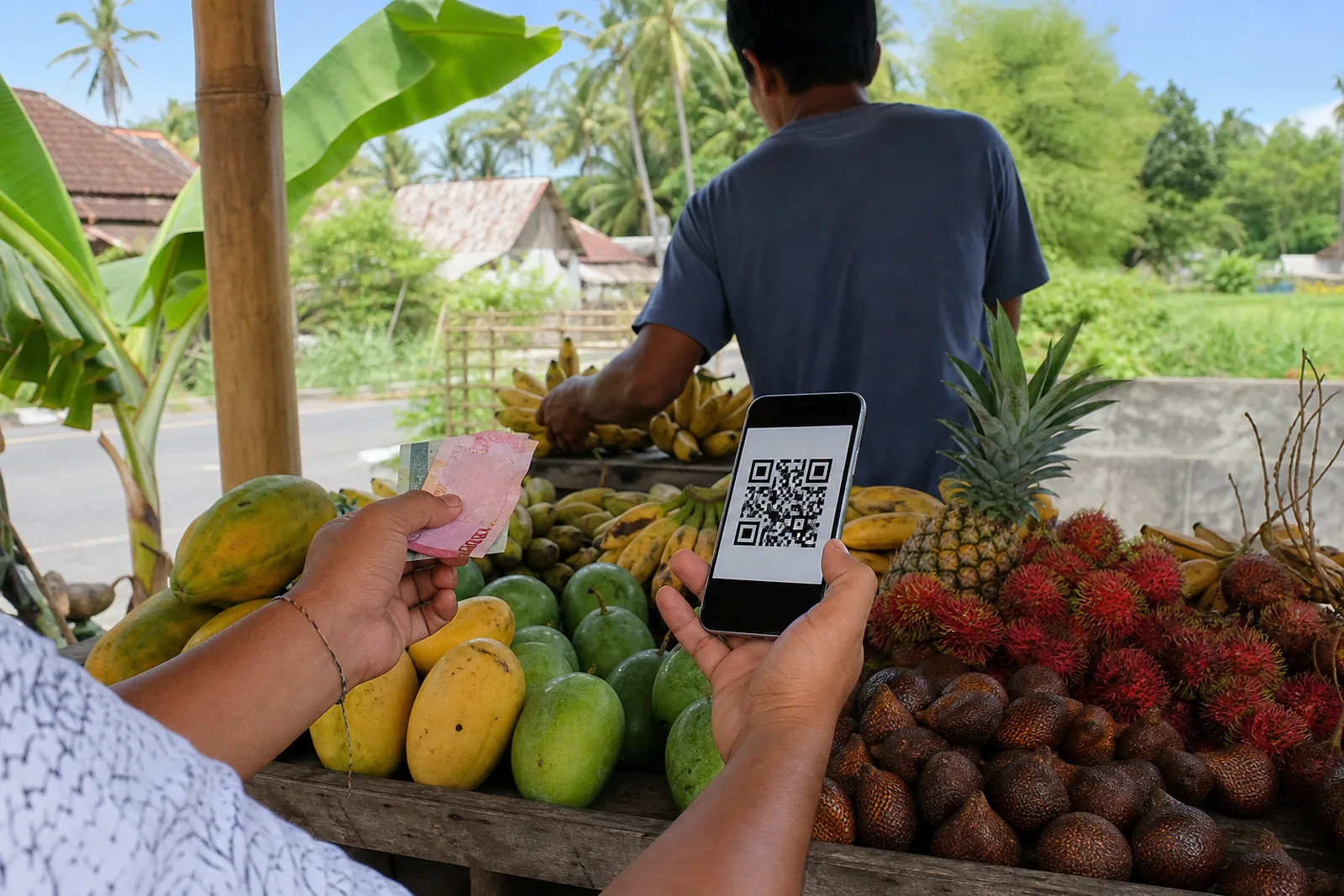
A payment code can look like a small piece of retail plumbing: a square graphic at a counter, a phone raised for a moment, a transaction completed without cash changing hands. Yet Bank Indonesia’s latest QRIS update is more revealing than that modest ritual suggests. It points to the increasingly important role that payment infrastructure plays in the country’s effort to bring micro, small and medium-sized enterprises into a more connected digital economy.
For investors considering Indonesia, including those assessing Lombok’s visitor economy and its surrounding business ecosystem, this is not a reason to confuse payment adoption with guaranteed commercial returns. It is, however, a useful marker of the operating environment. The question is less whether a QR code alone transforms a business than whether common digital rails reduce friction for the many small enterprises through which visitors, residents and suppliers interact.
The Context
Bank Indonesia recorded 65.77 million QRIS users as of June 2026. The system was accepted by 44.86 million merchants, of which 96.68% were MSMEs. QRIS, or Quick Response Code Indonesian Standard, is therefore not presented by the central bank merely as a consumer-payment tool. It is being positioned as an entry point into a wider financial and commercial system for smaller businesses.
“QRIS has become the main gateway, the entry point, for MSMEs into the digital financial ecosystem,” Bank Indonesia Deputy Governor Filianingsih Hendarta said in Jakarta.
That framing matters. Digital payments are often discussed in the language of consumer convenience: faster checkout, less cash handling, a familiar method for travellers. Bank Indonesia’s emphasis is broader. The institution links QRIS expansion to easier transactions and to the integration of MSMEs into the digital economy and financial ecosystem.
For a market such as Lombok, where investors may examine hospitality, tourism-facing services and the businesses that support them, the relevant insight is qualitative. An accommodation asset does not operate in isolation. It sits alongside cafés, transport providers, local suppliers, crafts businesses and other small operators. A common payment standard can make the commercial environment feel more legible to users while giving participating businesses a clearer route into digital activity.
The source does not claim that QRIS creates demand, raises occupancy or determines property values. Investors should resist that leap. Its value lies in the quieter work of infrastructure: standardising a common transaction method and making participation easier for a broad base of merchants.
The scale reported by Bank Indonesia also gives the development a national dimension. With 44.86 million accepting merchants, QRIS is no longer best understood as a niche service available only in selected retail settings. And because 96.68% of those merchants are MSMEs, the reported network is notably concentrated in the segment where digital tools can be most consequential for routine administration, customer access and formal financial engagement.
A Gateway, Not a Guarantee
Bank Indonesia’s argument rests on a practical sequence. Easier transactions can help bring MSMEs into digital channels; digital participation can then support broader access to markets and financial services. It is an institutional thesis about capability-building, not a promise that every small enterprise will prosper simply by displaying a code.
The central bank identifies digital transformation as increasingly important for productivity, market access and helping MSMEs move up the value chain amid the growth of the digital economy. Its stated approach has three strands:
- E-farming, using digital farming to improve productivity and efficiency.
- E-commerce, through MSME onboarding intended to widen digital market access.
- E-financing, through the Financial Information Recording Application Information System, known as SIAPIK, to strengthen financial reporting and access to financing.
Together, these strands show why QRIS should be read as part of a larger architecture rather than a standalone payments story. A payment acceptance tool may be the visible front door, but the policy objective stretches further: better records, wider market access, stronger business processes and more useful links to financing.
That distinction should appeal to serious investors. The most durable features of an investment environment are not always the most dramatic. They can be the systems that make ordinary commerce more consistent: how businesses take payment, maintain records, reach customers and engage with financial institutions. Such systems do not eliminate execution risk, operational variability or the need for rigorous asset-level due diligence. They can nevertheless influence how readily small businesses participate in the formal and digital economy.
Bank Indonesia also points to the Indonesian Digital Innovation Center, or PIDI, as part of this agenda. The centre connects talent, innovators, industry, government and strategic partners to develop digital solutions for implementation in the real sector, including MSMEs. According to Filianingsih Hendarta, PIDI reflects collaboration between Bank Indonesia, the Financial Services Authority and strategic partners to accelerate innovation and develop national digital talent.
For MSMEs, the intended role is deliberately practical: PIDI facilitates digital solutions that are easier to adopt and replicate, with the aim of improving productivity and efficiency and widening access to markets and financing. The language is important. It recognises that technology has little value if it cannot be used by businesses with limited time, skills or administrative capacity.
 QRIS’s Scale Changes the Digital Baseline for Indonesia’s Small Businesses · Illustration: HubLombok (AI-generated)
Why the Merchant Mix Matters
The figure of 96.68% deserves more attention than it may initially receive. It means that nearly all merchants accepting QRIS in the Bank Indonesia update were MSMEs. That merchant mix puts small enterprises at the centre of the network’s reported reach.
This has implications for how investors should read digitalisation in Indonesia. Large companies can often build proprietary systems, negotiate commercial arrangements and invest in specialist support. Smaller enterprises require accessible, shared infrastructure. A standard that can be used across a large merchant base is therefore potentially more meaningful than a limited service designed for major chains alone.
The effect is also likely to be felt through accumulation rather than spectacle. A guest pays for a meal, a supplier receives a payment, a local operator records a transaction and a business develops a more regular digital footprint. None of these actions is, by itself, a macroeconomic event. But a widely accepted standard can make each one less cumbersome.
QRIS is significant not because it removes every business constraint, but because it addresses a recurring point of friction across a large base of smaller merchants.
For Lombok, this is best treated as context for diligence, not a substitute for it. Investors should still ask granular questions about any relevant business or asset: how revenue is collected, what management systems are in place, how supplier relationships function, which customer segments are being served, and what evidence supports reported performance. Payment acceptance is one operational consideration among many.
Equally, the national figures should not be used to make unsupported claims about the level of QRIS adoption in a particular Lombok neighbourhood, business category or investment project. Bank Indonesia’s update provides an Indonesia-wide measure. It does not offer a local breakdown in the supplied material. That limit is worth preserving, particularly in a market where broad narratives can too easily be mistaken for property-specific evidence.
The disciplined reading is simpler. Indonesia’s central bank reports a digital payment network of substantial scale, overwhelmingly used by MSMEs on the merchant side. It sees that network as a gateway into a broader programme of digital transformation, including market access, record-keeping and financing.
What This Means for Investors
The immediate investment takeaway is not that QRIS changes an underwriting model overnight. It is that digital payments have become part of the background infrastructure against which Indonesian small-business activity is increasingly conducted. That is relevant to investors whose thesis depends, directly or indirectly, on a functioning local commercial ecosystem.
A sensible approach is to separate what the figures establish from what they do not.
| What Bank Indonesia’s update supports | What it does not establish | |---|---| | QRIS had 65.77 million users as of June 2026. | The commercial outcome for a specific Lombok business or asset. | | QRIS was accepted by 44.86 million merchants. | Local adoption levels in a particular district or tourism segment. | | 96.68% of accepting merchants were MSMEs. | A guaranteed improvement in revenue, margins or access to credit. | | BI views QRIS as a gateway to digital financial participation. | That payment digitisation removes operational or investment risk. |
This distinction is especially useful for international investors, who may encounter digitalisation as a shorthand for modernisation. The stronger conclusion is more modest and more useful: the reported QRIS footprint suggests a common payments infrastructure with deep MSME participation. It is one component of an ecosystem that Bank Indonesia is trying to strengthen through e-farming, e-commerce, e-financing and digital innovation.
The practical questions should follow from that context. Where relevant, investors can assess whether a business is able to accept the payment methods its customers expect; whether transaction and financial records are sufficiently robust; and whether management understands the operational value of digital tools. These are questions about resilience and execution, not promotional decoration.
There is also a wider lesson in the central bank’s focus on adoption. Infrastructure becomes economically meaningful when it is usable beyond the largest firms. The reported QRIS merchant base, dominated by MSMEs, is a reminder that Indonesia’s digital economy is being built through millions of relatively small commercial interactions as well as through major platforms and institutions.
For Lombok observers, the result is a more nuanced lens on the market. The island’s investment case should still be judged through asset-specific evidence, legal structure, management quality and realistic assumptions. But the underlying commercial setting matters too. Bank Indonesia’s QRIS update offers one clear signal that the country is seeking to make that setting more digitally connected for the small enterprises that underpin much everyday economic activity.
Stay informed, subscribe to the free Lombok Briefing for market intelligence like this, published twice a month.
How many people and merchants used QRIS in June 2026?
Bank Indonesia recorded **65.77 million QRIS users** as of June 2026. The payment standard was accepted by **44.86 million merchants**, according to the central bank’s update published by Antara Business.
Why does QRIS matter for Indonesia’s MSMEs?
Bank Indonesia says QRIS makes transactions easier and helps MSMEs integrate into the digital economy and financial ecosystem. **96.68%** of QRIS-accepting merchants were MSMEs, making small businesses central to the reported merchant network.
Does QRIS adoption prove a Lombok investment will perform well?
No. Bank Indonesia’s national QRIS figures do not establish revenue, occupancy, financing access or returns for a particular Lombok business or asset. They provide context on payment infrastructure and MSME digital participation, which investors should assess alongside asset-specific evidence.

The Lombok Buyer's Field Guide
Legal structures ranked by risk, the honest ROI math line by line, all six zones ranked, and the 24-point due-diligence checklist. The whole book, free in your inbox.
See what's inside