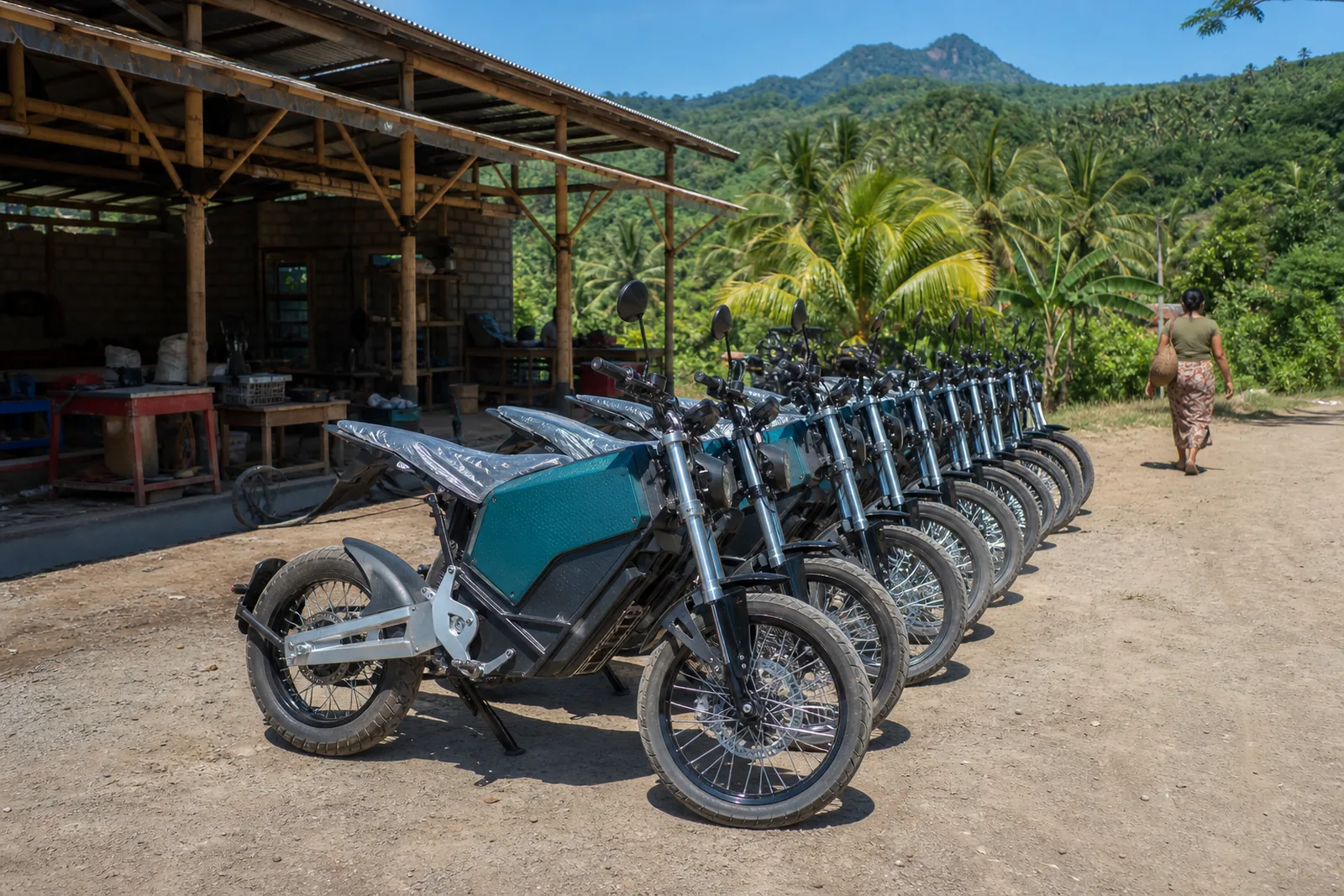
Prabowo Sets Two Million Goal for Indonesia’s National E-Motorcycles
Indonesia’s President has set a two million-unit ambition for national electric motorcycles, pairing industrial scale-up with cheaper consumer finance.
Quick answer: President Prabowo Subianto has challenged Indonesia’s domestic electric-motorcycle industry to reach two million units, while signalling lower instalment rates, possible zero-down-payment purchases and a trade-in route for petrol motorcycles. For investors, the announcement puts financing, local manufacturing capacity and charging-supporting infrastructure at the centre of Indonesia’s EV transition.
Indonesia’s electric-motorcycle policy has acquired a sharper industrial edge. At the launch of the national electric motorcycle, Molinas, and its supporting ecosystem in Cikarang, West Java, President Prabowo framed the next phase not as a tentative pilot but as a scale-up challenge for domestic producers and the institutions expected to back them.
The Context
The President’s intervention comes with a clear benchmark. Indika Energy Group has, according to Prabowo, produced 20,000 electric motorcycles to date. He said he would return when the group reaches 200,000, and again if it reaches two million.
“Today, the Indika Group has successfully produced 20,000 motorcycles. I told the Indika Energy Group that if you reach 200,000, I will come again; if you reach two million, I will come again.”
That language matters. The stated objective is not merely more electric vehicles on Indonesian roads; it is a nationally rooted manufacturing and support ecosystem capable of serving demand at a far larger scale. Prabowo urged relevant stakeholders, including sovereign investment agency BPI Danantara, to provide funding and infrastructure support for that ecosystem.
For capital watching Indonesia, the dispatch points to three connected policy priorities:
- domestic manufacturing scale;
- consumer affordability; and
- infrastructure capable of supporting wider electric-motorcycle adoption.
The source does not set out a timetable for the two million-unit ambition, nor does it specify individual funding allocations or infrastructure projects. That distinction is important: the announcement establishes political direction and a production target, rather than a detailed investment programme.
From 20,000 Units to a National Industrial Challenge
The scale implied by the President’s target is substantial when set against the production figure he cited for Indika Energy Group. The immediate question for manufacturers will be whether supply chains, production facilities, distribution and after-sales support can expand in step with consumer demand.
| Milestone cited by Prabowo | Role in the announcement | |---|---| | 20,000 motorcycles produced | Initial progress attributed to Indika Energy Group | | 200,000 motorcycles | Interim benchmark for a further presidential visit | | Two million motorcycles | National-scale production challenge |
Prabowo’s emphasis on BPI Danantara and infrastructure indicates that the state sees the transition as broader than factory output. A national EV ecosystem depends on a chain of participants: manufacturers need finance and inputs; buyers need products they can afford; and the wider system must make ownership practical.
The competitiveness argument is equally prominent. Prabowo said Indonesia needs to accelerate its domestic EV transition to remain competitive in an international environment shaped by carbon taxes and urban emissions restrictions. He cited Beijing as an example when discussing the future direction of urban traffic management.
This is a policy signal with implications beyond a single manufacturer. If the government follows through with the support it is reviewing, companies exposed to vehicle production, financing, supporting infrastructure and the replacement of conventional motorcycles could all face a materially different operating environment. Yet investors should separate the President’s ambition from confirmed implementation: the source reports a push for support, not completed measures or final programme terms.
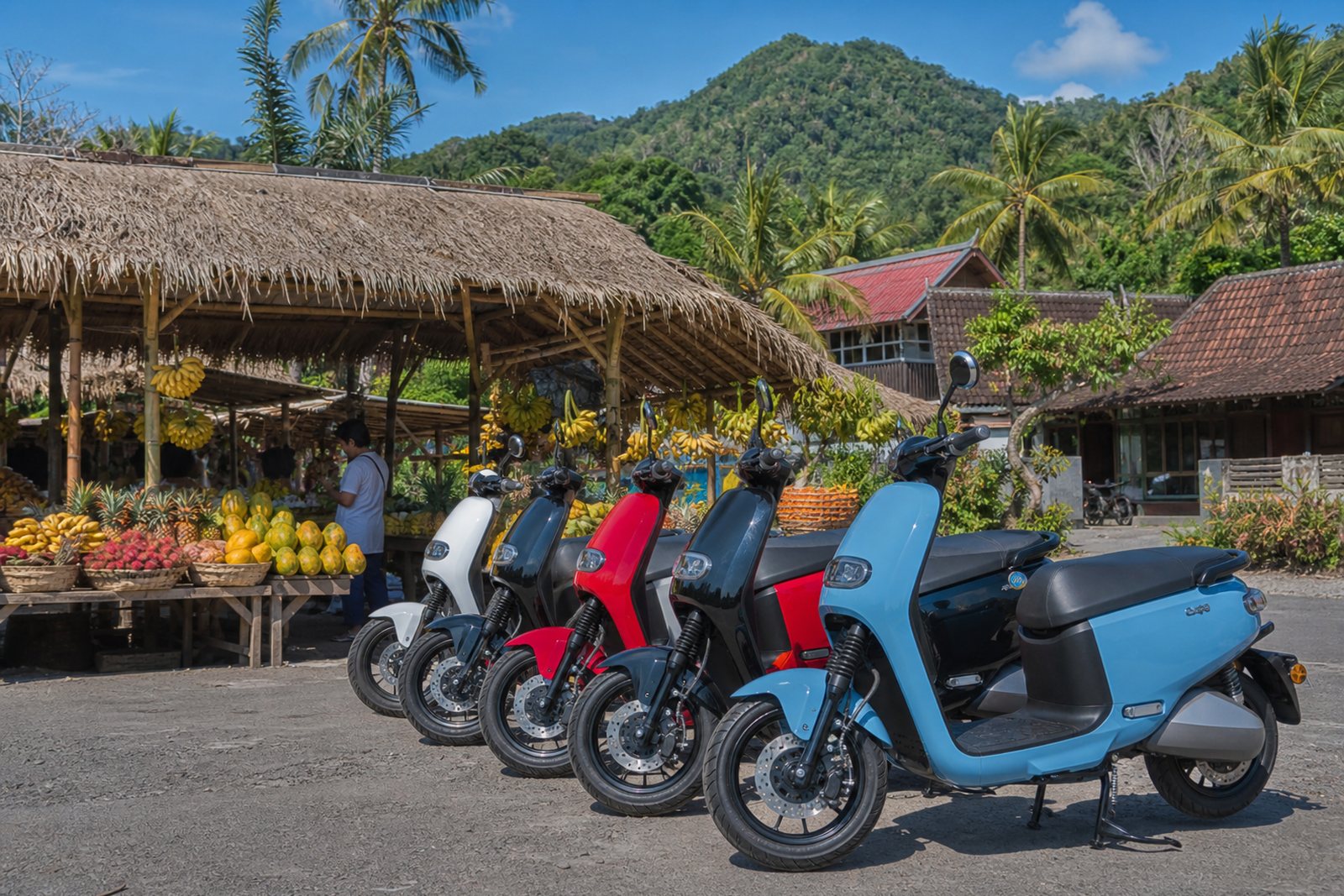 Prabowo Sets Two Million Goal for Indonesia’s National E-Motorcycles · Illustration: HubLombok (AI-generated)
Affordability Moves to the Fore
The consumer proposition is central to the announcement. Prabowo said the government would reduce interest rates on instalments and would try to eliminate down payments for buyers. Those are potentially consequential levers in a market where the upfront cost and monthly payment can determine whether a new technology reaches beyond early adopters.
“We will reduce interest rates on installments for the people. We will also try to eliminate down payments.”
The wording remains prospective. Lower instalment rates and zero-down-payment options were presented as policy intentions, not as a completed financing product with published eligibility rules. Investors should therefore resist treating either measure as currently available on the terms described.
The government is also reviewing a trade-in programme for owners of petrol-powered motorcycles. Under the scheme described by Prabowo, owners could exchange an existing petrol motorcycle for a new electric model by paying a minimal fee. Again, the source characterises this as under review rather than launched policy.
Prabowo also said electric motorcycles can cut daily mobility expenses by 50 to 70 percent compared with conventional fuel-powered motorcycles. This claimed operating-cost advantage is part of the administration’s argument for adoption, alongside cheaper access to financing.
For investors, the commercial logic is straightforward but not automatic. Financing support may lower the barrier to purchase; a trade-in mechanism may make switching easier for existing riders; and operating-cost savings may improve the ownership case. Their combined effect will depend on the final design, financing availability and the capability of the domestic ecosystem to deliver vehicles at scale.
What This Means for Investors
This is a live policy and industrial signal rather than a completed market transformation. The strongest immediate takeaway is that Indonesia’s leadership is explicitly linking electric-motorcycle adoption to domestic manufacturing, public financing conditions and infrastructure support.
Investors assessing the opportunity should watch for evidence in four areas:
- whether BPI Danantara and other stakeholders announce concrete funding or infrastructure commitments;
- whether lower-interest or zero-down-payment schemes receive final terms;
- whether the petrol-motorcycle trade-in proposal proceeds from review to implementation; and
- whether domestic producers translate the President’s challenge into verified capacity and output progress.
The announcement also reinforces a broader competitive framing. Carbon taxes and restrictions on urban emissions were invoked as reasons Indonesia cannot afford to lag in the EV transition. That makes the sector relevant not only to consumer-vehicle demand but also to national industrial positioning.
For European, Australian and American investors, prudence lies in distinguishing political momentum from investable execution. The President has supplied a headline target, an affordability agenda and a call for institutional backing. The next disclosures, on programme design, funding and actual manufacturing expansion, will determine where the economic value accrues.
Indonesia has put national electric motorcycles squarely into its industrial-policy conversation. The two million-unit goal is bold; the investable story will be written by the mechanisms that turn it into production, purchases and a functioning ecosystem.
Stay informed, subscribe to the free Lombok Briefing for market intelligence like this, published twice a month.
What electric-motorcycle target did President Prabowo set?
President Prabowo Subianto challenged Indonesia’s domestic electric-motorcycle industry to reach two million units. He cited 20,000 motorcycles already produced by Indika Energy Group and described 200,000 units as an interim milestone, but the source provides no timetable for the larger target.
Are zero-down-payment electric motorcycles available in Indonesia now?
The source reports that the government will try to eliminate down payments and reduce interest rates on instalments for electric-motorcycle buyers. These were presented by President Prabowo as policy intentions, not as a launched financing product with published terms or eligibility criteria.
What support is Indonesia considering for petrol motorcycle owners?
Indonesia is reviewing a trade-in programme under which owners could exchange a petrol-powered motorcycle for a new electric model by paying a minimal fee. The source describes the scheme as under review, so investors should not treat it as a final or operating programme.

The Lombok Buyer's Field Guide
Legal structures ranked by risk, the honest ROI math line by line, all six zones ranked, and the 24-point due-diligence checklist. The whole book, free in your inbox.
See what's inside