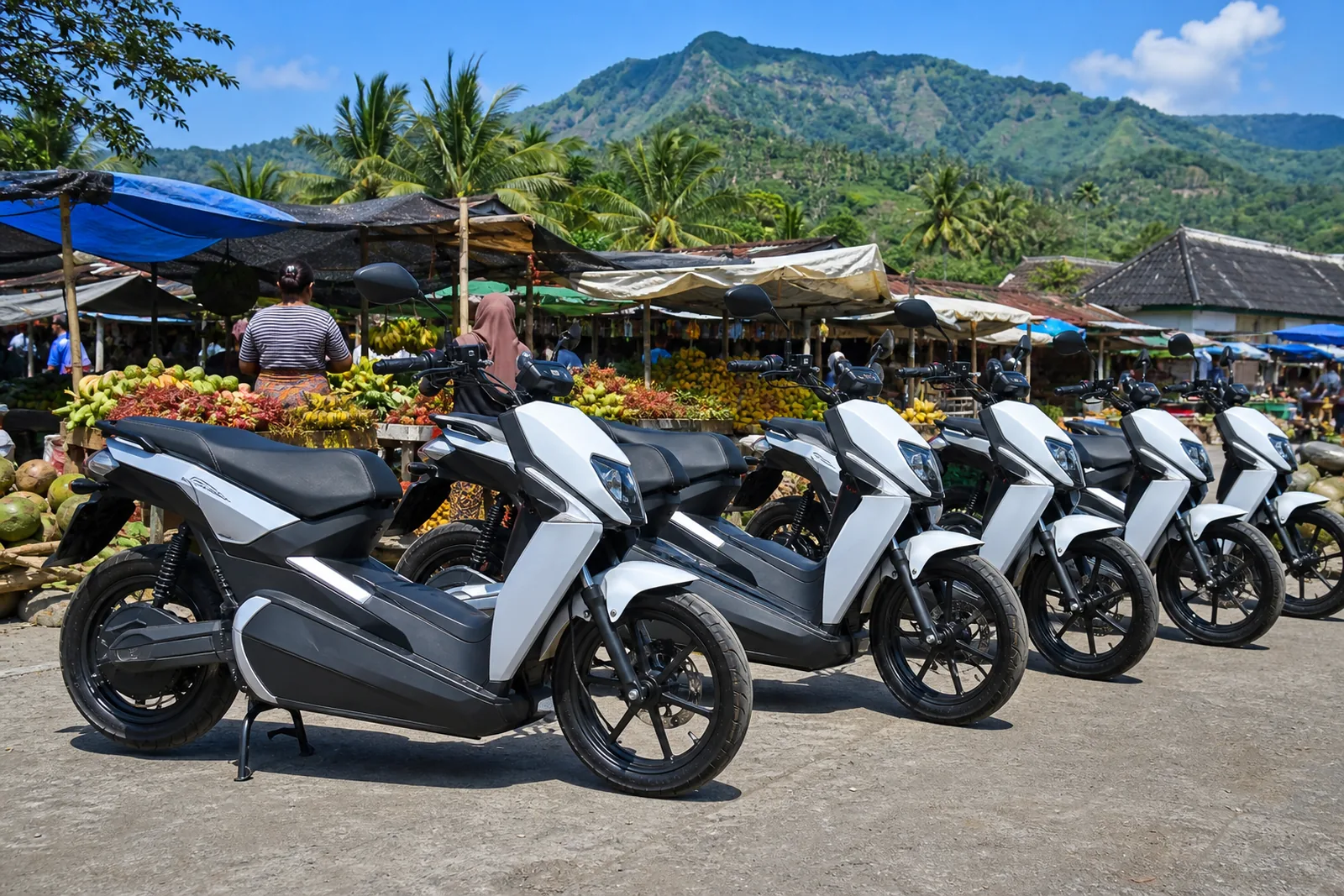
Prabowo Sets Two-Million Goal for Indonesia’s Electric Motorcycles
President Prabowo has urged domestic producers to scale electric motorcycle output, pairing a two-million-unit ambition with proposed buyer-finance support.
Indonesia’s electric-motorcycle push has acquired a striking political benchmark: two million units. President Prabowo Subianto has challenged domestic manufacturers to expand output while signalling that cheaper consumer finance could be central to wider adoption.
The announcement matters less as a near-term production forecast than as a clear statement of policy direction. It links industrial capacity, consumer affordability and Indonesia’s ambition to remain competitive as carbon taxes and urban-emissions restrictions gain influence internationally.
A production challenge, not yet a delivery timetable
Speaking at the launch of the national electric motorcycle, or Molinas, and its supporting ecosystem in Cikarang, West Java, President Prabowo praised the early progress of Indika Energy Group before setting a far larger ambition for the sector.
Indika Energy Group has produced 20,000 electric motorcycles to date, according to the President. He said he would return when the group reached 200,000 units, and again if it reached two million.
Key data: Indika Energy Group has produced 20,000 electric motorcycles to date; President Prabowo challenged the industry to reach two million units.
That distinction is important. The remarks establish a political target and a challenge to manufacturers, rather than providing a published schedule for when two million motorcycles will be made. Investors should therefore treat the figure as a signal of official ambition, not as a confirmed production outlook.
Even so, the scale of the challenge is meaningful. Electric-motorcycle adoption depends on more than factories assembling vehicles. It requires funding, supporting infrastructure and a proposition that makes financial sense for everyday riders. The President explicitly connected the production goal to those elements.
Finance is positioned as the demand lever
The government is preparing consumer-oriented financing schemes intended to encourage electric-vehicle adoption. President Prabowo said the policies would focus on reducing interest rates on instalments and exploring the removal of down payments for prospective buyers.
“We will reduce interest rates on installments for the people. We will also try to eliminate down payments,” President Prabowo said.
For the market, this is potentially as consequential as the manufacturing target. A high-profile domestic production goal can support investment in supply chains, but broad consumer demand depends on whether households can afford the initial purchase and subsequent repayments.
The proposal remains framed as a government effort under preparation and exploration. There is no confirmed timetable, final financing structure or stated eligibility in the source material. That leaves considerable execution detail unresolved, including how any lower-rate or zero-down-payment arrangements would be funded and administered.
Still, the policy emphasis is clear. Rather than relying solely on environmental messaging, the administration is seeking to reduce the immediate financial barrier to ownership. This is a pragmatic approach in a market where the purchase decision is likely to turn on cash flow as much as technology.
Operating savings underpin the broader case
President Prabowo also argued that electric motorcycles can reduce daily mobility costs by 50 to 70 percent compared with conventional fuel-powered motorcycles. That claimed saving is central to the public case for adoption: lower purchase barriers would be paired with lower operating costs after purchase.
The source attributes that operational-savings estimate to the President. It does not set out the assumptions behind it, such as vehicle use, electricity costs, maintenance or financing terms. Investors and buyers should consequently distinguish between the stated policy case and a personalised ownership calculation.
The government is also reviewing a trade-in programme for existing gasoline-motorcycle owners. Under the proposal described by the President, owners could exchange an older gasoline motorcycle for a new electric model by paying a minimal fee.
This approach could address a practical obstacle to transition: existing owners may be reluctant to replace a functioning conventional vehicle even when electric alternatives offer potential savings. A trade-in mechanism would seek to lower that friction, although the source provides no final scheme design or launch details.
Building an ecosystem, not merely a product line
President Prabowo called on relevant stakeholders, including sovereign investment agency BPI Danantara, to provide funding and infrastructure support for the national electric-vehicle ecosystem. The request suggests that government sees the sector as an industrial system rather than a stand-alone manufacturing initiative.
That system includes several connected priorities:
- Domestic manufacturing capacity capable of moving beyond early output.
- Consumer finance that lowers instalment costs and potentially removes down payments.
- Infrastructure and institutional backing for electric-vehicle adoption.
- A possible trade-in route for gasoline-motorcycle owners.
The language of self-reliance also runs through the initiative. At the Molinas launch, the President presented domestic production as part of Indonesia’s response to an international economy increasingly shaped by carbon taxes and urban-emissions restrictions. He cited cities such as Beijing in discussing the direction of urban traffic management.
This framing broadens the significance of electric motorcycles beyond consumer transport. It places them within industrial policy, energy transition and competitiveness. Whether that ambition produces sustained commercial momentum will depend on implementation across each part of the ecosystem the President identified.
What this means for investors
For investors following Indonesia’s transition economy, the immediate takeaway is a stronger official commitment to electric motorcycles and domestic production. The two-million-unit challenge sets a conspicuous benchmark, while the proposed financing measures acknowledge that affordability will shape adoption.
The opportunity is not confined to vehicle assembly. The President’s remarks point towards a wider field of activity around financing, infrastructure and trade-in mechanisms. But the principal risks remain execution risks: the source does not provide final programme rules, funding commitments, rollout dates or a production timetable.
A disciplined reading is therefore preferable to an overly promotional one. The administration has articulated a large ambition, highlighted early domestic output and proposed tools to stimulate demand. It has not yet supplied the granular implementation details investors would need to model outcomes with confidence.
Indonesia’s electric-motorcycle strategy is now moving from aspiration towards a more explicit industrial and consumer-finance agenda; its credibility will be tested by the practical architecture that follows.
Stay informed, subscribe to the free Lombok Briefing for analysis like this, published twice a month.
What electric motorcycle target did President Prabowo set?
President Prabowo Subianto challenged domestic electric-motorcycle manufacturers to scale production to two million units. The source presents this as an ambition and industry challenge, rather than a published delivery timetable or confirmed production forecast.
What buyer-finance measures are being considered for electric motorcycles?
The government is preparing consumer-focused financing schemes. President Prabowo said the measures would seek to reduce interest rates on instalments and explore eliminating down payments, but the source does not provide final programme rules, timing or eligibility.
How much could electric motorcycles reduce daily mobility costs?
President Prabowo said switching to an electric motorcycle could cut daily mobility expenses by 50 to 70 percent compared with conventional fuel-powered motorcycles. The source does not detail the assumptions behind that estimate, so individual costs may differ.

The Lombok Buyer's Field Guide
Legal structures ranked by risk, the honest ROI math line by line, all six zones ranked, and the 24-point due-diligence checklist. The whole book, free in your inbox.
See what's inside