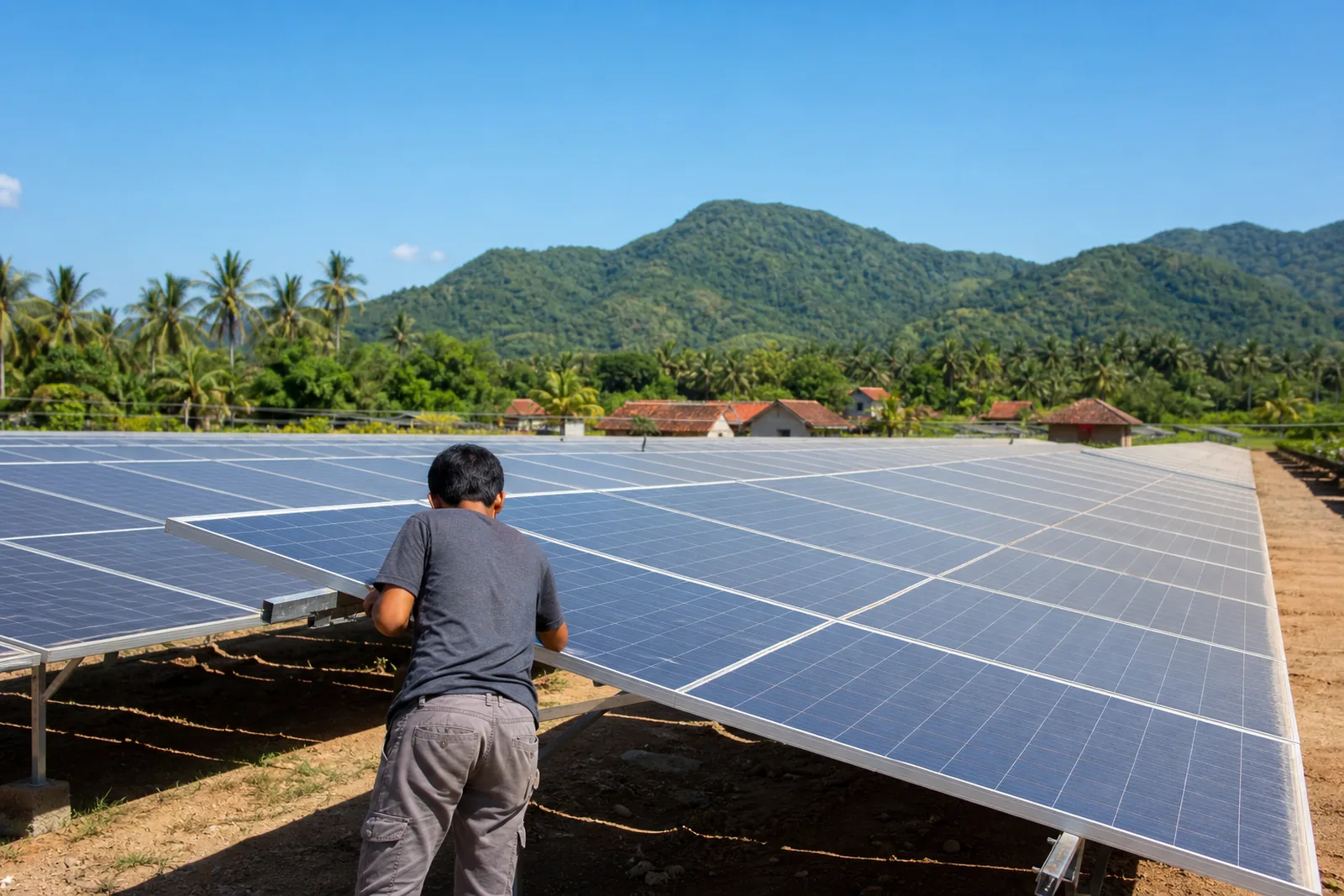
Prabowo Orders PLN to Retire Diesel Power as Solar Ambitions Rise
Indonesia’s president has ordered PLN to replace 13 GW of diesel power with non-fossil energy, framing solar expansion as an economic-security priority.
Indonesia’s clean-energy agenda has acquired a sharper economic and strategic edge. President Prabowo Subianto has ordered state utility PT PLN to shut diesel-fired power plants with 13 gigawatts (GW) of capacity and replace them with non-fossil energy.
The instruction, announced at the inauguration of the National Electric Motorcycle initiative in Bekasi, West Java, places reduced fuel-import dependence at the centre of Indonesia’s energy policy. For investors, the significance lies less in one announcement than in the direction of travel: energy security, electrification and domestic renewable capacity are being presented as mutually reinforcing priorities.
A directive aimed at imported-fuel dependence
Prabowo framed the planned retirement of diesel generation as part of a wider push for energy self-sufficiency. Indonesia currently spends about US$28 billion to US$30 billion annually on fuel imports, he said, a cost that he argued leaves the country exposed to conditions beyond its control.
Key policy signal: PLN has been ordered to replace diesel-fired capacity totalling 13 GW with non-fossil energy.
The President’s argument is principally one of resilience. Imported fuel can expose domestic prices and planning to global oil-market shocks, including those associated with trade disputes and regional conflicts. His message was that a country with substantial domestic resources should be less reliant on overseas energy supplies.
That framing matters because it links the clean-energy transition to a concern with broad political and economic appeal: reducing vulnerability. Renewable deployment is not being described solely as an environmental objective, but as an instrument for lowering exposure to imported fuel and strengthening Indonesia’s economic position.
For foreign investors assessing Indonesia, this distinction is useful. Policy programmes tend to gain greater durability when they serve several objectives at once. In this case, the stated objectives are non-fossil generation, reduced imports and greater energy independence.
Solar becomes the headline technology
Prabowo identified solar power as one of Indonesia’s cleaner alternatives to fossil fuels and pointed to the country’s broader clean-energy potential. He also referred to discoveries by Indonesian scientists and researchers, as well as the potential for natural hydrogen reserves.
The most concrete part of the announcement is the scale of the solar ambition. The President set a target to install 100 GW of solar power capacity over the next four years. He added that the target for this year alone is 30 GW.
The President said Indonesia is targeting 100 GW of solar capacity over four years, including 30 GW this year.
These are targets, not completed installations, and investors should treat them accordingly. A target signals political intent and can shape priorities for utilities, suppliers, developers and capital providers; it does not by itself establish delivery timelines, project economics or the pace at which diesel capacity will be retired.
Still, the announcement places solar at the forefront of the administration’s stated energy strategy. It also aligns electricity policy with the National Electric Motorcycle initiative, where the remarks were delivered. The shared theme is a shift away from imported fuel towards domestically sourced electricity and alternative energy.
The economic logic: insulation from external shocks
Prabowo’s central case was direct: dependence on imported energy leaves Indonesia affected by events in which it may have no direct involvement. In an era when trade friction and regional conflict can influence oil prices, that exposure can carry a material economic cost.
The annual fuel-import bill cited by the President, US$28 billion to US$30 billion, gives this argument a fiscal and balance-of-payments dimension. Replacing some fossil-fuel dependence with domestic non-fossil generation could, in the government’s stated view, reduce the country’s sensitivity to overseas supply and price movements.
This is not a claim that the announced measures will immediately remove that exposure. Nor did the announcement provide a timetable for the shutdown of individual plants, details of replacement technologies beyond the broader non-fossil and solar direction, or financing arrangements. Those implementation questions will determine the practical impact.
But the policy rationale is clear. Energy independence is being positioned as a means of strengthening Indonesia’s economic footing, rather than merely an aspirational slogan attached to the energy transition.
Execution will determine the investment case
The scale of the stated ambitions makes execution the crucial question. Retiring 13 GW of diesel-fired capacity while pursuing 100 GW of solar capacity will require operational decisions by PLN and a credible path from stated policy to installed infrastructure.
Investors should therefore distinguish between the announcement’s strategic importance and its commercial specifics. The former is already evident: diesel generation is being singled out for replacement, while non-fossil power, particularly solar, has been assigned an expansive role. The latter remains to be tested through implementation.
Several questions will be central as further information emerges:
- How and when PLN will sequence the retirement of diesel-fired plants;
- What mix of non-fossil generation will replace them;
- How the solar targets will be translated into projects and operating capacity;
- What mechanisms will support delivery of the administration’s energy-self-sufficiency objective.
The source announcement does not answer these questions, so prudent investors should avoid assuming outcomes beyond the commitments stated by the President. Yet the policy signal is meaningful precisely because it is explicit about both the capacity targeted for replacement and the intended renewable direction.
What this means for investors
For investors following Indonesia, the immediate takeaway is a stronger official commitment to reducing reliance on imported fuel. The government is tying that commitment to a diesel phase-out order for PLN, a national solar target and a broader case for energy security.
The opportunity, if policy translates into execution, will sit across the ecosystem required for a cleaner and more self-reliant electricity system. The risk is equally familiar: ambitious capacity targets need to be matched by delivery. At this stage, the President’s announcement should be read as a high-level strategic directive rather than a complete investment blueprint.
What is already clear is the narrative shaping the administration’s approach. Indonesia’s clean-energy transition is being presented as a response to external vulnerability, import costs and the country’s own resource potential. That makes energy policy an increasingly important lens through which to view the country’s economic direction.
Stay informed, subscribe to the free Lombok Briefing for analysis like this, published twice a month.
What did President Prabowo order PLN to do?
President Prabowo Subianto ordered state utility PT PLN to shut diesel-fired power plants with 13 GW of capacity and replace them with non-fossil energy. The announcement presented the move as part of Indonesia’s pursuit of greater energy self-sufficiency.
What solar target did Indonesia’s President announce?
President Prabowo said Indonesia is targeting 100 GW of solar power capacity over the next four years. He also said the target for this year alone is 30 GW. These are stated policy targets rather than completed capacity.
Why is Indonesia seeking to reduce fuel imports?
Prabowo said Indonesia spends about US$28 billion to US$30 billion annually on fuel imports and remains exposed to global oil-price shocks linked to trade disputes and regional conflicts. He argued that greater domestic energy capacity would strengthen economic resilience.

The Lombok Buyer's Field Guide
Legal structures ranked by risk, the honest ROI math line by line, all six zones ranked, and the 24-point due-diligence checklist. The whole book, free in your inbox.
See what's inside