
Lombok Notebook: What Normal Bali–NTT Flights Say After the Quake
Normal Bali–NTT flights after the Nagekeo earthquake offer a measured reminder of how operational continuity shapes regional travel confidence.
Quick answer: Bali’s I Gusti Ngurah Rai International Airport reported normal operations and no cancellations on its East Nusa Tenggara routes after the magnitude 7.7 Nagekeo earthquake. For Lombok investors, the immediate lesson is not a market forecast, but the value of distinguishing a serious regional event from the continued functioning of the travel links on which island tourism depends.
Natural disasters test more than buildings and emergency systems. They also test information: whether travellers, operators and investors can establish what has actually changed, what has not, and how quickly. In this instance, Antara Business reported a clear operational fact from Bali’s principal airport: flights and airport services continued normally through at least noon on Saturday.
The Context
The earthquake struck East Nusa Tenggara (NTT) at 5:58 a.m. Central Indonesia Time, according to Antara Business. Its initial magnitude was reported as 7.0 and later revised to 7.7. The epicentre was 30 kilometres northeast of Nagekeo District and about 685 kilometres from Bali’s Kuta area, where I Gusti Ngurah Rai International Airport is located.
Those distances matter because headlines can compress geography. NTT, Bali and Lombok are connected in travellers’ mental maps, airline networks and holiday itineraries, but they are distinct places with different operating conditions. A report of a powerful earthquake in one province should therefore prompt a precise question for any investor exposed to regional tourism: what is the confirmed effect on the specific transport or hospitality asset under consideration?
In this case, Gede Eka Sandi Asmadi, an airport spokesman, said that flight operations and airport services at I Gusti Ngurah Rai Airport were “running normally and optimally”. He added that normal operations had continued from the time of the earthquake through at least noon WITA.
“There have been no flight cancellations,” Asmadi said, according to Antara Business.
The point is modest but important. An airport remaining open does not erase the human consequences of an earthquake in the affected area; Antara Business reported the airport management’s condolences and concern for residents of Nagekeo and surrounding areas. Nor does it establish that every part of the wider tourism economy is untouched. It does, however, separate an observed operational outcome from the wider anxiety that can accompany regional news.
For an investor, this distinction is part of basic risk literacy. The relevant evidence is often more granular than the headline:
- whether airport services are operating;
- whether flights are being cancelled;
- which routes are affected;
- whether the destination itself is accessible; and
- whether a claim concerns an immediate disruption or a longer-term commercial implication.
This is especially useful in a market where travel access is a practical foundation of demand. South Lombok’s foreign-arrivals trend is recorded in HubLombok’s verified market facts as +40-50% year on year, attributed to tourism recovery and the MotoGP effect. That is a market context, not evidence that a particular event will change arrivals. The two should not be conflated.
Operational Continuity Is the Story
Antara Business identified two regular NTT routes from Bali’s airport: Labuan Bajo and Tambolaka. The source named AirAsia, Garuda Indonesia, Citilink, Batik Air, Lion Air, Super Air Jet and Wings Air among the airlines serving those routes.
The reported flight pattern gives some texture to the airport’s ordinary role in the regional network. Labuan Bajo averages nine daily departures and eight arrivals, while Tambolaka has three departures and two arrivals each day. These are not Lombok routes, and they should not be presented as a measure of Lombok’s own connectivity. They are, instead, evidence of the scheduled links that Bali’s airport maintained while the earthquake news was unfolding.
| Route from Bali | Reported regular schedule | |---|---| | Labuan Bajo | Nine daily departures; eight arrivals | | Tambolaka | Three daily departures; two arrivals |
Airport continuity is sometimes treated as a technical footnote. In an island tourism economy, it is better understood as a live operating variable. A destination’s investment case may rest on the appeal of its coastline, the quality of its accommodation and the credibility of its legal structures, but the guest experience begins with the ability to reach the region and move through it predictably.
That does not mean that a functioning airport warrants sweeping conclusions. Investors should resist the temptation to turn one day’s operational update into a statement about every property, every booking or every island. The source supports a narrower conclusion: Bali’s I Gusti Ngurah Rai Airport said its services and Bali–NTT flights were operating normally after the earthquake, and no flight cancellations had occurred.
The more durable lesson concerns how to read disruption. First-party operational statements deserve attention, particularly when they identify the location, the timeframe and the activity in question. At the same time, they should sit alongside verified local information about the asset, its access routes and its management arrangements.
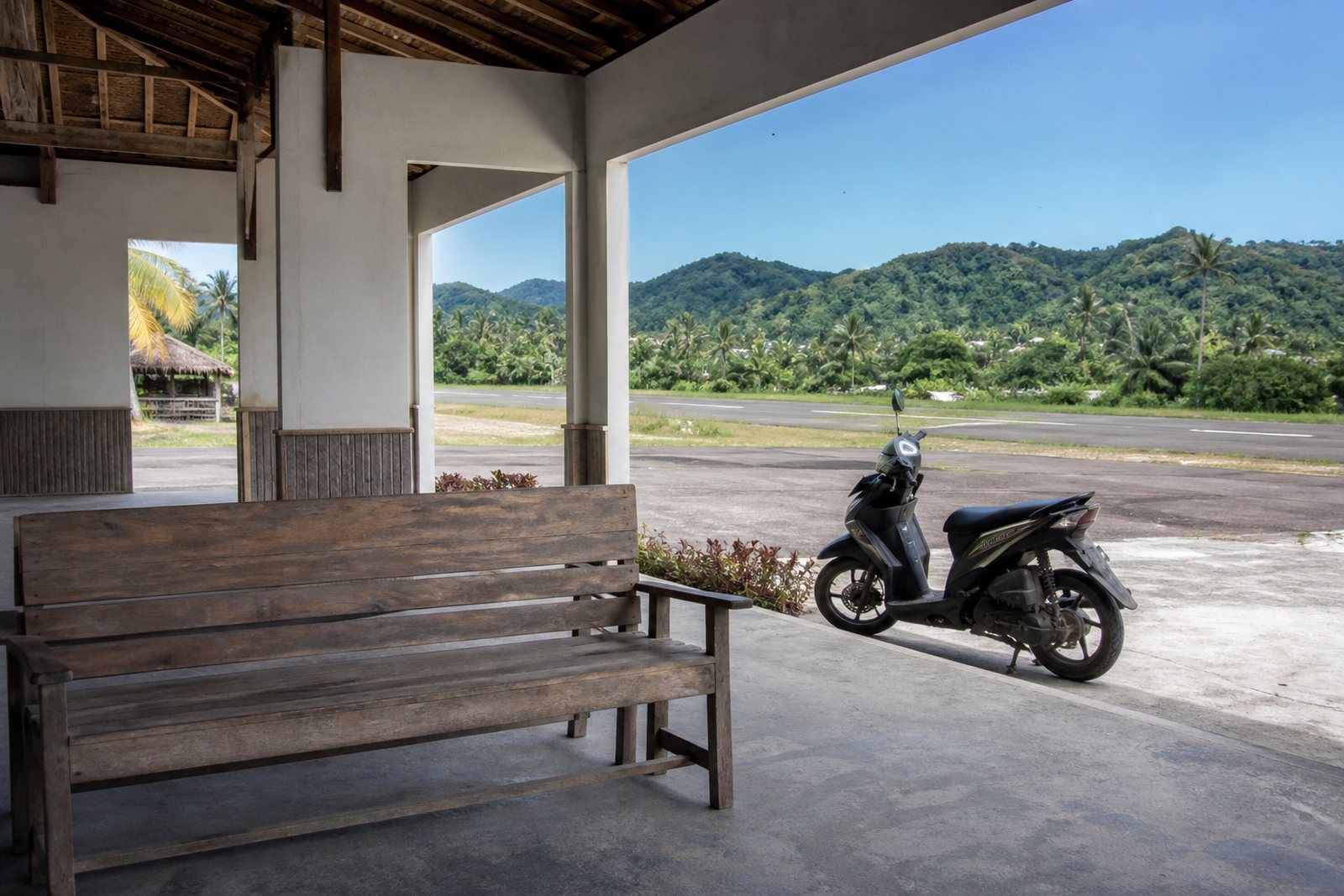 Lombok Notebook · Illustration: HubLombok (AI-generated)
The Wider Lombok Lens
For Lombok, the investor question is not whether an event elsewhere should be ignored. It is whether the available facts support a conclusion about Lombok. Often, they do not. That discipline is valuable because property narratives can become overly broad at precisely the moment when clarity matters most.
The established South Lombok case remains a separate one. HubLombok’s verified facts place turnkey investment-grade villa entry prices at EUR 95,000-350,000, compared with USD 400,000-800,000 for a comparable specification in Bali. Prime tourist-zone land in South Lombok is quoted locally per are, with the overall market spread at about Rp 30-400 million per are. An are equals 100 m².
The differences between zones are similarly material. Kuta is identified as the demand and liquidity leader, with land at Rp 300-400 million per are. Are Guling is described as an early-cycle frontier, at Rp 120-180 million per are. Mawun and Bumbang sit at lower quoted ranges, while Selong Belanak and Mandalika occupy their own positions within the market. These are location-specific observations, not interchangeable labels for “Lombok”.
That specificity should extend to income assumptions. Developer-quoted gross yields are listed at 12-22%, while honest net rental yields after management fees and realistic occupancy are 7-12%; top-performing assets can reach about 15% net. Management fees are 18-22% of gross rental revenue, and OTA or booking commissions are 15-20%. Investors evaluating a hospitality asset should ask which of those terms is being quoted, rather than treating “yield” as a single universal number.
The same applies to occupancy. Realistic stabilised occupancy for the first one to three years is 55-70% in South Lombok, while Bali is listed at 70-85%. These figures are a reminder that the familiar Bali benchmark is not automatically portable to a younger market. Lombok’s investment proposition may include earlier-cycle pricing and the “Bali-overflow” thesis, but it also requires sober underwriting.
Legal structure is another area in which precision is preferable to shorthand. Foreigners cannot hold freehold, known as Hak Milik or SHM; it is reserved for citizens. Available routes include leasehold, Hak Pakai for eligible residents, and a PT PMA holding Hak Guna Bangunan. Nominee arrangements, in which an Indonesian holds freehold on a foreign buyer’s behalf, are illegal and void in court.
A transaction should therefore be treated as a chain rather than a signature. Buyer transfer duty, BPHTB, is about 5% of assessed value. Deeds are executed by a licensed PPAT notary; the deed of sale is the AJB, and the land agency is BPN. HubLombok’s legal and notary advisory partner, TerraNusa Advisory, provides due diligence on certificates, ownership history, zoning and encumbrances, alongside PT PMA setup, tax matters and title-transfer support. As with transport updates, the practical value lies in checking the particular asset rather than relying on a broad reassurance.
What This Means for Investors
The Bali–NTT flight update is best read as an exercise in disciplined interpretation. It confirms that, after the Nagekeo earthquake, Bali’s airport reported normal operations and no cancellations on the relevant routes. It does not establish a new tourism trend, a property-market outcome or a risk-free operating environment for Lombok.
For investors considering South Lombok exposure, a sensible response is to keep the layers separate:
- humanitarian impact and local conditions in the affected area;
- confirmed transport operations on named routes;
- the independent market fundamentals of the Lombok location under review; and
- the legal, construction, insurance and management due diligence required for a specific acquisition.
That approach is less dramatic than reacting to a regional headline, but it is more useful. The strongest investment decisions usually come from treating resilience as something to verify in components: access, documentation, operating costs, occupancy assumptions and the quality of the counterparty.
Lombok’s appeal is not strengthened by pretending that regional events do not matter. It is strengthened when investors can assess them with proportion, acknowledging the gravity of an event, following verified operational information, and refusing to turn a single data point into an unsupported market narrative.
Stay informed, subscribe to the free Lombok Briefing for market intelligence like this, published twice a month.
Were Bali–NTT flights cancelled after the Nagekeo earthquake?
No. Antara Business reported that Bali’s I Gusti Ngurah Rai International Airport said flight operations and airport services were running normally after the magnitude 7.7 earthquake, with no flight cancellations on the relevant NTT routes through at least noon WITA.
Does normal Bali airport service prove Lombok tourism was unaffected?
No. The airport statement confirms normal operations at Bali’s I Gusti Ngurah Rai Airport and continued Bali–NTT flights. It does not establish conditions across Lombok or every tourism business, which should be assessed using location-specific operational information.
What should Lombok property investors check after regional disruption news?
Investors should separate confirmed transport operations from wider market claims, then review the particular asset’s access, legal structure, costs, occupancy assumptions and management arrangements. Foreigners cannot hold Indonesian freehold, and nominee structures are illegal and void in court.

The Lombok Buyer's Field Guide
Legal structures ranked by risk, the honest ROI math line by line, all six zones ranked, and the 24-point due-diligence checklist. The whole book, free in your inbox.
See what's inside