
Lombok Notebook: NTB’s Solar Ambition Enters the Investor Conversation
NTB has used the Indonesia Solar Summit to signal support for renewable energy and regional collaboration. For investors, the next question is execution.
Quick answer: NTB’s government has used the Indonesia Solar Summit 2026 to restate its support for renewable energy, solar-energy provision and regional cooperation with Bali and NTT. For Lombok investors, the announcement is a policy signal rather than an investable result: its significance will depend on how those commitments are translated into credible projects and processes.
The most useful investment signals are often quieter than a launch, a transaction or a new development. They emerge when public institutions describe the direction in which they want capital, infrastructure and administrative attention to move.
That was the importance of NTB’s presence at Indonesia Solar Summit 2026. The official account of DPMPTSP Provinsi NTB presented the occasion as a statement of intent: a province seeking to widen the space for green investment while placing solar energy within a broader regional conversation.
The Context
According to Official Instagram · DPMPTSP Provinsi NTB, the head of the provincial investment and one-stop integrated services agency, H. Irnadi Kusuma, accompanied NTB Governor Lalu Muhamad Iqbal at Indonesia Solar Summit 2026 in Sanur, Bali. The Governor participated as a principal panellist in a discussion on national energy sovereignty through accelerated regional energy independence, alongside the Governors of Bali and NTT.
The wording matters. The post did not announce a completed solar project, a financing programme, a timetable or a capacity target. Instead, it set out three commitments attributed to the NTB provincial government:
- full support for the renewable-energy transition;
- an ambition for NTB to become not only a solar-energy user but a capable provider; and
- continued reinforcement of regional cooperation between Bali, NTB and NTT through KR BNN.
“NTB is targeted not only to become a user, but also a resilient provider of solar energy,” the provincial agency said in its post.
For an investor, this is best read as a directional policy message. It places renewable energy within the province’s investment narrative, and it links the subject to a regional framework rather than treating Lombok as an isolated market.
The distinction is important. Policy ambition can shape priorities, conversations and the willingness of agencies to engage with prospective capital. Yet ambition is not, by itself, a project pipeline, a procurement framework, a grid study, a guarantee or a return profile. Treating it as any of those would add certainty that the official post does not provide.
From Aspiration to an Investment Proposition
The DPMPTSP account describes the agency’s presence as evidence of readiness to oversee and open broad opportunities for green investment in NTB. That is a meaningful institutional signal, particularly because investment in energy is rarely determined by resource potential alone.
Solar projects, whether large or small, sit at the intersection of land, permissions, counterparties, technical connection, operating arrangements and long-term demand. A public commitment to green investment may help establish a more receptive backdrop for these conversations. It does not remove the need to test each element individually.
The practical question is therefore not whether solar is an attractive theme in the abstract. It is whether a particular opportunity has the ingredients to become durable.
| Investor question | What the official post establishes | What still requires diligence | |---|---|---| | Provincial direction | NTB supports renewable energy and green investment | How that support applies to a specific proposal | | Solar ambition | NTB aims to be a solar-energy provider as well as a user | Project structure, delivery route and commercial terms | | Regional cooperation | NTB intends to strengthen cooperation with Bali and NTT | The operational effect of that cooperation on a project |
This is where patient capital earns its advantage. It separates an encouraging policy backdrop from contractual certainty. It asks who is responsible for implementation, what permissions are required, how revenues would be earned, where the operational risks sit and what remedies exist if a project does not proceed as expected.
For property owners, hospitality operators and businesses with an interest in Lombok, the policy message may still be relevant without presenting a direct investment opportunity. Energy reliability, energy cost and sustainability expectations can all affect an operating environment. But the source offers no project-specific claims about any of these outcomes. The sensible conclusion is simply that energy has moved higher in the province’s public investment conversation.
A Regional Frame, Not a Standalone Promise
The reference to KR BNN is arguably the most revealing element of the announcement. By connecting Bali, NTB and NTT, the provincial government frames future energy needs as a regional issue.
This approach has strategic logic. Investors frequently assess a location not only through its own institutions, but through the networks in which it participates. Regional cooperation can create a forum for shared priorities and potentially for more coordinated discussion around infrastructure and investment. The source says NTB will continue to strengthen its steps through this cooperation in response to future energy-demand challenges.
That still leaves substantial questions unanswered, as it should at this stage. The post does not specify which initiatives are under consideration, how cooperation will be governed, which parties may participate or whether any private investment process has begun. It provides no basis for assuming a particular project, commercial benefit or timetable.
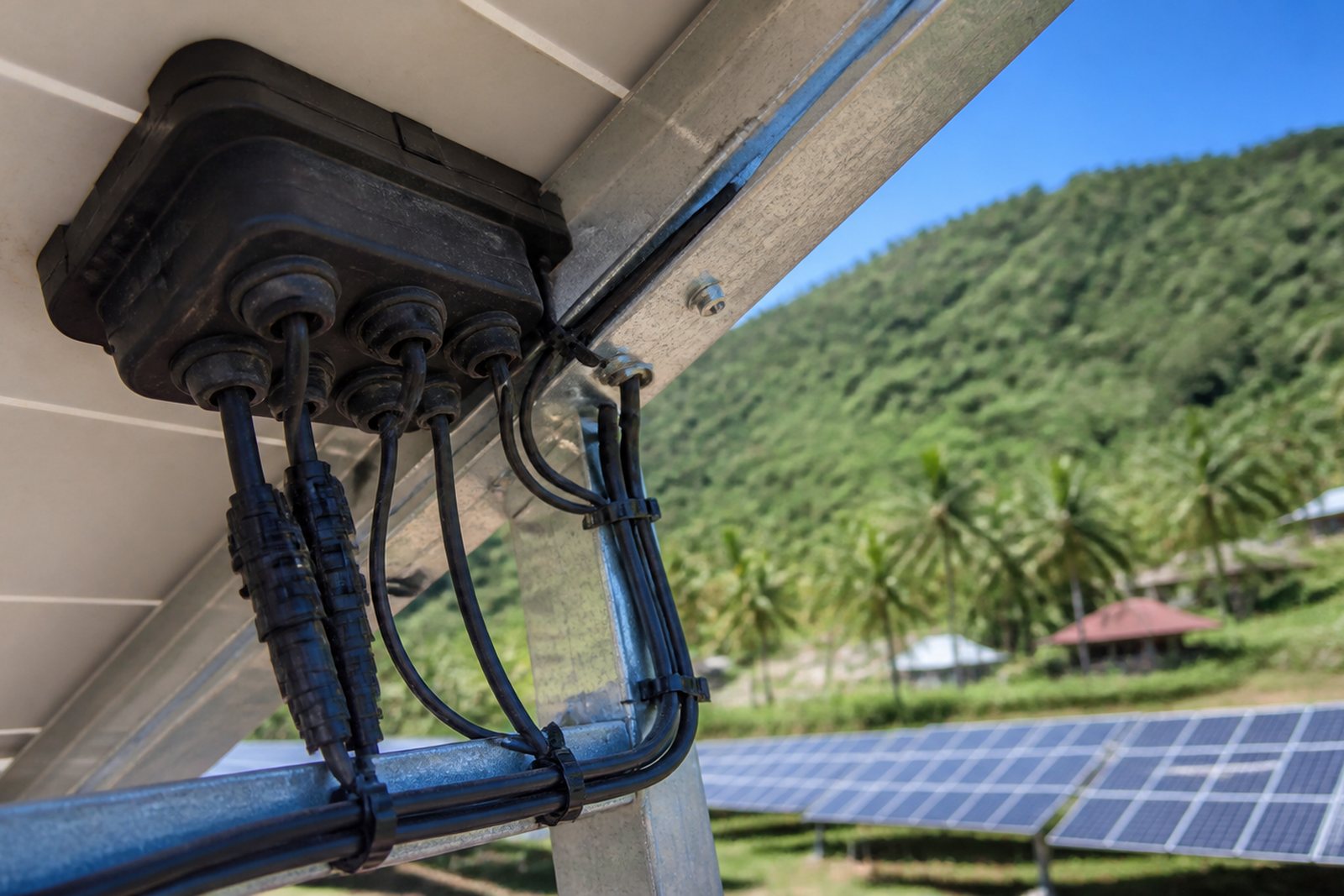 Lombok Notebook · Illustration: HubLombok (AI-generated)
Investors should resist two opposite errors. The first is to dismiss a policy signal because it is not yet a transaction. The second is to treat it as a transaction because the theme is compelling. A measured reading is more useful: NTB is publicly associating itself with renewable energy, solar provision and a wider Bali–NTB–NTT framework; the investable consequences remain to be demonstrated through implementation.
There is also an institutional dimension. DPMPTSP’s role in the post is not merely ceremonial. The agency presents itself as ready to guard the process and create room for green investment. For prospective investors, that makes the agency a relevant part of the local landscape. It does not substitute for independent legal, technical, financial and commercial review.
The quality of that review matters especially in infrastructure-adjacent themes. An attractive narrative can conceal unresolved dependencies; a modest announcement can precede serious administrative preparation. Neither possibility should be assumed. Each should be tested against documents, approvals, counterparties and the terms available for the particular opportunity.
What This Means for Investors
For the moment, the strongest conclusion is modest but useful. NTB’s official participation in Indonesia Solar Summit 2026 signals that the province wants renewable energy and green investment to form part of its development agenda. The stated ambition to become a solar-energy provider gives that message a sharper focus, while KR BNN places it within a regional frame.
For investors considering Lombok or the wider NTB economy, that changes the questions worth asking. Energy should sit alongside the familiar considerations of location, regulation, operations and market demand. It is becoming a subject for due diligence, not an assumption to be left in the background.
A disciplined investor might seek clarity on:
- the relevant government pathway for a proposed green investment;
- the permissions, land position and counterparties attached to a specific project;
- the commercial structure rather than the policy language around it;
- the practical meaning of regional cooperation for the opportunity under review; and
- the evidence that an announced priority has progressed into an executable arrangement.
The official post is most valuable as a marker of attention. It shows provincial leadership using a national forum to articulate an energy agenda and DPMPTSP positioning itself as an institution open to green investment. That is worthy of notice, particularly for investors building a long-term understanding of Lombok’s economic setting.
But the premium on nuance remains. The opportunity is not yet defined by the announcement; it is defined by what follows it. In emerging investment narratives, the gap between intention and execution is not a footnote. It is the central question.
Stay informed, subscribe to the free Lombok Briefing for market intelligence like this, published twice a month.
What did NTB announce at Indonesia Solar Summit 2026?
According to DPMPTSP Provinsi NTB, the provincial government restated support for renewable energy, expressed an ambition to become a solar-energy provider as well as a user, and said it would strengthen regional cooperation with Bali and NTT through KR BNN.
Does the announcement create a solar investment opportunity in Lombok?
Not on the information supplied. The official post communicates policy commitments and openness to green investment, but it does not announce a specific project, timetable, financing arrangement, capacity target or commercial terms. Investors should assess individual opportunities through full diligence.
Why should Lombok investors watch NTB’s renewable-energy agenda?
The announcement suggests that energy and green investment are receiving public attention within NTB’s development agenda. That can be relevant to the operating environment, but the practical implications for any investor depend on future implementation, approvals, counterparties and project-specific terms.

The Lombok Buyer's Field Guide
Legal structures ranked by risk, the honest ROI math line by line, all six zones ranked, and the 24-point due-diligence checklist. The whole book, free in your inbox.
See what's inside