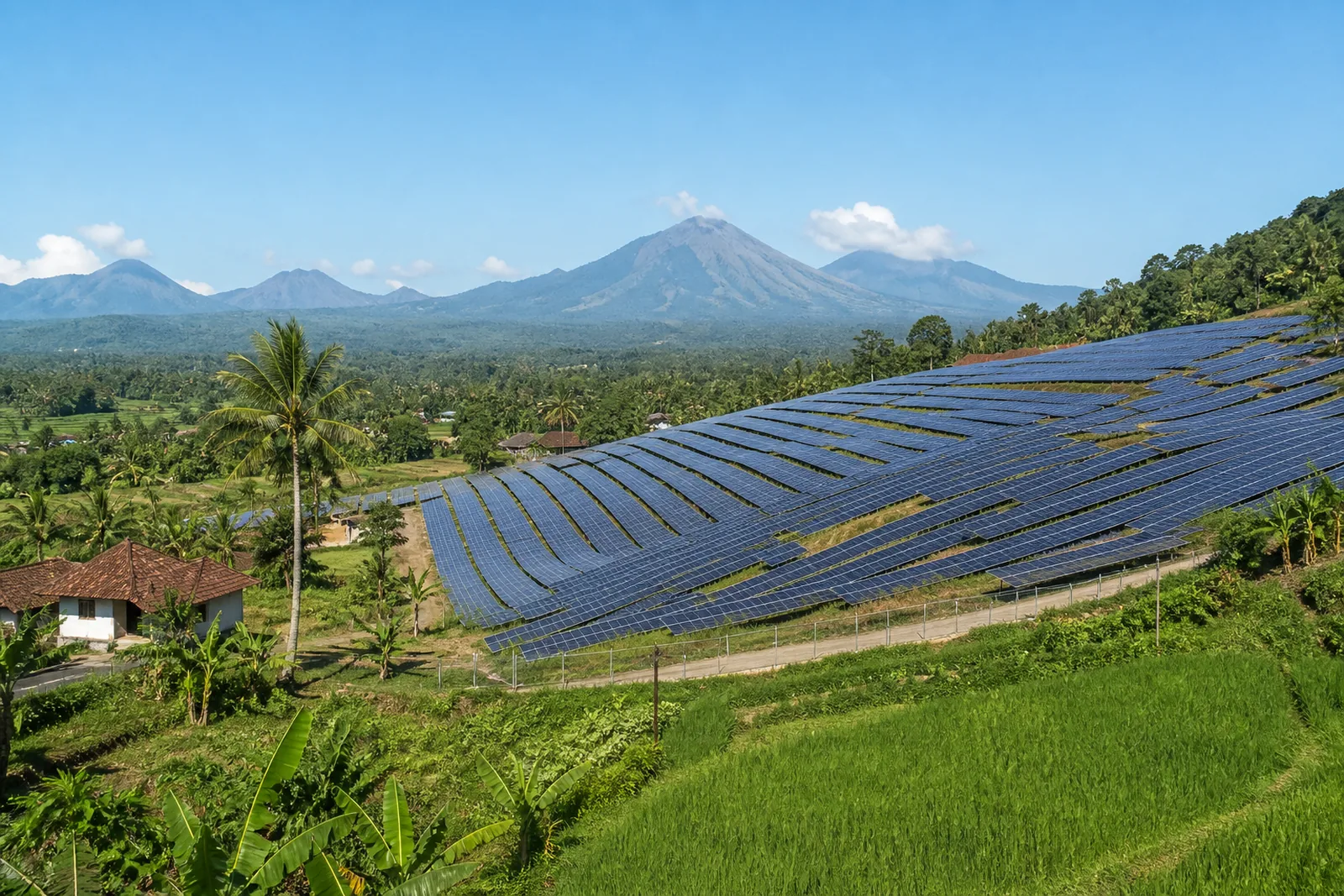
NTB’s Solar Ambition Is an Investment Signal, Not Yet an Investment Case
NTB has set out a solar-energy ambition. For investors, the value lies in tracking how that commitment becomes investable infrastructure.
Quick answer: NTB’s stated ambition to support renewable energy and become a capable solar-energy provider is a constructive long-term signal for Lombok investors. It does not yet establish a project pipeline, financial return or delivery timetable; its immediate relevance is that energy policy is becoming part of the region’s investment conversation.
The Context
On 14 July 2026, the West Nusa Tenggara provincial government used the Indonesia Solar Summit 2026 in Sanur, Bali, to set out an energy ambition with implications beyond the conference room. The Governor of NTB, Dr H. Lalu Muhamad Iqbal, appeared as a principal panellist in a discussion on accelerating regional energy self-reliance, alongside the governors of Bali and NTT. He was accompanied by H. Irnadi Kusuma, head of NTB’s investment and one-stop services agency, DPMPTSP Provinsi NTB.
The official DPMPTSP account described three connected commitments: support for the renewable-energy transition; an intention for NTB eventually to become not merely a solar-energy user but a capable provider; and closer regional co-operation through the Bali–NTB–NTT regional co-operation framework, known as KR BNN.
That wording matters. It is an expression of policy direction, not an announcement of a specific solar plant, grid upgrade, financing programme or investment approval. The distinction may sound fussy, but it is the distinction on which sound infrastructure investing rests. A stated ambition can shape priorities, attract conversations and inform the posture of public agencies. It cannot, by itself, demonstrate bankable demand, land readiness, connection capacity or an investable contractual structure.
For Lombok, this is nevertheless worth watching. Investors often analyse a destination through a narrow lens: visitor demand, property supply, transport access and construction costs. Energy is usually treated as a technical afterthought. Yet reliable, affordable and appropriately governed energy sits beneath almost every serious economic proposition, from hospitality and housing to small industry and digital services.
DPMPTSP Provinsi NTB says the provincial administration is seeking to open the widest possible space for green investment in West Nusa Tenggara.
The phrase should be read as an invitation to scrutiny rather than a reason for premature conviction. The relevant question is no longer simply whether NTB supports solar energy. It is how its support is translated into rules, projects, partnerships and operational capacity that investors can assess.
From Conference Commitment to Investable Reality
The Indonesia Solar Summit appearance places NTB in a wider regional discussion. Bali, NTB and NTT face related questions about future energy needs, economic development and the role of renewable generation. DPMPTSP’s reference to KR BNN suggests that NTB sees co-operation across the three regions as part of its answer.
For investors, regional language can have genuine value when it leads to co-ordinated planning. Energy systems do not sit neatly within tourism brochures or administrative boundaries. Generation, demand, equipment supply, regulation and investment capability all need to work together. A regional framework may help officials exchange priorities and create a shared vocabulary for the energy transition. But its practical significance should be judged by what follows, not by the label alone.
A useful way to separate signal from substance is to ask what sort of evidence emerges next.
| What the official post establishes | What investors would still need to verify | | --- | --- | | NTB supports renewable energy | Which projects, programmes or procurement routes are available | | NTB aims to become a solar-energy provider | How generation, buyers and grid arrangements would operate | | NTB wants green investment | The applicable approvals, counterparties and investment terms | | NTB values regional co-operation | Whether KR BNN produces practical, investable co-ordination |
This is not scepticism for its own sake. It is the normal discipline required when public ambition meets private capital. The early stages of an energy transition are inherently institutional: officials set intentions, agencies align, and potential investors test whether the operating environment can support long-lived assets. Lombok investors should resist the temptation to collapse those stages into a single conclusion.
The role of DPMPTSP is especially relevant in this regard. An investment agency accompanying provincial leadership at a national forum signals that the administration connects energy policy with investment readiness. That is meaningful because green investment is not only a matter of technology. It also depends on clarity of process, confidence in public counterparts and an ability to move from high-level commitments to credible opportunities.
Still, the official post does not specify the form that such opportunities might take. It does not identify sites, developers, customers, tariffs, offtake arrangements, permitting routes or schedules. None should be assumed. Nor does it say how future solar provision would be shared between public institutions, private businesses, communities or external investors.
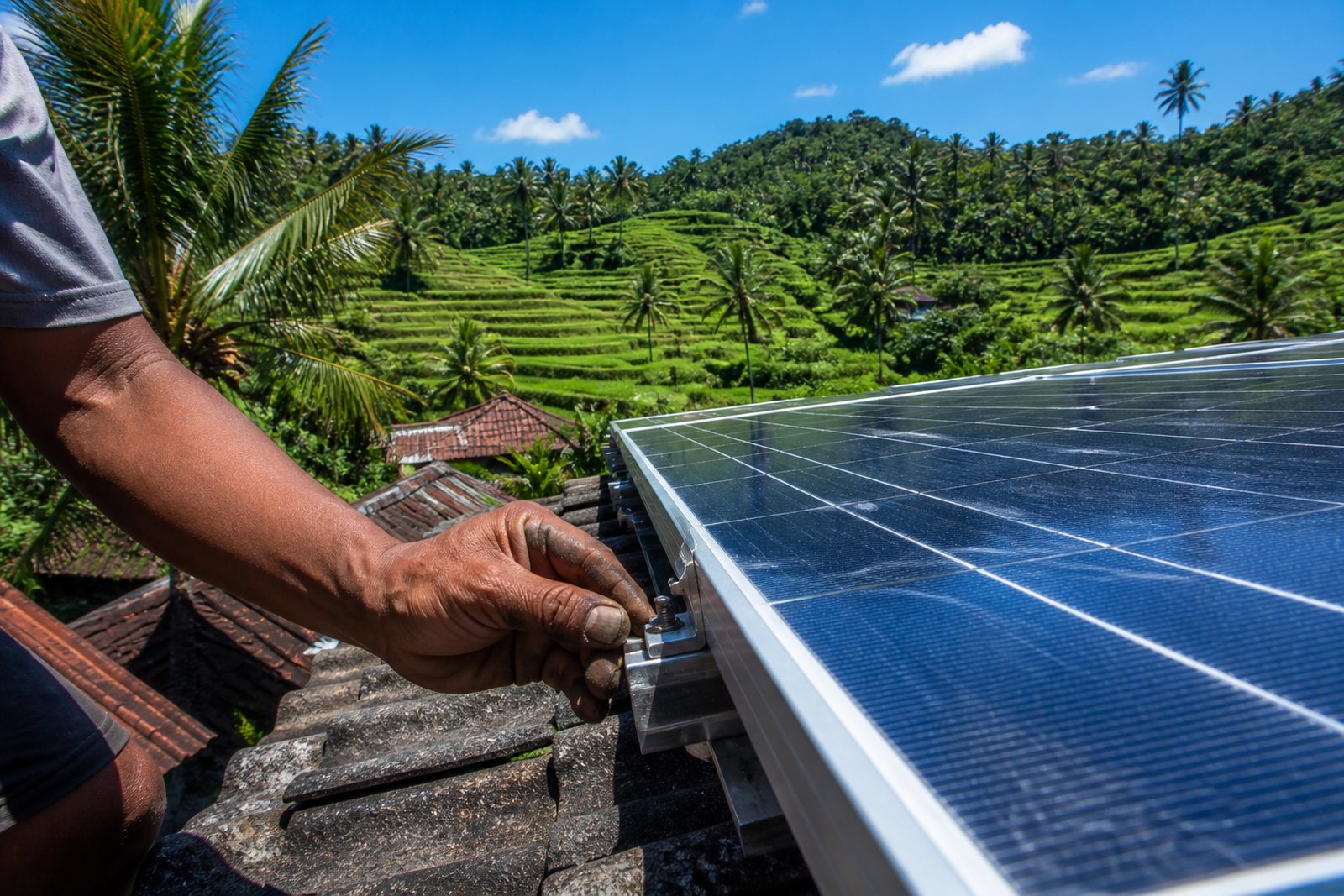 NTB’s Solar Ambition Is an Investment Signal, Not Yet an Investment Case · Illustration: HubLombok (AI-generated)
Why Energy Belongs in the Lombok Investment Notebook
The most useful interpretation of NTB’s solar message is strategic rather than promotional. It enlarges the set of questions that a patient investor should ask about Lombok and the wider province.
For a hospitality or real-estate investor, energy affects the quality of an operating environment. A well-run renewable transition could eventually influence resilience, cost management, development standards and the attractiveness of a destination to environmentally conscious guests and owners. But the word could is crucial. The official post establishes an aspiration, not an outcome. No investment model should treat a policy statement as a guaranteed improvement in utility costs, reliability or asset values.
For an infrastructure-minded investor, the message may be more direct: provincial leadership is publicly framing renewable energy as an economic-development issue. That can be an early marker of future opportunity. Yet infrastructure requires a different level of diligence from lifestyle property. The questions are granular and unglamorous: who is authorised to develop an asset, what approvals apply, how electricity is delivered, who bears construction and operating risk, and what legal remedies exist if a project changes course.
For investors assessing businesses that serve Lombok’s visitor economy, the implication is also indirect. A province positioning itself for a renewable-energy transition may influence how operators think about future facilities and supply chains. But individual businesses will remain exposed to their own commercial realities. A green narrative does not replace basic examination of demand, management quality, cash flow and contractual obligations.
There is a broader analytical point here. Energy policy is often evaluated through grand national rhetoric: sovereignty, transition and self-reliance. DPMPTSP’s account uses precisely that language, framing the summit discussion around national energy sovereignty through accelerated regional independence. The investment test, however, is local execution. Does the policy direction improve the capacity of institutions to support projects? Does it produce transparent decisions? Does it create an environment in which capital can enter, operate and exit with reasonable confidence?
Those questions are deliberately more demanding than asking whether solar energy is desirable. They are also more useful. A solar ambition can be strategically sensible while still being early, incomplete or difficult to implement. Mature investors can hold both ideas at once: welcome the direction, and reserve judgement on the economics.
What This Means for Investors
The immediate conclusion is measured. NTB’s official presence at the Indonesia Solar Summit 2026 gives investors a credible first-party indication that renewable energy and green investment are priorities of the provincial administration. It is not a basis for claiming that a particular opportunity exists, that returns will follow, or that delivery is assured.
For investors already looking at Lombok, this belongs on the watchlist rather than in the valuation model. Follow the policy trail for evidence that converts intent into specifics. Useful developments would include clear investment processes, defined project opportunities, transparent roles for public and private participants, and practical signs that the Bali–NTB–NTT co-operation framework is producing operational alignment. Until then, the appropriate stance is attentive but unsentimental.
A compact diligence agenda follows naturally:
- Treat DPMPTSP’s statements as official policy positioning, not as project documentation.
- Seek primary documents before relying on any claim about a solar development or green-investment programme.
- Separate provincial ambition from the commercial prospects of a particular asset or business.
- Test any future opportunity for legal, operational and contractual clarity.
- Watch whether regional co-operation produces specific, assessable actions rather than only shared language.
The best Lombok investment research has room for both optimism and restraint. NTB’s solar ambition is encouraging because it signals that the province is considering the energy foundations of future growth, and that its investment agency wants to participate in the green-investment conversation. The hard work now is to observe whether that ambition acquires the practical detail that long-term capital requires.
Stay informed, subscribe to the free Lombok Briefing for market intelligence like this, published twice a month.
What did NTB commit to at the Indonesia Solar Summit 2026?
According to DPMPTSP Provinsi NTB, the provincial government reaffirmed support for renewable energy, an ambition to become a capable solar-energy provider, and stronger co-operation with Bali and NTT through the KR BNN regional framework.
Does NTB’s solar statement create an investment opportunity now?
No specific opportunity is established by the official post. It contains no project, timetable, financial return, approval route or commercial terms. Investors should treat it as a policy signal and seek primary documentation before assessing any future proposition.
Why should Lombok investors monitor NTB’s energy policy?
Energy policy can shape the wider operating environment for infrastructure, businesses and property over time. NTB’s stated renewable-energy direction is relevant context, but it should not be treated as evidence of guaranteed lower costs, greater reliability or investment returns.

The Lombok Buyer's Field Guide
Legal structures ranked by risk, the honest ROI math line by line, all six zones ranked, and the 24-point due-diligence checklist. The whole book, free in your inbox.
See what's inside