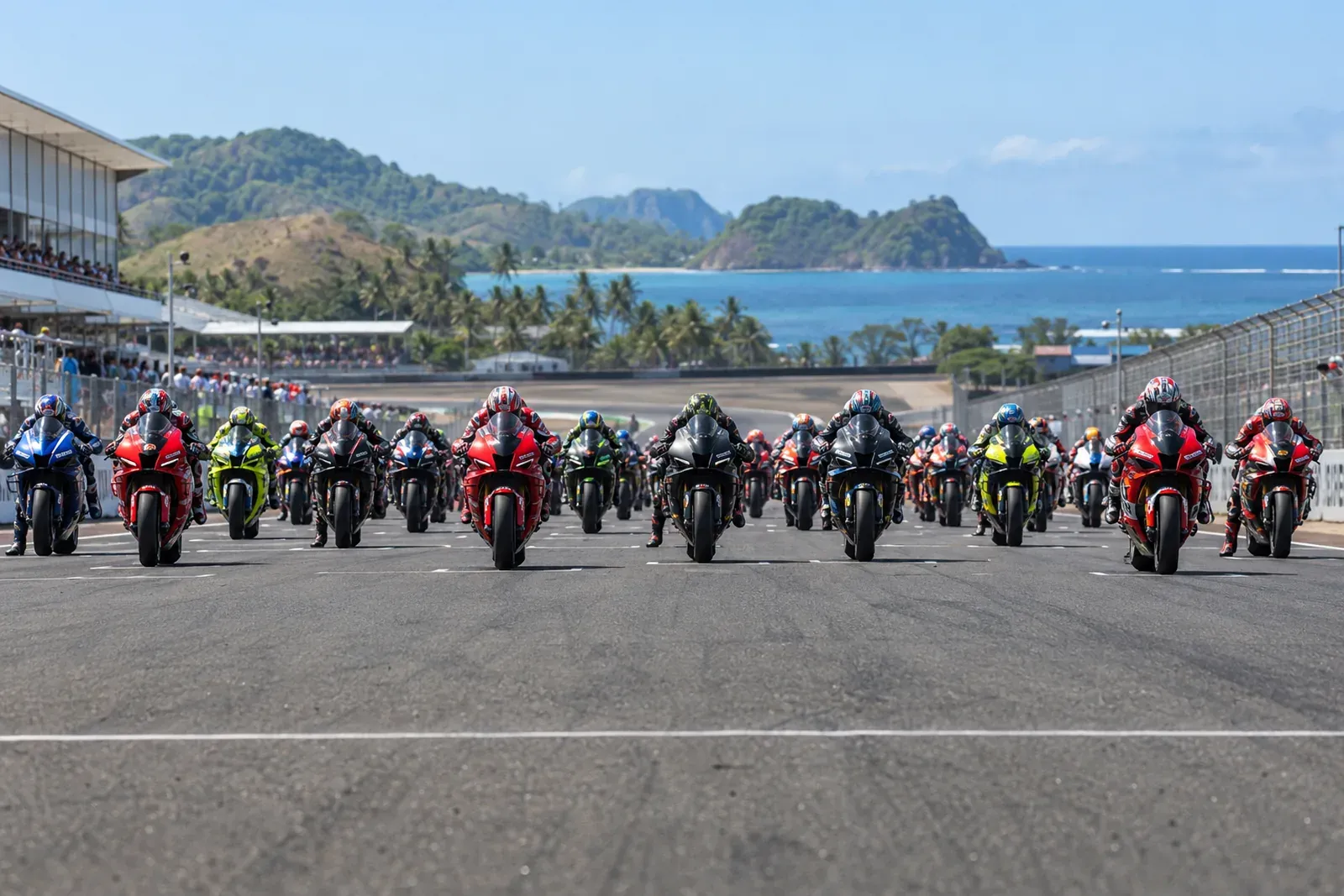
Mandalika’s MotoGP Market: What 114 Local Sellers Tell Investors
MotoGP brought a temporary sales surge to 114 local businesses at Mandalika. The figures show the event’s reach, and why a race weekend is not a year-round demand measure.
Quick answer: Antara reports that 114 local MSMEs sold food, handicrafts and other products at Mandalika during the 2026 MotoGP weekend, with vendors describing stronger sales than they typically earn outside the circuit. The figures point to a substantial event-day marketplace, but do not establish how much of the uplift reaches Lombok businesses year-round or becomes profit.
The race weekend offers a useful view of tourism as a place where local commerce can meet visiting crowds. Its more interesting lesson for investors is also its limit: a circuit filled with spectators is a concentrated setting, and the sales reported there should not be mistaken for a measure of ordinary demand across Lombok.
The Context
Antara Business reported that the Lombok Sumbawa Festival took place within the Mandalika International Street Circuit during the Pertamina Grand Prix of Indonesia, held from 9 to 11 October 2026. The NTB provincial government facilitated the participation of 114 local MSMEs. Food and beverage businesses accounted for more than 70 per cent of them, while handicrafts and other products gave visitors a wider selection of local goods.
The vendors’ accounts describe brisk trade. A food seller said she sold hundreds of meal packages daily during the first two days and that visitors had bought nearly everything she brought. Her reported daily revenue exceeded Rp2.5 million, more than she typically earned outside the venue. A handicraft seller said demand for pearl jewellery and kain tenun was strong among both domestic and international tourists.
These accounts are specific to the event. The report attributes the increase to strong spectator turnout and notes that stalls were positioned behind the spectator stands, where, according to a vendor, they received a steady flow of customers. The setting matters. A sales opportunity can depend on how many people pass a stall, what they can afford and how easily they can find the products. It is reasonable to infer that placement and foot traffic helped vendors reach buyers; the report does not quantify how much each factor contributed.
The provincial government also arranged product selection and hygiene training before the event. These are practical features of the marketplace: vendors were chosen to participate, and food businesses received preparation guidance. The report does not detail the selection criteria, training content or its effect on sales, so those steps should be understood as part of the event’s organisation rather than as proof of a lasting change in business capability.
The Circuit as a Marketplace
Mandalika’s circuit grounds provided a setting in which local sellers could offer goods directly to spectators. Food vendors sold rice boxes and cerorot, a traditional Lombok sweet made with rice flour, coconut milk and palm sugar, steamed in cone-shaped palm leaves. Handicraft vendors presented pearl bracelets, brooches, loose pearls and woven textiles. The mix brought everyday food and locally associated products into the same event marketplace.
Reported prices show a broad range of purchases. Three pieces of cerorot sold for Rp10,000, and meal boxes for Rp30,000. At the handicraft stall described by Antara, prices ranged from Rp100,000 to more than Rp500,000, depending on pearl grade and quality. Those are prices at participating stalls, not a survey of prices elsewhere in Lombok. Nor does the report say how many items of each kind were sold.
114 local MSMEs were facilitated to take part, with food and beverage sellers making up more than 70 per cent of the group.
That mix has an economic dimension beyond the final value of sales. Food and drink can serve immediate needs during an event; handicrafts and textiles offer products that visitors may associate with the place. This is an interpretation of the product mix described by Antara, rather than evidence that a particular purchase led to later orders, repeat visits or longer-term business growth.
The circuit’s role is worth distinguishing from the broader tourism proposition. A race weekend concentrates spectators in a defined venue, and the report records sales by businesses selected to trade there. That gives a clear account of activity at the event, but it cannot stand in for sales across Central Lombok, the province or the wider visitor economy. The report provides no comparison of vendors inside and outside the circuit beyond one food seller’s account of her usual revenue, and no total for sales by all participating businesses.
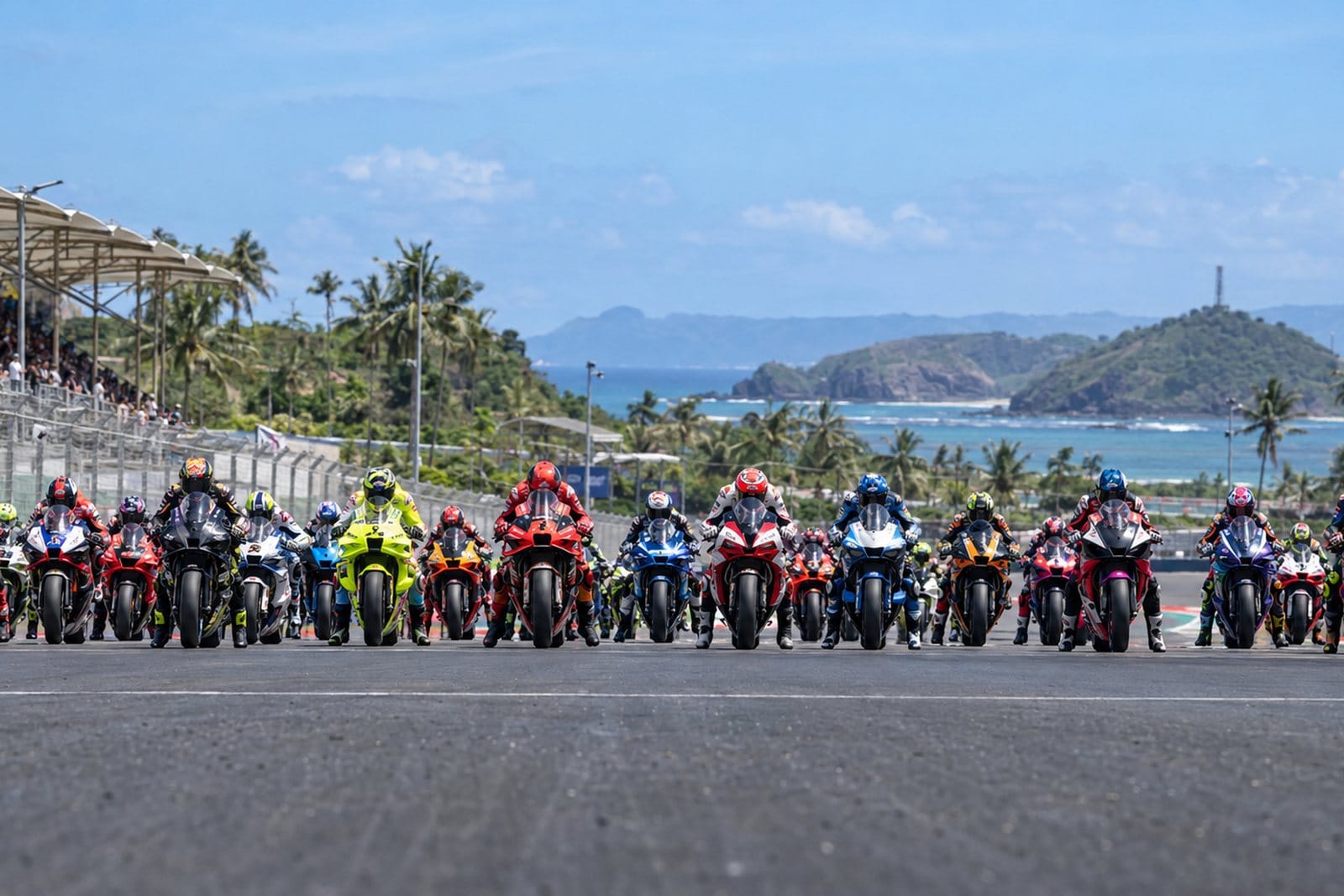 Mandalika’s MotoGP Market · Illustration: HubLombok (AI-generated)
What the Sales Figures Can and Cannot Say
Antara reports that the NTB Cooperatives and SMEs Office expected total sales generated by this year’s MSME activities to exceed the figures recorded in 2025, citing rising ticket sales as support for that expectation. This is an official’s forecast, not a final sales tally. The report does not provide the total for 2025, a total for 2026 or a like-for-like breakdown by vendor or product. The expectation therefore signals optimism about the event, but does not yet measure the outcome.
The individual accounts are informative but selective. One food seller reported daily revenue above Rp2.5 million, and a handicraft seller described stronger demand. Neither account gives costs, unsold stock, margins or the proportion of sales retained after expenses. Revenue is not profit. A stall can sell quickly and still face costs that determine whether the trading opportunity was financially worthwhile. The source does not provide enough information to calculate that result.
The report also does not say how the 114 businesses were distributed across the province, how many were first-time participants, or whether their sales continued after the race. These gaps are not flaws in an event report; they mark the boundary of what it can establish. The sales evidence concerns the festival marketplace at Mandalika during a particular race weekend, not the typical performance of a Lombok MSME.
For investors, the useful signal is therefore modest but relevant. The event created a venue for local businesses to reach a large spectator audience, and sellers reported strong demand for affordable food and local handicrafts. That is evidence of commercial activity around the event. It is not evidence, on its own, of sustained consumer demand, a rise in household incomes or a reliable spillover into other businesses. Those broader conclusions would require information the report does not supply.
What This Means for Investors
Mandalika’s MSME activity adds texture to the tourism story: an event can create a concentrated marketplace where local goods meet visiting spectators. For an investor assessing Lombok, it is a reminder to ask how visitor spending is organised and who can access it, as well as how many people attend. In this case, stalls inside the circuit and a selection process connected vendors with event traffic. The source does not show whether comparable access exists beyond the venue.
A careful reading separates three things: the event’s reported sales momentum, the administration’s expectation that aggregate sales would surpass 2025, and the unknowns around profit and persistence. The first is based on vendor testimony; the second remains a forecast; the third cannot be resolved from the report. Keeping those categories apart helps avoid treating a high-profile weekend as a proxy for Lombok’s everyday economy.
The strongest conclusion is also the most bounded: MotoGP gave 114 local MSMEs a platform at Mandalika, and participating vendors described a meaningful lift in sales during the race weekend. Whether that platform translates into durable growth for those businesses is a separate question, and the available account leaves it open.
Stay informed: subscribe to the free Lombok Briefing, published twice a month (the 1st and 15th), for market intelligence like this.
How many local businesses took part in Mandalika’s MotoGP marketplace?
The NTB provincial government facilitated participation by 114 local MSMEs at the Lombok Sumbawa Festival inside the Mandalika circuit. Food and beverage businesses made up more than 70 per cent of the participants, with handicraft sellers also represented.
Do the reported MotoGP sales show that local businesses made a profit?
No. Antara reports vendor accounts of sales and daily revenue, but does not provide costs, margins or unsold stock. The figures indicate activity at the event marketplace; they are not enough to calculate profit or judge whether the vendors’ businesses grew.
Can the MotoGP weekend predict year-round demand in Lombok?
The report documents sales during a concentrated race weekend, when vendors traded inside the circuit and benefited from spectator traffic. It does not track sales after the event or across Lombok, so the weekend alone cannot establish year-round demand.

The Lombok Buyer's Field Guide
Legal structures ranked by risk, the honest ROI math line by line, all six zones ranked, and the 24-point due-diligence checklist. The whole book, free in your inbox.
See what's inside