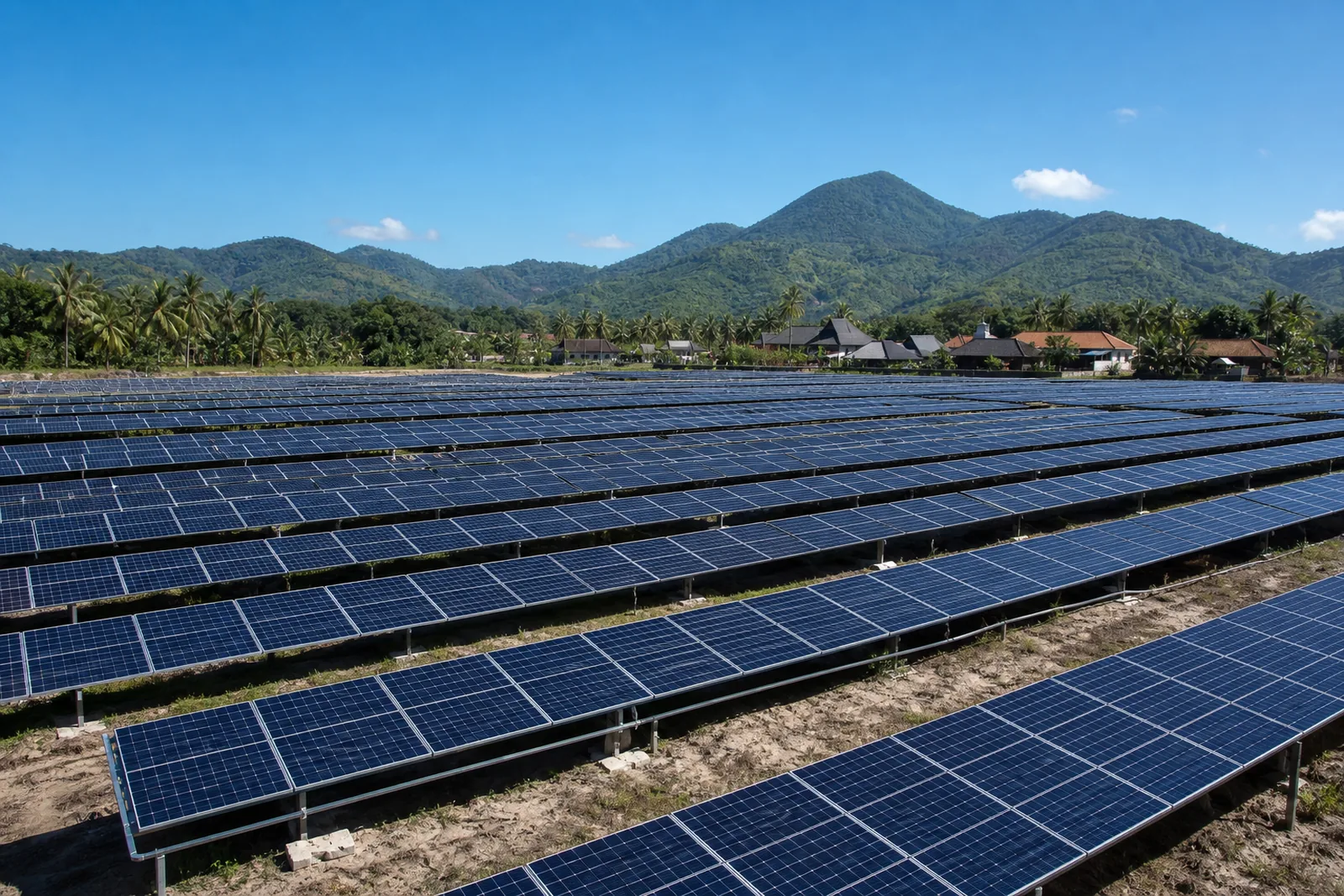
NTB Positions Solar Energy as a Green-Investment Priority
NTB has used the Indonesia Solar Summit to signal support for renewable energy and a broader opening for green investment.
Quick answer: NTB’s provincial government has signalled that renewable energy, particularly solar, is a strategic priority and that it wants to open wider space for green investment. For Lombok investors, the announcement is a policy signal rather than a project commitment: assess opportunities only when specific plans, approvals and commercial terms emerge.
NTB has taken its energy message to a national stage. In an official post, the province’s investment and one-stop services agency said its leadership used the Indonesia Solar Summit 2026 to underline support for renewable-energy transition, solar provision and regional cooperation with Bali and NTT.
The Context
The statement came from DPMPTSP Provinsi NTB, the provincial investment and integrated services agency. It said its head, H. Irnadi Kusuma, accompanied the Governor of NTB, Dr. H. Lalu Muhamad Iqbal, to the Indonesia Solar Summit 2026 at Hotel The Meru Sanur in Bali.
According to the agency, the Governor appeared as a principal panellist in a discussion on achieving national energy sovereignty by accelerating regional energy independence. The forum also involved the governors of Bali and NTT.
That setting matters. The post is not an announcement of a signed investment, an operating solar project or a defined procurement process. It is a first-party account of an official forum and of the provincial government’s stated direction. Investors should read it accordingly: as an indication of policy intent and administrative posture, not as a substitute for project documentation.
DPMPTSP described three connected commitments. First, it said NTB strongly supports the transition to renewable energy. Secondly, it said NTB is being targeted to develop beyond being an energy user and to become a resilient provider of solar energy. Thirdly, it said the province would strengthen its approach through the Bali, NTB and NTT Regional Cooperation framework, known as KR BNN.
DPMPTSP said its participation reflected readiness to support and open the widest possible room for green investment in NTB.
The language is consequential because investment policy is rarely expressed through one announcement alone. It is often formed through the alignment of political leadership, investment agencies, sector authorities and regional partners. This post signals that the province wishes to present that alignment publicly around renewable energy.
From Energy User to Solar Provider
The most commercially notable element is DPMPTSP’s description of NTB’s intended role. The agency said the province is targeted not merely to consume solar energy but to become a provider of it. That is an ambition with implications across the investment chain, though the post does not specify which technologies, sites, counterparties, ownership structures or timelines may be involved.
For now, the careful reading is straightforward. NTB is seeking to position solar energy as part of its investment proposition. It is also linking that proposition to a broader regional conversation rather than treating energy planning as a purely provincial matter.
This distinction is important for capital allocation. A policy declaration can create attention and encourage early dialogue, but it does not by itself establish revenue, rights to land, grid access, permitting status or an investable return profile. Those matters remain transaction-specific.
Investors considering an eventual renewable-energy opportunity in Lombok or the wider province should separate the layers of information:
- Policy intent: DPMPTSP says NTB supports renewable energy and aims to support green investment.
- Regional positioning: the province says it will work through the KR BNN cooperation framework with Bali and NTT.
- Project reality: a specific investment would still require its own verified scope, approvals, contractual arrangements and risk assessment.
The official post offers evidence for the first two layers. It does not provide the information needed to complete the third. That restraint is especially valuable in a market where broad sustainability language can be mistaken for an immediate commercial pipeline.
 NTB Positions Solar Energy as a Green-Investment Priority · Illustration: HubLombok (AI-generated)
Regional Cooperation Becomes Part of the Investment Narrative
DPMPTSP’s emphasis on KR BNN gives the announcement a wider frame. The agency said that, in responding to future energy needs, NTB would continue strengthening its steps through regional cooperation with Bali and NTT.
For investors, regional cooperation can be relevant because energy systems, infrastructure priorities and institutional relationships do not always stop at provincial boundaries. Yet the source does not set out the framework’s operating mechanism, any allocation of responsibilities, or any specific initiative arising from it. It would be premature to infer more.
What can be said is that NTB has chosen to place its renewable-energy ambitions alongside a regional cooperation narrative at a national forum. That choice suggests the province sees green investment not simply as a standalone environmental theme, but as part of a larger economic and energy-security conversation.
The participation of the provincial investment agency is equally worth noting. Its stated role was to accompany the regional leadership and to help safeguard readiness while opening space for green investment. For prospective investors, that makes DPMPTSP an institution to watch for future formal information, rather than evidence that an opportunity is already available.
A disciplined investor response is therefore neither to dismiss the announcement as rhetoric nor to price it as a completed development. The appropriate posture is to monitor for the next level of disclosure: named projects, official processes, relevant permissions and clear commercial terms.
What This Means for Investors
The immediate takeaway is strategic rather than transactional. NTB is publicly signalling support for renewable energy, solar provision and green investment. That may be relevant to investors whose Lombok thesis includes infrastructure resilience, sustainability-linked development or the long-term operating environment for assets in the province.
It is not, however, a basis for assuming that solar capacity will be available to a particular property, that costs will change, or that a specific investment will receive approval. None of those conclusions appears in the DPMPTSP post.
A sensible watchlist following this dispatch would include:
| Investor question | What the official post establishes | What remains to be verified | |---|---|---| | Is renewable energy a provincial priority? | DPMPTSP says NTB strongly supports the renewable-energy transition. | How this priority is expressed in specific projects or processes. | | Does NTB seek a larger solar role? | The agency says NTB is targeted to become a resilient solar-energy provider. | The delivery model, scope and commercial arrangements. | | Is there a regional dimension? | NTB says it will strengthen action through KR BNN with Bali and NTT. | The framework’s specific initiatives and investor relevance. |
For real-estate investors, the broader lesson is familiar: operating conditions increasingly form part of an asset’s long-term assessment. Energy policy can influence the context in which hospitality, residential and mixed-use assets operate, but an official ambition is not yet a project-level solution. Due diligence should remain grounded in the documents and conditions attached to the asset under consideration.
HubLombok is the editorial arm of Samudra Villas, an active developer in Are Guling, South Lombok. This dispatch is based on the official DPMPTSP Provinsi NTB post and does not treat its stated commitments as completed investment outcomes.
The clearest conclusion is that NTB is making a visible bid to be part of Indonesia’s renewable-energy investment conversation. The next signal investors need is not a louder commitment, but a more detailed one.
Stay informed, subscribe to the free Lombok Briefing for market intelligence like this, published twice a month.
What did NTB announce at the Indonesia Solar Summit?
According to DPMPTSP Provinsi NTB, the provincial government reaffirmed support for renewable-energy transition, said NTB is targeted to become a resilient solar-energy provider, and highlighted cooperation with Bali and NTT through the KR BNN framework.
Does this announcement create an investable solar project in Lombok?
No specific solar project, investment process, commercial terms, approvals or timeline is stated in the official post. The announcement is a policy and investment-positioning signal; investors should await formal project-level disclosures before making decisions.
Why should Lombok property investors follow NTB’s solar policy?
Energy policy can shape the longer-term operating context for property and hospitality assets. DPMPTSP’s statement signals provincial support for renewable energy, but it does not establish energy access, costs or project benefits for any individual asset.

The Lombok Buyer's Field Guide
Legal structures ranked by risk, the honest ROI math line by line, all six zones ranked, and the 24-point due-diligence checklist. The whole book, free in your inbox.
See what's inside