
Why NTB Is Looking to Its Diaspora as an Investment Connector
NTB’s investment agency sees the diaspora as more than a remittance source: potentially a bridge for capital, partnerships and market knowledge.
Quick answer: NTB’s investment agency is positioning the Indonesian diaspora as a potential source of investment, business partnerships and market connections across renewable energy, tourism, marine sectors and food security. For Lombok investors, the significance lies in policy direction: better diaspora-focused rules could widen the province’s investment channels, but material legal and administrative issues remain unresolved.
A regional discussion in Mataram offers a useful glimpse of how West Nusa Tenggara is thinking about capital: not simply as money arriving from outside Indonesia, but as a relationship carried through people with knowledge of both places. That is a long-term proposition, and one that depends less on rhetoric than on whether regulation can make participation practical.
The Context
On 9 July, the West Nusa Tenggara Investment and One-Stop Integrated Services Agency, known as DPMPTSP NTB, took part in a regional discussion forum on gathering input for regulations governing the Indonesian diaspora. The forum, held in Mataram, was organised by the Coordinating Ministry for Law, Human Rights, Immigration and Corrections.
DPMPTSP NTB was represented by its agency secretary, Dadang Fajar, with investment-management and licensing officials also accompanying the delegation. According to the agency’s official account, the purpose was to contribute to an inclusive legal framework for the diaspora.
The institutional setting matters. Discussions about diaspora policy can easily become abstract, framed around identity, overseas communities or remittances. DPMPTSP NTB’s intervention placed the subject within an investment agenda. Dadang Fajar described NTB as the nation’s fourth-largest contributor of Indonesian migrant workers, and argued that diaspora communities could serve not only as remittance contributors but also as investors, business partners and “investment connectors”.
That final phrase is the most economically revealing. An investment connector does not necessarily arrive with a completed transaction. The role can involve introducing partners, interpreting market expectations, linking a project to overseas networks or carrying institutional familiarity between jurisdictions. For a province seeking investment, these intermediary functions can be as consequential as the initial source of funds.
DPMPTSP NTB said it had offered investment opportunities in:
- renewable energy;
- tourism;
- marine sectors; and
- food security.
The post does not specify individual projects, capital requirements or timetables. It would therefore be premature to treat the discussion as an announcement of investable schemes. Its value lies instead in signalling the sectors that the agency is presenting to diaspora-linked investors and partners.
“The diaspora” is being approached by DPMPTSP NTB as a possible channel for investment relationships, not solely as a source of remittances.
For international observers of Lombok and the wider NTB economy, that distinction is worth retaining. Policy interest in diaspora capital is not the same as a new legal right, a guarantee of access or evidence that a particular investment route is already functioning. It is, however, an indication of where the provincial investment conversation is being directed.
From Overseas Community to Investment Infrastructure
The appeal of diaspora participation is straightforward in principle. People with personal, family or professional links to a place may have a deeper understanding of its social and commercial context than a wholly external investor. Equally, those living abroad may understand the expectations of overseas partners, lenders, customers or operators. A well-designed policy can seek to make that dual familiarity economically useful.
DPMPTSP NTB’s account presents this as a matter of ecosystem-building. The provincial government, it said, has prepared measures intended to support investment through Regional Regulation of NTB Number 6 of 2024, implementation of the “Karpet Merah” policy, and a plan to establish NTB Capital.
The official post does not explain the precise terms of those measures. Investors should consequently resist assigning them benefits that have not been set out publicly in the source. Still, their appearance together suggests an administrative ambition: to make the province more legible and accessible to prospective investors, including those connected to Indonesia through its diaspora.
This is especially relevant because the opportunity set described by DPMPTSP NTB is broad. Renewable energy, tourism, maritime activity and food security operate on different commercial cycles, involve different permissions and carry different execution risks. A diaspora policy cannot substitute for project-level assessment in any of them. It may, however, make it easier for prospective participants to identify opportunities and navigate the distance between interest and execution.
There is also a subtler point. Capital is often discussed as though it moves once a price and an asset have been agreed. In reality, the decision to invest commonly rests on a chain of confidence: trust in counterparties, clarity about documentation, a workable visa or company structure, confidence in asset rights, and an understandable route through government systems. Diaspora networks can help establish introductions and context, but they cannot replace this chain.
That is why the DPMPTSP NTB post is more useful as a policy notebook entry than as a conventional investment announcement. It identifies a potential bridge between local opportunities and international networks, while also acknowledging the obstacles that prevent such bridges from automatically carrying investment.
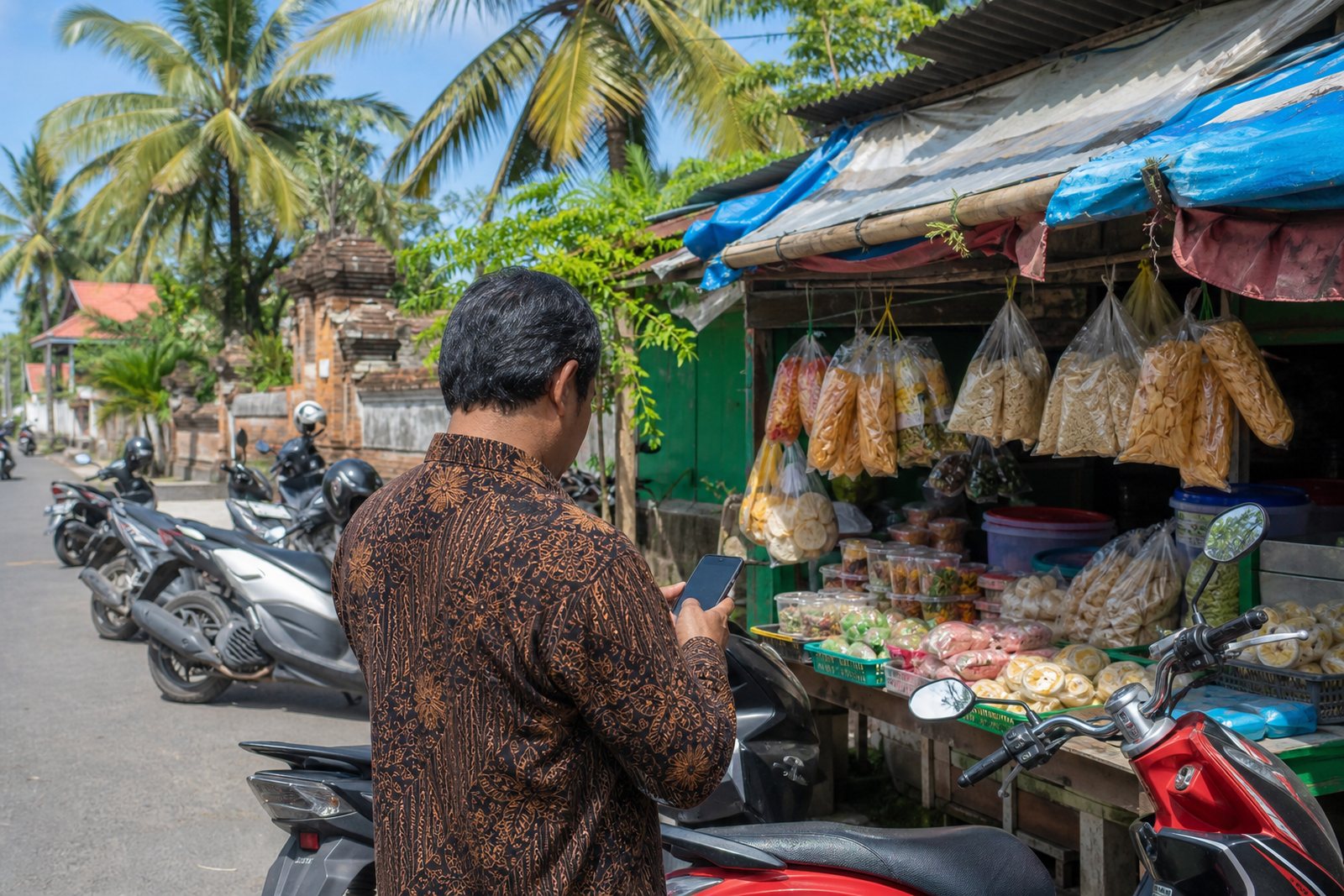 Why NTB Is Looking to Its Diaspora as an Investment Connector · Illustration: HubLombok (AI-generated)
The Frictions the Policy Must Address
DPMPTSP NTB was explicit that fuller diaspora participation still faces constraints. The agency cited the absence of comprehensive regulation, difficulties integrating with the OSS system, and asset-ownership issues linked to the unfinished Detailed Spatial Plan, or RDTR, in some areas.
These are not minor technicalities. Each describes a different point at which investor interest can be delayed or weakened.
First, comprehensive regulation matters because a diaspora investor or business partner needs to know which rights, routes and processes apply. A broad policy aspiration can encourage attention, but it does not answer the practical questions behind a commitment. Fragmented rules can leave applicants and counterparties uncertain about which institution has authority or how an entitlement is exercised.
Second, the reference to OSS integration underlines the importance of administrative interoperability. Digital systems are often presented as a convenience; in investment work they are also part of legal certainty. When a route depends on systems that do not connect cleanly, the investor’s timeline becomes harder to assess and the advisory burden rises.
Third, DPMPTSP NTB’s reference to ownership issues and incomplete RDTR planning in some areas is particularly material for asset-backed investment. Planning and spatial clarity shape what can be done with a site, how a use is assessed and whether a project’s assumptions can be properly tested. The post does not identify the affected locations, and no conclusion should be drawn about a specific asset or district from this general statement.
The agency’s proposed follow-up measures are correspondingly practical in character. It recommended:
- harmonising the Diaspora Identity Number, or NID, with visa facilities;
- providing certainty over property rights for former Indonesian citizens; and
- formulating a Global Citizen of Indonesia, or GCI, policy.
For foreign and diaspora-linked investors, the emphasis on property rights deserves careful reading. Indonesian property law distinguishes among rights and legal structures, and foreign nationals cannot hold freehold title, known as Hak Milik or SHM; it is reserved for Indonesian citizens. Available routes include leasehold, Hak Pakai for eligible residents, and a foreign-owned PT PMA holding Hak Guna Bangunan, or HGB. The appropriate route depends on the buyer, the asset and the intended use.
This is precisely why a policy proposal should not be mistaken for a completed reform. DPMPTSP NTB’s recommendation for certainty over property rights for former Indonesian citizens recognises that the present framework can present unresolved questions. It is not, on the basis of the post, evidence that a new right has already been granted.
Where property is involved, disciplined due diligence remains central. This includes reviewing the relevant certificate, ownership history, zoning and encumbrances, as well as the proposed legal structure and transfer process. TerraNusa Advisory, HubLombok’s legal and notary advisory partner, describes its role as covering due diligence, PT PMA setup, taxes and deed-and-title transfer at the BPN land office. That work should be considered project-specific, rather than assumed from a broader policy initiative.
What This Means for Investors
The immediate investment implication is one of attention rather than action. DPMPTSP NTB’s participation in the forum suggests that the province sees the diaspora as part of its future investment infrastructure. For investors with Indonesian heritage, former citizenship or relevant overseas networks, this may eventually create more coherent pathways into partnerships and projects. The source does not establish when, or whether, each proposed measure will take effect.
For international investors without diaspora links, the development still matters as context. A province that aims to connect local opportunities with overseas communities may develop richer channels for introductions, operating partnerships and market information. But it does not reduce the need to assess a transaction on its own merits.
A sensible reading of the official post separates three layers:
| Layer | What the source supports | What remains unconfirmed | | --- | --- | --- | | Policy direction | DPMPTSP NTB wants diaspora participation in investment and business partnerships. | The final form of any national or regional diaspora framework. | | Sector focus | The agency highlighted renewable energy, tourism, marine sectors and food security. | Specific projects, returns, terms or launch schedules. | | Implementation | The agency identified regulation, OSS integration, ownership and RDTR issues. | Resolution dates and the effect on any particular asset. |
That separation is more than editorial caution. It is an investing discipline. Emerging policy can be valuable information, particularly where it points to institutional priorities. Yet it should inform questions, not replace answers.
For those considering Lombok or wider NTB exposure, the practical task is to identify the relevant route before becoming attached to the opportunity. Is the proposition a direct investment, a partnership, a company-held asset, a tourism operation or a supply-chain business? Which permissions and ownership structures apply? Does the zoning support the intended use? And is the regulatory point being presented as current law, an administrative practice or a recommendation for reform?
DPMPTSP NTB’s post is encouraging in one limited but meaningful sense: it acknowledges that attracting diaspora-linked investment requires more than an invitation. It requires legal harmonisation, functional systems and clarity around assets. Those are the right subjects to place on the table. The harder test will be whether they are translated into rules and processes that an investor can use with confidence.
For now, the notebook conclusion is measured. NTB is articulating a broader conception of its diaspora: not simply people abroad, but potential commercial bridges between the province and global networks. That is a credible strategic idea. Its investable significance will depend on the unglamorous work of implementation.
Stay informed, subscribe to the free Lombok Briefing for market intelligence like this, published twice a month.
What role does NTB see for the Indonesian diaspora?
DPMPTSP NTB says the diaspora could contribute not only remittances, but also investment, business partnerships and investment connections. The agency highlighted renewable energy, tourism, marine sectors and food security as areas where it is presenting investment potential.
Has NTB announced new property rights for former Indonesian citizens?
No. DPMPTSP NTB recommended greater certainty over property rights for former Indonesian citizens, but its post does not state that a new right has been enacted. Foreigners cannot hold Indonesian freehold, or Hak Milik, which is reserved for citizens.
What issues could still affect diaspora-linked investment in NTB?
DPMPTSP NTB identified the lack of comprehensive regulation, OSS-system integration difficulties, asset-ownership questions and incomplete RDTR planning in some areas. Investors should assess the legal structure, zoning and documentation for each proposed transaction rather than relying on policy direction alone.

The Lombok Buyer's Field Guide
Legal structures ranked by risk, the honest ROI math line by line, all six zones ranked, and the 24-point due-diligence checklist. The whole book, free in your inbox.
See what's inside