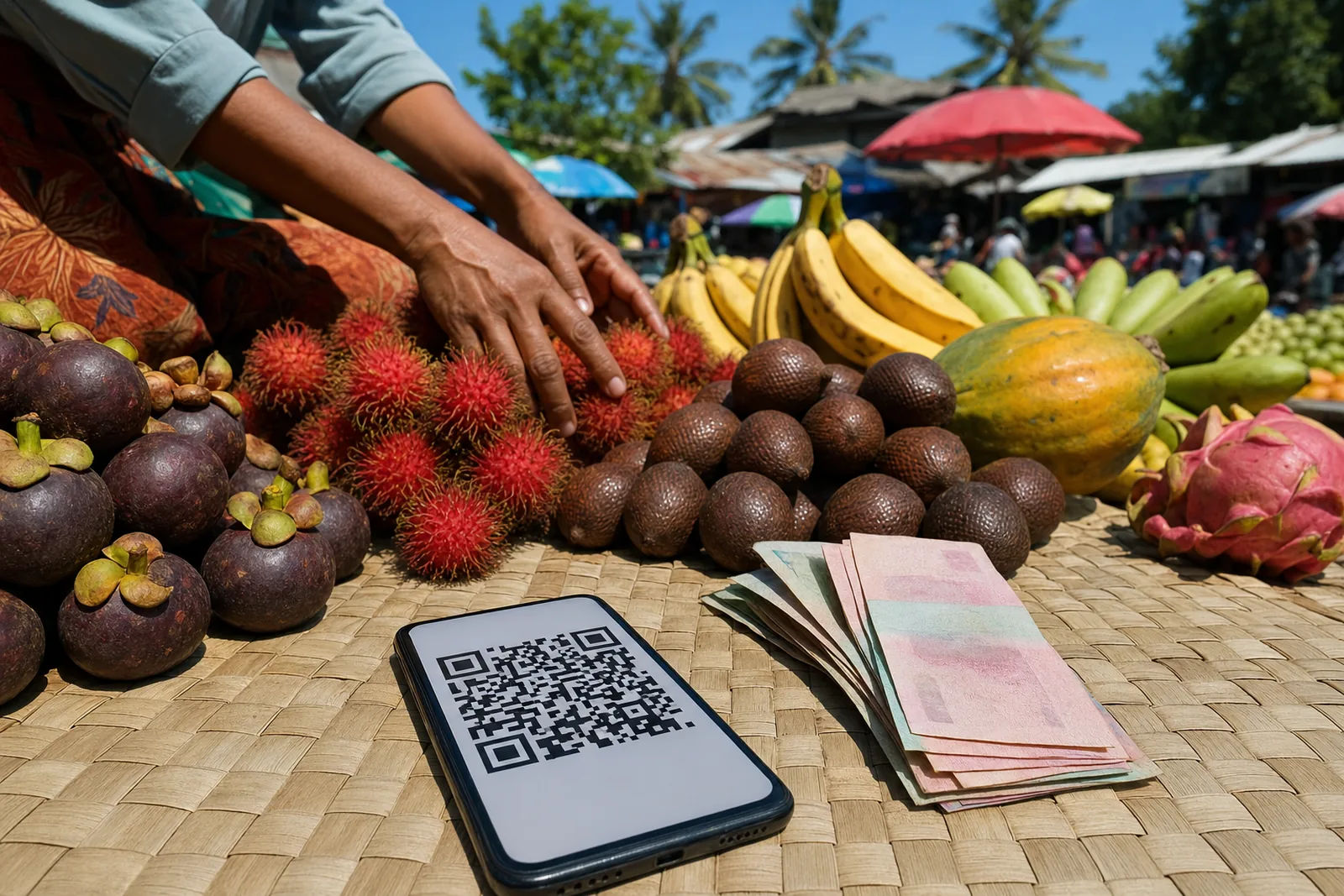
NTB Backs QRIS Push as Market Traders Join Digital Payments
NTB’s investment agency has backed Bank NTB Syariah’s QIBAS programme, using QRIS payments at Mataram’s Dasan Agung Market.
Digital payments are moving from policy ambition to everyday commerce in West Nusa Tenggara. At Dasan Agung Market in Mataram, the province’s investment and one-stop services agency used QR-code payments to demonstrate support for the digitalisation of small businesses.
The visit placed Bank NTB Syariah’s QIBAS programme at the centre of a broader discussion about business efficiency, financial records and the local investment climate. For investors watching Lombok’s economic development, the significance lies less in a single market transaction than in the institutional backing for a more formal and traceable business ecosystem.
A practical signal from NTB’s investment agency
H. Irnadi Kusuma, S.STP., ME., head of the Nusa Tenggara Barat Provincial Investment and One-Stop Integrated Services Agency, known locally as DPMPTSP, visited traders at Pasar Dasan Agung in Mataram with agency officials. The group did not arrive for an inspection. Instead, it made purchases using a scanned QR code.
The source describes the exercise as a deliberate demonstration of adoption rather than a ceremonial endorsement. Irnadi and his team used RIMO, Bank NTB Syariah’s Rinjani Mobile Banking application, to make payments.
“Digitalisation is no longer merely discourse, but a necessity that must be implemented together,” the source said, describing the signal sent by DPMPTSP’s direct use of the payment application.
That distinction matters. Small-business digitalisation is often discussed in abstract terms: more technology, greater access, better administration. Here, the provincial body responsible for investment and business services chose a familiar retail setting and a routine purchase to make the case.
DPMPTSP’s role is traditionally associated with business licensing and integrated public services. Its participation suggests a wider interpretation of that mandate: not simply helping enterprises enter the formal economy, but encouraging operating practices that may make those enterprises easier to understand, support and finance.
QIBAS and the QRIS entry point
The initiative supported by DPMPTSP is QIBAS, short for QRIS dan Action Mobile, a programme initiated by Bank NTB Syariah to accelerate financial digitalisation in NTB. The source positions QRIS-based transactions as a practical entry point for smaller enterprises.
QR payments are particularly relevant in a traditional-market context because they allow a buyer and seller to complete a transaction through a scan, rather than relying solely on cash. The source does not claim that digital payment adoption resolves every commercial challenge faced by micro, small and medium-sized enterprises. Its argument is more specific: transactions that are digitally recorded can improve the quality and availability of a business’s financial history.
Irnadi linked that record-keeping to access to bank financing. In his words, when small businesses use digital transactions, their bookkeeping becomes more orderly and their financial histories are recorded. This, he said, can make it easier for them to seek financing from banks.
For market traders, the immediate relevance is operational. For the wider economy, it is about the gradual creation of more visible commercial activity. A recorded transaction history may give a lender more material to assess than a cash-only flow of trade. The source presents this as a foundation for sustainable welfare, rather than as a guarantee of credit approval or business growth.
Ease of doing business begins below the boardroom
The language of “ease of doing business” is frequently applied to large investors, permits and major projects. DPMPTSP’s stated rationale brings the concept closer to the daily economy of market vendors and other small businesses.
According to Irnadi, the digital transformation of small businesses aligns with DPMPTSP’s core task of improving ease of doing business and strengthening the investment climate at the local level. The connection is important: a local investment environment is not formed only by regulations or headline developments. It is also shaped by how businesses receive payments, keep records and interact with formal financial institutions.
DPMPTSP said it has a moral and functional responsibility to foster an efficient, transparent and competitive business ecosystem, with QRIS transactions serving as one gateway.
The emphasis on transparency and efficiency should be read as an official objective, not as a completed outcome. The source reports a public endorsement of the QIBAS programme and a demonstration of usage; it does not provide adoption rates, financing volumes or evidence of subsequent commercial results.
Still, the policy direction is clear. The provincial agency sees financial digitalisation among UMKM, Indonesia’s micro, small and medium-sized enterprises, as consistent with a stronger local business climate. Bank NTB Syariah’s role is to provide the QIBAS programme and the RIMO application used in the demonstration; DPMPTSP’s role is to add institutional support and visibility.
What this means for investors
Investors assessing Lombok and the wider NTB economy should treat this development as a signal of administrative and financial modernisation at the small-business level, rather than as a standalone investment thesis.
The source supports several measured conclusions:
- Public-sector support is visible. DPMPTSP officials demonstrated the use of QR-based payments at a traditional market, rather than limiting their support to statements.
- The focus is on small-business capability. The QIBAS programme is framed as an accelerator of financial digitalisation for UMKM in NTB.
- Financial records are central to the rationale. DPMPTSP argues that recorded digital transactions can help businesses maintain tidier bookkeeping and financial histories.
- Formal finance is the intended link. The source says better-recorded financial histories can make it easier for businesses to access bank financing; it does not promise financing or specify outcomes.
- Investment climate is the broader policy frame. DPMPTSP explicitly connects UMKM digitalisation with ease of doing business and the strengthening of local investment conditions.
For international investors, this is a useful reminder that the quality of a destination’s commercial ecosystem is built incrementally. The important question is not whether one market visit transforms the economy, but whether programmes such as QIBAS continue to translate official support into durable habits among businesses and consumers.
The reported visit offers evidence of intent: NTB’s investment agency is using its platform to encourage QRIS adoption and digital financial practices among local traders. The next meaningful development will be how that intent is sustained across the businesses the programme is designed to serve.
Stay informed, subscribe to the free Lombok Briefing for analysis like this, published twice a month.
What did DPMPTSP do at Dasan Agung Market?
DPMPTSP Provinsi NTB, led by H. Irnadi Kusuma, visited Dasan Agung Market in Mataram and made purchases by scanning QR codes. The officials used Bank NTB Syariah’s RIMO mobile-banking application to demonstrate support for digital transactions among market traders.
What is the QIBAS programme in NTB?
QIBAS, or QRIS dan Action Mobile, is a Bank NTB Syariah programme described by the source as a vehicle for accelerating financial digitalisation in NTB. DPMPTSP supports it as part of efforts to improve business efficiency, transparency and local competitiveness.
Why are digital payments relevant to small businesses in Lombok?
According to DPMPTSP’s stated rationale, digital transactions can help small businesses keep more orderly records and create a recorded financial history. The agency says this may make it easier for businesses to access bank financing, while supporting ease of doing business locally.

The Lombok Buyer's Field Guide
Legal structures ranked by risk, the honest ROI math line by line, all six zones ranked, and the 24-point due-diligence checklist. The whole book, free in your inbox.
See what's inside