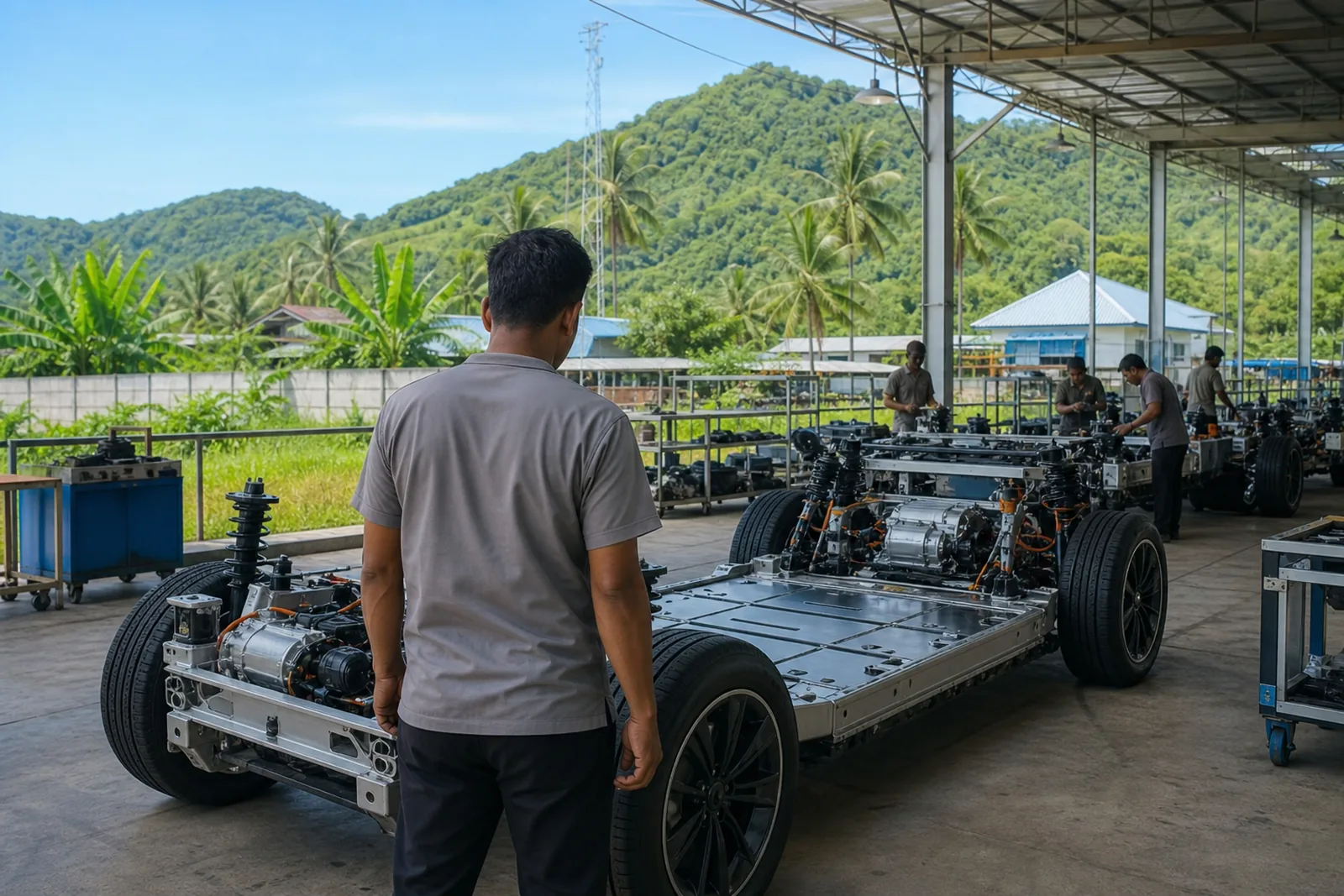
Molinas Launch Puts ‘Indonesia Incorporated’ at the Centre of EV Ambitions
President Prabowo Subianto framed Molinas as a test case for coordinated Indonesian industrial and technological development.
President Prabowo Subianto has presented the launch of Molinas, a national electric motorcycle and supporting ecosystem, as a practical expression of “Indonesia Incorporated”. The message from the launch was broader than a single vehicle: Indonesia’s economic and technological ambitions, he argued, require private enterprise, state-owned enterprises and academia to work together.
A national project, not simply a motorcycle
Speaking at the Molinas launch in Cikarang, Bekasi district, West Java, Prabowo described the initiative as an example of a country drawing together its domestic capabilities. In his formulation, “Indonesia Incorporated” means aligning groups across the economy, including stronger and weaker participants, around national development and industrial capacity.
“Today, in my opinion, is one good example of what I call Indonesia Incorporated,” Prabowo said, according to Antara Business.
The President thanked the private companies, entrepreneurs, state-owned enterprises and academic institutions involved in the project. His emphasis was on the combination of commercial execution, public-sector participation and research capability, rather than on any one institution acting alone.
For investors watching Indonesia, that distinction matters. The launch was framed not as a narrow consumer-product announcement, but as an attempt to establish an ecosystem around an electric motorcycle. Such language signals an interest in building domestic capability across several connected parts of the value chain.
The ecosystem is the central proposition
Minister of State Secretary Prasetyo Hadi said Molinas would be developed as a national ecosystem rather than merely as a brand or an individual vehicle model. The intended scope includes industrial and manufacturing development, components and batteries, charging and battery-swapping infrastructure, financing, distribution, after-sales services and stronger market absorption.
That breadth is significant because electric mobility depends on more than assembly. A vehicle may be the visible product, but its commercial utility is shaped by access to batteries, charging or swapping options, financing, maintenance and distribution. The source does not provide targets, investment sums or rollout dates for these elements. It does, however, make clear that the initiative’s stated ambition extends across the full commercial and operating chain.
The stated Molinas ecosystem covers manufacturing, components, batteries, charging and swapping infrastructure, financing, distribution, after-sales service and market absorption.
For a national industry, coordination across those functions can be as important as the product itself. A fragmented approach may leave crucial gaps between production and everyday customer use; a more integrated model seeks to connect the institutions that can address those gaps.
Technology as an economic capability
Prabowo argued that success in the modern era is partly determined by a nation’s ability to master science and technology and apply technology to national development. He placed academia within that argument, describing the experts produced through higher education and research as central to research and development.
This is an industrial-policy argument as much as an environmental or transport one. The President’s remarks linked technology capability with the development of domestic industry. In that sense, Molinas is being positioned as a vehicle for collaboration between those who finance, manufacture, research, regulate, distribute and service a product.
The language also underscores a recurring question for international investors: whether an opportunity is best understood as an isolated company proposition or as part of a wider effort to develop domestic capacity. In Molinas, the government’s framing clearly favours the latter interpretation. The project’s relevance will therefore rest not only on the motorcycle itself, but on whether the promised network of industrial, service and infrastructure components develops in a coherent way.
Collaboration as a policy signal
“Indonesia Incorporated” is deliberately inclusive language. Prabowo called for the strong, middle, lower-middle and weak to unite, while highlighting the contributions of businesses, SOEs, entrepreneurs and academia. The policy message is that national development should coordinate actors with different resources and roles.
For overseas observers, the practical implication is not that every initiative will carry the same structure or outcome. Rather, Molinas offers a current example of the government’s preferred model for strategic development: collaboration among domestic commercial, state and research institutions.
Investors should separate that policy ambition from evidence of commercial delivery. The source describes the ecosystem’s intended components, but does not establish operating performance, consumer uptake, manufacturing output or financial results. Those distinctions are especially important in emerging industrial themes, where a compelling strategic direction can precede demonstrable execution.
What this means for investors
Molinas is most relevant as an indicator of Indonesia’s stated approach to industrial development and technology-building. The key points to watch are straightforward:
- Ecosystem execution: whether the proposed links between manufacturing, components, batteries, infrastructure, financing and after-sales services are implemented in a connected manner.
- Institutional coordination: whether private companies, SOEs and academic institutions continue to work together beyond the launch phase.
- Market absorption: whether the initiative develops the stronger market acceptance identified by the government as part of the ecosystem.
- Evidence over rhetoric: whether future disclosures provide operational and commercial evidence alongside the national-development narrative.
The broader investment lesson is one of discipline. Government endorsement and a national strategic narrative can be important context, particularly in sectors tied to technology and industrial capability. Yet investors should assess each business and project on its own disclosed fundamentals, execution record and operating model.
Molinas now stands as an early marker of how Indonesia seeks to combine industry, technology and institutional collaboration; its longer-term significance will depend on how that ecosystem takes shape.
Stay informed, subscribe to the free Lombok Briefing for analysis like this, published twice a month.
What is Molinas?
Molinas is a national electric motorcycle and supporting ecosystem launched in Indonesia. According to the government’s description, the ecosystem is intended to include manufacturing, components and batteries, charging and battery-swapping infrastructure, financing, distribution, after-sales services and stronger market absorption.
What does ‘Indonesia Incorporated’ mean in the Molinas launch?
President Prabowo Subianto used “Indonesia Incorporated” to describe domestic forces working together to build the economy and strengthen national capability. At the Molinas launch, he highlighted collaboration among private companies, entrepreneurs, state-owned enterprises and academia.
What should investors watch after the Molinas launch?
Investors should watch for evidence that the proposed ecosystem is implemented across manufacturing, batteries, charging or swapping infrastructure, financing, distribution and after-sales service. The launch sets out an ambition, but the source provides no operating performance, consumer uptake or financial results.

The Lombok Buyer's Field Guide
Legal structures ranked by risk, the honest ROI math line by line, all six zones ranked, and the 24-point due-diligence checklist. The whole book, free in your inbox.
See what's inside