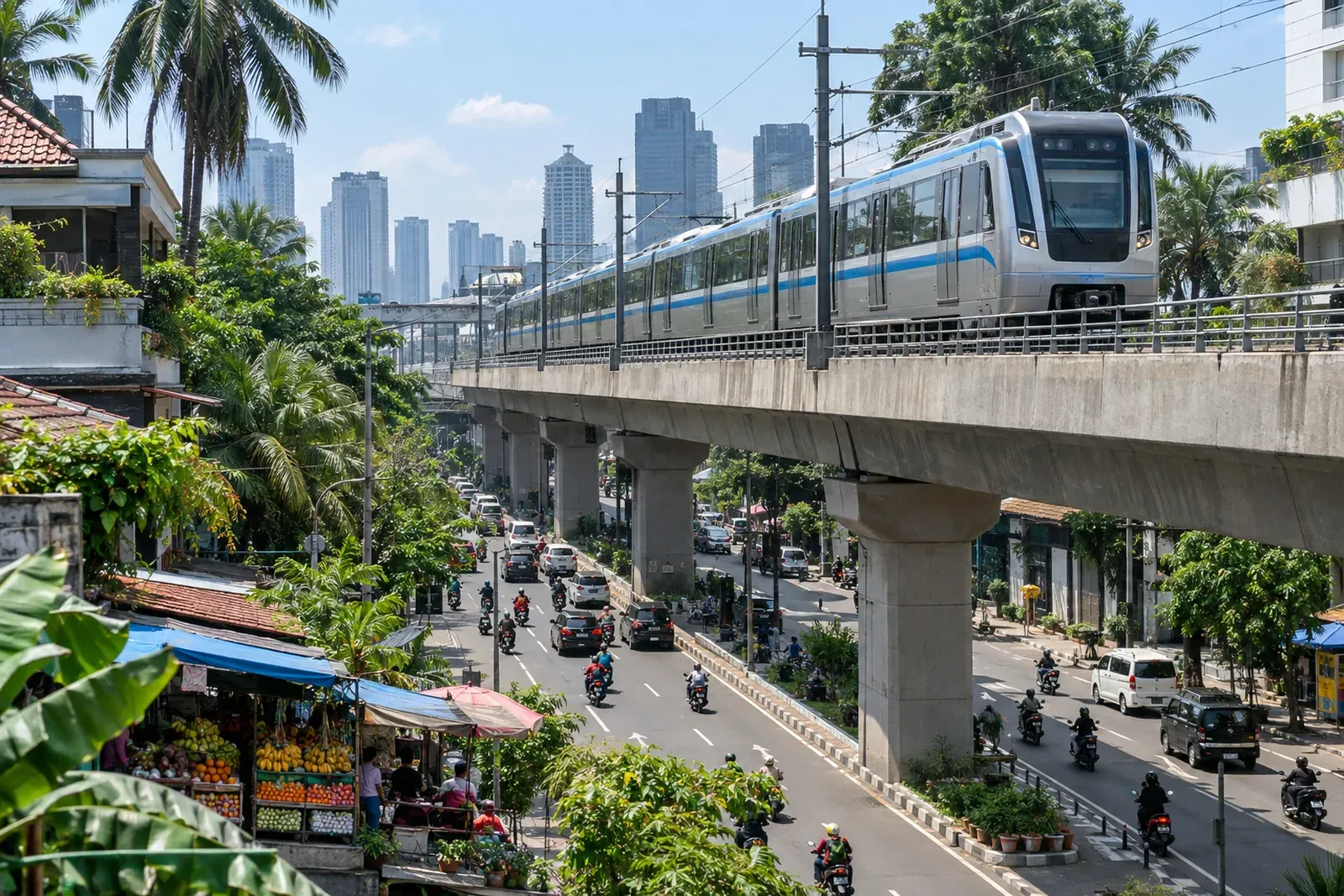
Jakarta Opens New LRT Corridor as Prabowo Backs Wider Transit Push
President Prabowo Subianto inaugurated a new 12-kilometre LRT link joining South and North Jakarta, and pointed to the state fund Danantara as the vehicle for further expansion.
President Prabowo Subianto inaugurated Jakarta's new light rapid transit (LRT) corridor connecting Manggarai in South Jakarta to Kelapa Gading in North Jakarta on Wednesday, framing the launch as a marker of the capital's continuing urban development push. He also signalled that the state asset fund Danantara would help finance future expansion of the network.
Quick answer: Jakarta has opened a roughly 12-kilometre LRT corridor linking Manggarai and Kelapa Gading, built in two phases and fully funded by the city's own regional budget at a combined cost of Rp 12.1 trillion (US$684.78 million). President Prabowo Subianto and Jakarta Governor Pramono Anung rode the full route together and Prabowo pointed to the Danantara fund as a channel for further transit investment.
A corridor built in two stages
The completed route covers approximately 12 kilometres, joining South and North Jakarta in a single line.
The corridor was delivered in two distinct phases. The first stretch, 5.8 kilometres with six stations running from Pegangsaan Dua to Velodrome, was completed between 2016 and 2019. The second phase, a 6.4-kilometre extension with five stations connecting Rawamangun to Manggarai, began construction in October 2023. Both phases were funded entirely through Jakarta's regional budget, at a combined cost of Rp 12.1 trillion (US$684.78 million).
The inauguration ride
Prabowo and Governor Pramono Anung tested the full route on Wednesday, travelling southbound from Kelapa Gading to Manggarai in under 30 minutes. The two men, from opposing political camps, Prabowo as Gerindra's patron and Pramono as a senior PDI-P figure, rode together in a carriage filled with high-school students, alongside senior officials from the State Palace and City Hall.
Danantara enters the transit conversation
At the launch event in Manggarai, Prabowo described the extended LRT line as evidence of progress in the capital's urban development and said the state asset fund Danantara would support further expansion of Jakarta's public transport network. Danantara has separately been reported as a financing channel for other stalled or planned LRT works, underscoring its emerging role as a vehicle for national infrastructure funding beyond what regional budgets can carry alone.
Why this matters beyond Jakarta
Jakarta's transit build-out is a Java-centric story, and nothing in the announcement extends it to Lombok or to any other regional market. What it does illustrate is a pattern investors watching Indonesia already track: infrastructure spending backed jointly by regional government and a national state fund, executed in phases rather than as a single mega-project, and inaugurated with visible political buy-in from both the ruling coalition and the opposition. That combination, sustained public financing plus cross-party support, is the kind of signal that shapes broader confidence in Indonesia's infrastructure delivery over time, even in markets far from the capital.
What this means for investors
This is a Jakarta transport story, not a Lombok one, and none of the figures here should be read as applicable to South Lombok's property or tourism market. The relevant takeaway for investors tracking Indonesia more broadly is procedural: a Rp 12.1 trillion project spanning two administrations and roughly seven years, funded without reliance on foreign debt, reached completion and now has a named vehicle, Danantara, for what comes next. Investors evaluating any Indonesian regional market, Lombok included, should treat this as one more data point on how the country funds and delivers large public works, not as a driver of demand or pricing in a specific province.
What happens next in Jakarta, particularly how Danantara's role in transit financing develops, is worth watching as a bellwether for how Indonesia funds infrastructure at scale going forward.
Stay informed: subscribe to our free Lombok Briefing, published twice a month (the 1st and 15th), for analysis like this.
What did Jakarta's new LRT corridor cost and who paid for it?
The roughly 12-kilometre Manggarai to Kelapa Gading corridor cost a combined Rp 12.1 trillion (US$684.78 million), fully funded by Jakarta's regional budget across both construction phases, without reliance on external financing for the build itself.
Does this Jakarta LRT news affect the Lombok property market?
No. This is a Jakarta-specific transit project funded through the city's regional budget. It has no direct bearing on South Lombok property, tourism or infrastructure, and no figures from this story should be applied to that market.
What role will Danantara play in future Indonesian transit projects?
President Prabowo indicated the state asset fund Danantara would help finance further expansion of Jakarta's public transport network, positioning it as a national-level funding channel alongside regional government budgets for future transit works.

The Lombok Buyer's Field Guide
Legal structures ranked by risk, the honest ROI math line by line, all six zones ranked, and the 24-point due-diligence checklist. The whole book, free in your inbox.
See what's inside