Indonesia’s Gold Strategy Is Also a Test of Economic Credibility
MIND ID’s push to formalise gold supply offers Lombok investors a useful read on Indonesia’s approach to reserves, regulation and economic resilience.
Quick answer: MIND ID’s proposal to channel more domestically produced gold through formal, traceable supply chains could support Indonesia’s foreign-exchange resilience over time. For Lombok investors, it is not a property-market catalyst, but it is a useful signal of how national institutions are approaching currency stability, regulation and strategic domestic assets.
There is an understandable temptation to read every Indonesian economic announcement through the immediate lens of tourism, construction or property. This one deserves a slower reading. MIND ID’s support for using domestic gold production to strengthen Bank Indonesia’s foreign-exchange reserves is principally a national policy proposition, yet it illuminates the institutional setting in which long-term investment decisions are made.
The Context
At the MINDialogue conference in Jakarta, MIND ID President Director Maroef Sjamsoeddin argued that gold should be considered a strategic domestic asset in an era of global market fluctuations. His central point was straightforward: gold produced within Indonesia has the potential to contribute to the country’s foreign-exchange reserves and, in doing so, strengthen economic sovereignty.
The proposal arrives against a modest movement in the reserve data. Bank Indonesia reported foreign-exchange reserves of US$145.3 billion at the end of July 2026, compared with US$145.6 billion in June. The US$300 million decline was attributed by the central bank to government foreign-debt repayments and measures to stabilise the rupiah. Tax revenues and global bond issuances partly offset those pressures.
The more important point is adequacy rather than month-to-month direction. Bank Indonesia said the July reserve position covered 5.5 months of imports, above the international benchmark of three months. That does not make reserves an abstract macroeconomic footnote. Foreign-exchange reserves are part of the country’s capacity to manage external obligations and periods of currency pressure.
“Gold is a domestically produced commodity with the potential to become a strategic asset that can help strengthen the country’s foreign exchange reserves,” Maroef said.
For an overseas investor, the distinction matters. A reserve figure is not a promise about the rupiah, nor is MIND ID’s statement an announcement of a completed policy change. It is, however, an example of a state-owned enterprise placing resource formalisation, traceability and national financial resilience in the same conversation.
From Informal Output to a Traceable Supply Chain
MIND ID’s case does not rest simply on producing more gold. Its emphasis is on bringing artisanal mining into a formal system through People’s Mining Permits, known as IPR, alongside regulatory harmonisation and technical guidance. The objective is to direct locally mined gold into recognised supply chains and refineries certified by the London Bullion Market Association.
That is a significant distinction. Gold that sits outside formal channels has limited usefulness to an institution seeking dependable, traceable supply. Formalisation is therefore presented as both an economic and governance exercise: permits establish a recognised operating route, technical guidance supports participation within that route, and certified refining creates a destination compatible with formal bullion markets.
Maroef also called for legally registered aggregator institutions in the midstream sector. Their role, as described by MIND ID, would be to safeguard supply-chain traceability. This is the unglamorous middle of the proposition, but it may be its most consequential element. A strategic-asset narrative only carries weight where the path from production to refinery can be documented and governed.
The policy architecture outlined by MIND ID can be understood in three linked stages:
- Formal mining access: artisanal mining is brought into the system through IPR permits, regulatory harmonisation and technical guidance.
- Traceable aggregation: legally registered institutions gather supply in the midstream while maintaining visibility over its origin and movement.
- Certified refining: formal supply is channelled towards refineries certified by the LBMA.
None of this removes the practical difficulty of implementation. The source describes plans and a policy direction, not evidence that the intended system is already operating at full scale. Investors should retain that distinction. Yet the framing is revealing: Indonesia’s gold ambition is being described not merely as extraction, but as an exercise in converting domestic production into a resource that official institutions can more readily recognise and use.
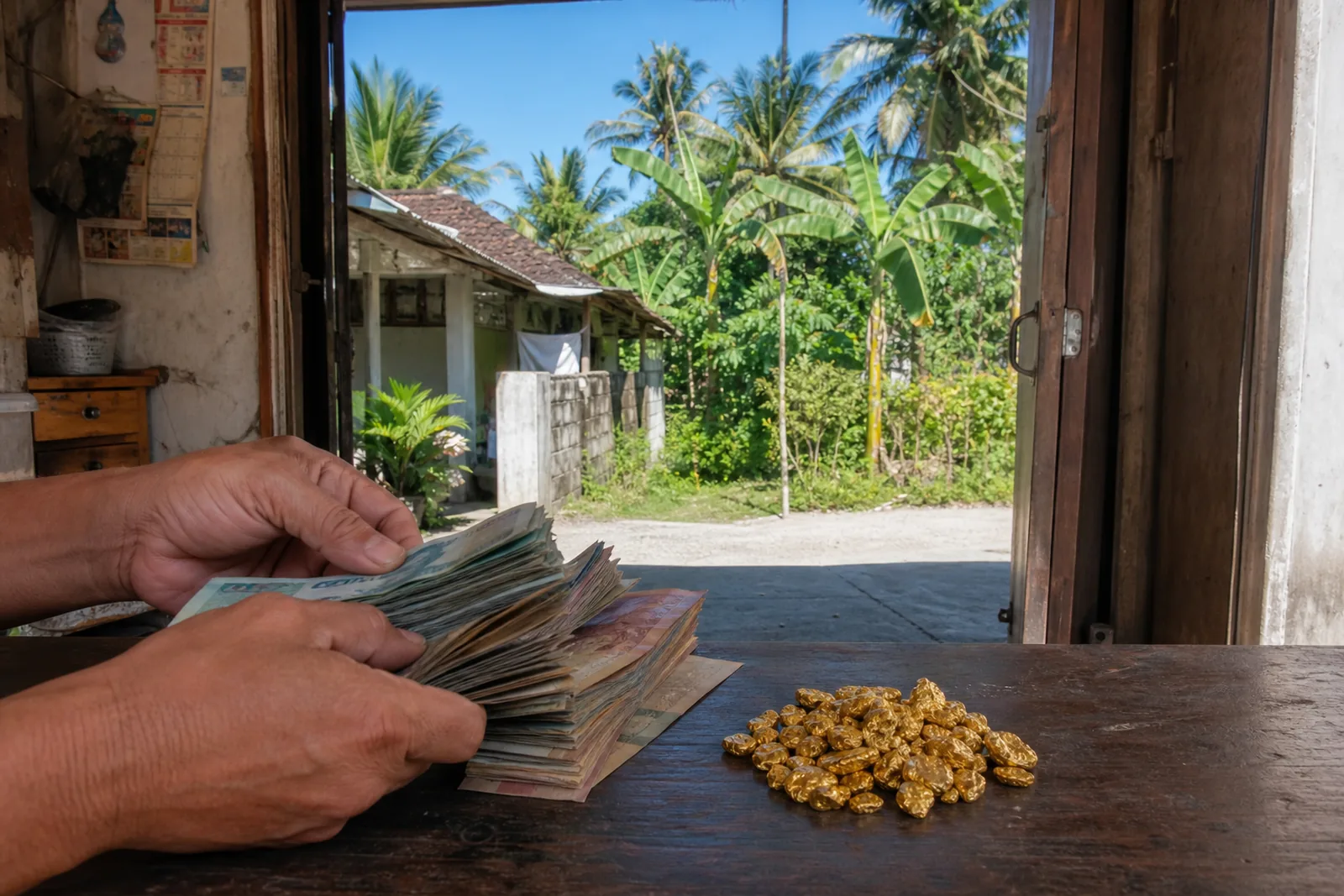
 Indonesia’s Gold Strategy Is Also a Test of Economic Credibility · Illustration: HubLombok (AI-generated)
Why Reserve Policy Reaches Beyond Jakarta
The connection to Lombok is indirect, and it should be treated honestly. MIND ID’s initiative concerns national gold production, the mining sector and Bank Indonesia’s reserves; it does not announce a programme for South Lombok, a tourism policy or a change to foreign property ownership. It would be a mistake to attach local asset-price conclusions to it.
Its relevance lies elsewhere. Foreign purchasers in Indonesia ultimately invest within a national framework of currency management, public institutions and legal administration. A country’s reserve position cannot tell an investor whether a particular land parcel is suitable, whether a title is clean, or whether a villa operator will perform. Those are separate questions requiring asset-level scrutiny. But reserve policy forms part of the wider environment in which those decisions sit.
The July data offer a useful example of why the wider view matters. Reserves fell from US$145.6 billion to US$145.3 billion, while Bank Indonesia characterised the remaining level as adequate for 5.5 months of imports. The central bank linked the decline to known pressures, government foreign-debt repayments and rupiah-stabilisation measures, and also identified countervailing support from tax revenues and global bond issuances.
That is a more nuanced picture than a headline about a falling reserve number. It describes a central bank managing several flows at once. For investors assessing Indonesia over a long holding period, the relevant habit is to distinguish between a monthly movement and the resilience indicators surrounding it.
| Issue | What the source says | Investor reading | |---|---|---| | Reserve level | US$145.3 billion at end-July 2026 | A national macroeconomic reference point, not an asset valuation. | | Monthly change | Down US$300 million from June | Context matters: BI cited debt repayments and rupiah stabilisation measures. | | Import cover | 5.5 months | BI said this remained above the international three-month benchmark. | | Gold policy | Formalise supply and improve traceability | A proposed institutional route, not a completed outcome. |
There is a broader investment lesson in the table. Numbers should be read with their operating context, and statements of intent should be separated from execution. This is particularly important in emerging-market investment, where national narratives can become overly compressed: a reserve number becomes a verdict on a currency; a resource initiative becomes a guaranteed economic gain; an attractive local opportunity becomes detached from the legal and macroeconomic systems around it.
MIND ID’s language is notable precisely because it resists a purely extractive story. It links gold to sovereignty, while the mechanism it sets out is administrative as much as geological: permits, regulatory alignment, registered aggregators, traceable chains and LBMA-certified refineries. In investment terms, that is a reminder that institutional capacity is often built through processes that are less visible than a new resort, road or development launch.
What This Means for Investors
The practical conclusion is measured. Investors with exposure to Lombok, or considering it, should treat the MIND ID announcement as macro context rather than a direct investment signal. It does not change the need for transaction-specific due diligence, proper documentation, independent legal advice and a clear view of currency exposure. It does provide another datapoint on the policy priorities being articulated by Indonesia’s economic institutions.
Three observations are worth carrying forward.
- Reserve adequacy is more informative than a single monthly change. Bank Indonesia reported 5.5 months of import cover, above the international three-month benchmark, alongside the July decline in reserves.
- Formalisation is central to the gold proposition. MIND ID is not only discussing domestic output; it is advocating a formal route from artisanal mining through registered aggregation to certified refining.
- Policy intent is not implementation. The source reports MIND ID’s support and plans. Investors should not assume an immediate addition to reserves, a defined timetable or a predictable effect on any local investment market.
For those buying real assets, this is the right level of interpretation. National financial resilience matters, but it is only one layer of analysis. The investor’s closer work remains practical: understand the structure of the transaction, establish what is being bought, identify the relevant obligations and assess the asset on its own merits. Macro context should sharpen that work, not substitute for it.
Indonesia’s effort to make domestic gold more useful to its financial system is therefore best viewed as a long-horizon institutional story. The reserve figure supplies the immediate backdrop; the proposed supply-chain reforms explain the mechanism; and the eventual test will be whether formalisation and traceability can turn an ambition into durable capacity. For Lombok investors, the value is in recognising the signal without exaggerating it.
Stay informed, subscribe to the free Lombok Briefing for market intelligence like this, published twice a month.
What did MIND ID propose for Indonesia’s domestic gold?
MIND ID supported strengthening foreign-exchange reserves by optimising domestic gold production and formalising artisanal mining. Its proposed route includes People’s Mining Permits, regulatory harmonisation, technical guidance, registered aggregators and supply to LBMA-certified refineries.
How large were Indonesia’s foreign-exchange reserves in July 2026?
Bank Indonesia reported foreign-exchange reserves of US$145.3 billion at the end of July 2026, down from US$145.6 billion in June. The central bank said the July level covered 5.5 months of imports, above the international benchmark of three months.
Does MIND ID’s gold proposal directly affect Lombok property investors?
No direct Lombok property measure was announced. The relevance is broader macroeconomic context: the proposal indicates an institutional focus on domestic strategic assets, formal supply chains and foreign-exchange resilience. It does not replace asset-level due diligence or determine local property performance.

The Lombok Buyer's Field Guide
Legal structures ranked by risk, the honest ROI math line by line, all six zones ranked, and the 24-point due-diligence checklist. The whole book, free in your inbox.
See what's inside