Indonesia's Fishing Village Modernization: What Lombok Investors Should Know
President Prabowo's ambitious 1,386 Red and White Fishing villages initiative targets coastal infrastructure modernization by end-2026. Here's what it means for Lombok's property market and economic t
Indonesia's Fishing Village Modernization: What Lombok Investors Should Know
President Prabowo Subianto has unveiled an expansive coastal development agenda: completion of 1,386 Red and White Fishing villages by the end of 2026. For Lombok investors, this initiative represents far more than a national infrastructure project, it signals a sustained government commitment to rural coastal economic transformation that could reshape both tourism appeal and property fundamentals across the island.
The Context
Indonesia's fishing villages program is rooted in a simple but powerful principle: that sustainable coastal development requires infrastructure parity between urban centers and fishing communities. The "Red and White Fishing Villages" initiative (named for Indonesia's national colors) focuses on upgrading critical amenities, harbors, markets, ice production facilities, processing plants, and community spaces, in fishing-dependent regions.
The 1,386 villages represent a substantial portion of Indonesia's ~3,600 fishing communities. Prabowo's administration has committed to completing these upgrades within 18 months from announcement (target: December 2026). This aggressive timeline reflects a policy priority that extends beyond coastal development into broader economic inclusion and food security goals.
Key program metrics:
- Budget scope: Not publicly itemized per village, but estimated at roughly $150–250 million aggregate across the program
- Beneficiary communities: Approximately 2–3 million fishers and dependent household members
- Geographic focus: Coastal provinces including NTB (Nusa Tenggara Barat), NTT, South Sulawesi, and East Java
- Timeline: Full deployment by Q4 2026
"Modern fishing infrastructure is the foundation for dignified livelihoods and food sovereignty," a statement aligned with Prabowo's administration messaging on economic equity.
For Lombok, which has a substantial artisanal fishing sector concentrated around South Lombok and parts of the North, this program arrives with concrete timing and political backing.
Lombok's Fishing Economy and the Infrastructure Inflection
Lombok's economic identity has been reframed in recent years as a tourism destination, a narrative driven by MotoGP arrivals (+47% tourism growth following events), airport expansion cycles (2025–26), and Bali-overflow thesis. Yet beneath this overlay sits an older, more resilient foundation: fishing.
The island hosts approximately 12,000–15,000 active fishers across its coastlines, concentrated in:
| Region | Primary Activities | Current Infrastructure Status | |--------|--------------------|------------------------------| | South Lombok | Tuna, mackerel, artisanal | Basic; limited cold-chain | | North Lombok | Seasonal pelagics, grouper | Aging port facilities | | West Coast | Mixed artisanal, subsistence | Minimal market infrastructure | | Gili Islands | Tourist-oriented, small-scale | Specialized; higher margins |
Historically, Lombok's fishing sector has operated with minimal modernization, basic ice production, informal market sales, limited value-added processing. This has kept operational costs high and margins compressed. A fishery upgrade program changes the economic math:
- Cold-chain efficiency improves catch preservation and extends distribution radius
- Processing facilities enable value-added products (fish meal, canned fish, dried fish) with higher margins
- Formal market infrastructure reduces middleman costs and creates direct buyer access
- Community amenities (fuel stations, ice plants, repair facilities) reduce operational friction
These upgrades do not directly produce property value gains, but they do something arguably more important: they stabilize and grow the economic base of coastal communities.
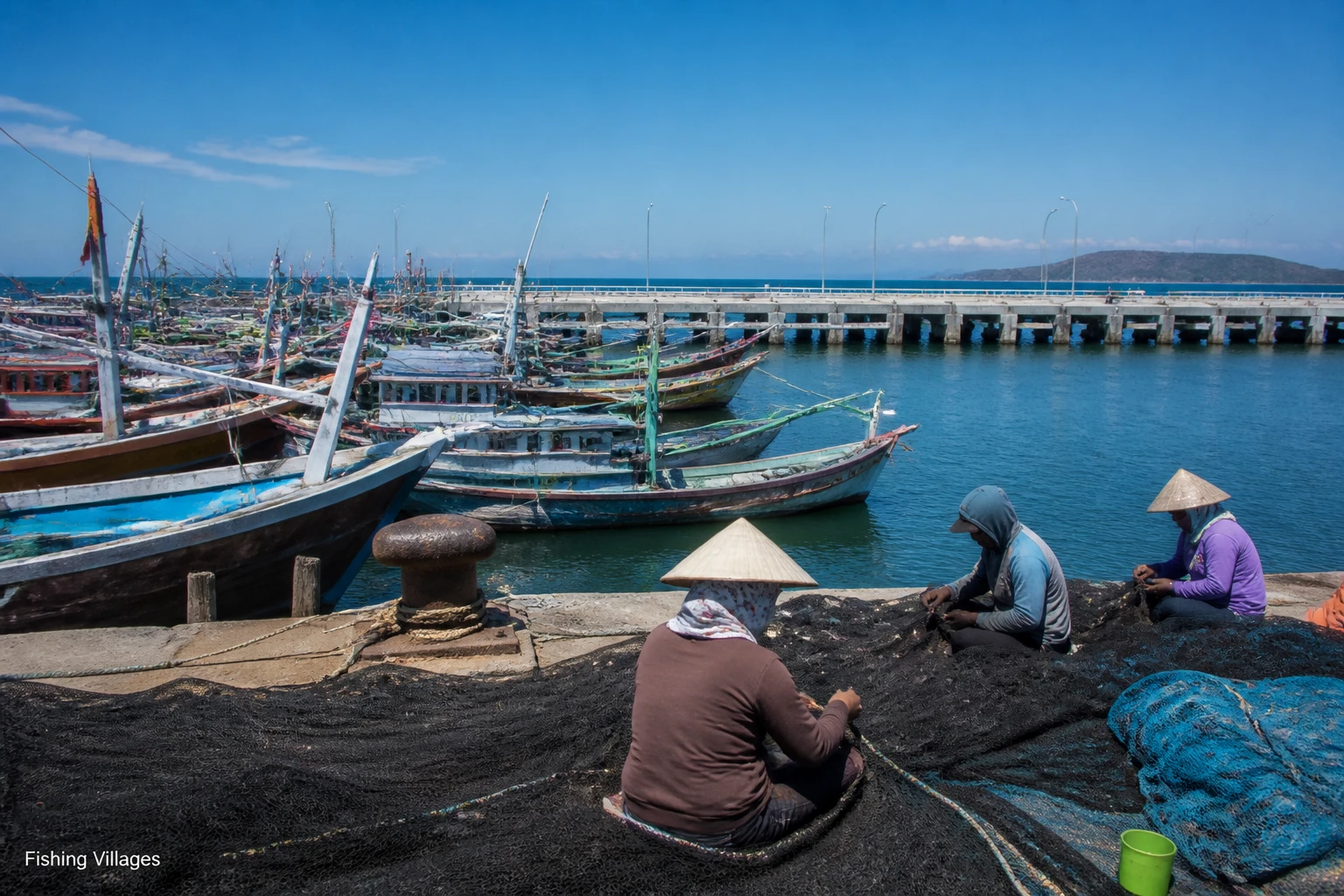
 Indonesia's Fishing Village Modernization · Photo by Cầu Đường Việt Nam on Pexels
The Investment Angle: Economic Resilience and Secondary Effects
For Lombok property investors, the fishing village modernization program matters through three interconnected channels:
1. Economic diversification and stability
Lombok's property market has been anchored increasingly on tourism. Airport expansion, MotoGP, and international brand arrivals (from mid-range to luxury) have driven yields of 12–22% in premium coastal segments and created pricing momentum in South Lombok entry-market assets (€95–350K). But tourism is cyclical and geopolitically fragile. A modernized fishing sector adds economic resilience, it creates year-round employment, stabilizes rural purchasing power, and reduces dependence on international visitor flows.
Investors sensitive to risk diversification should note: properties in communities with upgraded fishing infrastructure benefit from less volatile tenant bases and more stable service-sector employment (harbor maintenance, processing, transport, retail).
2. Infrastructure spillovers
Fishing village modernization requires port upgrades, road access, electricity, and water systems. These investments generate positive externalities for nearby property, a harbourside villa or apartment benefits from improved port infrastructure not just aesthetically but also through reduced congestion, better security, and enhanced services. South Lombok investors should monitor which communities are prioritized in Prabowo's 1,386 village rollout; early beneficiaries may see property appreciation as infrastructure becomes tangible.
3. Demographic and migration flows
As fishing communities modernize, they become more attractive to younger, educated workers. This can reverse rural-to-urban migration trends and increase local purchasing power. Investors in hospitality, service residential, and commercial property in port towns stand to benefit from increased local demand for accommodation, dining, retail, and skilled services.
What This Means for Investors
Three practical takeaways emerge:
Monitor the rollout timeline. Prabowo's commitment is concrete and time-bound (Q4 2026). Investors should track which Lombok fishing communities are announced as priority sites. Early announcement signals infrastructure development is imminent, which typically precedes property appreciation by 6–12 months.
Reframe Lombok's investment thesis. The island is no longer purely a "tourism play." It is becoming a diversified economic zone with tourism upside, fisheries resilience, and improving infrastructure. This reduces portfolio volatility for investors holding South Lombok property over multi-year horizons.
Look at secondary property near port towns. Premiumization (mid-range to upper-mid apartments, service residences, small commercial) in fishing community hubs, areas like Teluk Kodek or Gili Meno periphery, may outperform pure resort-adjacent property if infrastructure development signals stronger local employment growth.
The yields available in Lombok (12–22% depending on segment) remain competitive globally. But they now sit atop a more resilient economic foundation than tourism alone provides.
This fishing village modernization program is not a silver bullet for property appreciation, but it is a significant shift in Indonesia's coastal development priorities. For Lombok investors, it signals that the government is serious about long-term economic infrastructure beyond tourism, and that translates into more stable underlying economics for property held over 5+ year horizons.
The next 18 months will be crucial. Investors should monitor Prabowo's announcement cadence regarding which communities are prioritized. Early signals will be valuable.
Stay informed, subscribe to the free Lombok Briefing for market intelligence like this, published twice a month.
What is Indonesia's Red and White Fishing Villages program and how does it affect Lombok?
President Prabowo Subianto's program targets completion of 1,386 Red and White Fishing villages by end of 2026, with an estimated aggregate budget of $150 to $250 million. Upgrades cover harbors, ice plants, processing facilities, and market infrastructure across coastal provinces including NTB, where Lombok is located. Around 2 to 3 million fishers and dependent households are expected to benefit.
How does Lombok's fishing sector support property investment beyond tourism?
Lombok hosts approximately 12,000 to 15,000 active fishers. Modernizing this sector through cold-chain systems, processing plants, and formal markets stabilizes year-round employment and reduces dependence on tourism cycles. For property investors, communities with upgraded fishing infrastructure tend to have less volatile tenant bases, complementing the 12 to 22% yields already seen in premium South Lombok coastal segments.
Which parts of Lombok stand to benefit most from the fishing village infrastructure program?
South Lombok, focused on tuna and mackerel with currently limited cold-chain infrastructure, and North Lombok, with aging port facilities for seasonal pelagics, are among the areas with the most scope for improvement. Investors in South Lombok entry-market assets, priced between roughly €95,000 and €350,000, should track which communities are prioritized in the 1,386-village rollout, as early beneficiaries may see property appreciation as infrastructure becomes tangible.
The Lombok Buyer's Field Guide
Legal structures ranked by risk, the honest ROI math line by line, all six zones ranked, and the 24-point due-diligence checklist. The whole book, free in your inbox.
See what's inside