Indonesia’s Steady Rate: What It Does, and Does Not, Tell Lombok Investors
Bank Indonesia has held its benchmark at 5.75%, citing contained inflation and room for growth. For Lombok investors, the decision is useful context, not a property-market forecast.
Quick answer: Bank Indonesia kept its benchmark interest rate at 5.75% in September, citing contained inflation and room for economic growth. For Lombok property investors, that is a signal of the national policy setting, not a direct forecast for local prices, occupancy or borrowing costs. Any investment decision still turns on the asset, financing terms and realistic net returns.
For an investor considering property in South Lombok, a central bank decision made in Jakarta can feel distant from the practical questions: what does a villa cost, how might it be rented, and what legal structure can a foreign buyer use? Yet monetary policy belongs in the background of those decisions. It helps describe the conditions in which the wider economy is operating, while leaving much of the property-specific risk untouched.
The September decision is notable for its restraint. Bank Indonesia says inflation remains within its target range and the economy is operating below full potential. Its public explanation is that tightening could impose a cost on growth. That is a careful balance, not a declaration that every part of the economy is comfortable or that investment returns are assured.
The Context
Bank Indonesia held its key benchmark at 5.75% in September. It also left the deposit facility rate at 4.75% and the lending facility rate at 6.50%. These are national policy rates. They should not be confused with the interest rate offered to an individual borrower, the financing cost of a property project, or the return an investor receives from a rental asset.
The central bank’s case rested on two linked observations. First, inflation was described as well controlled, with core inflation at 2.92% year on year in August. Second, Indonesia was said to remain below its full economic potential, with a negative output gap. In the central bank’s account, that leaves space for expansion without immediately creating excessive inflationary pressure.
That reasoning helps explain why policymakers did not raise rates to attract foreign capital. The central bank’s stress-testing indicated that a 25-basis-point increase in the BI-Rate could reduce national economic growth by approximately 0.1 percentage point. This is an estimate of a national effect, not a measure of the consequences for Lombok’s property market. It does, however, show the trade-off policymakers say they are weighing: higher rates may support some objectives while placing a drag on domestic momentum.
The decision also sits alongside a separate effort to draw in foreign capital. Rather than relying on higher policy rates or increased yields on Bank Indonesia Rupiah Securities, the authorities have used non-rate measures, including hedging incentives for capital inflows. According to the central bank, the policy had drawn approximately $6 billion through Domestic Non-Deliverable Forward and currency swap transactions since its introduction about a month earlier.
That figure is a reported result of the policy, not evidence of investment into Lombok property. It concerns capital flows through specified financial transactions. For investors, the distinction matters: national inflows can indicate attention to Indonesia’s financial conditions, but they do not establish who is buying villas, what they are paying, or whether a given location is gaining durable rental demand.
A national signal, not a local property forecast
A stable benchmark can be useful to investors because it describes one part of the country’s monetary setting. It cannot settle the financing question for a particular purchase. The price and availability of a loan depend on the terms offered to that borrower and project. The central bank announcement does not provide those terms, nor does it say how any individual lender will respond to the unchanged rate.
The same boundary applies to currency and foreign capital. The central bank’s hedging incentives are intended to attract inflows without raising rates, but the reported total does not tell a property investor what exchange rate to expect, how a future conversion might affect their budget, or whether a particular villa will produce income in a currency that matches their obligations. Those questions require transaction-specific planning and independent advice.
For South Lombok, the verified market context is more direct. Turnkey investment-grade villas are priced from EUR 95,000 to EUR 350,000, while comparable specification in Bali is USD 400,000 to USD 800,000. The comparison gives a sense of relative entry points, but currencies and individual properties differ. It does not show that a Lombok property will appreciate or rent successfully simply because the national benchmark stayed unchanged.
Rental estimates demand similar care. Honest net rental yield is 7-12% after management fees and realistic occupancy; developer-quoted gross yields are a different measure and exclude relevant costs. Stabilised occupancy in the first years is estimated at 55-70%. These figures describe market expectations in the verified facts, not a forecast derived from the September rate decision. A national policy rate should not be used to make a gross return look like a net one, or to imply a particular occupancy outcome.
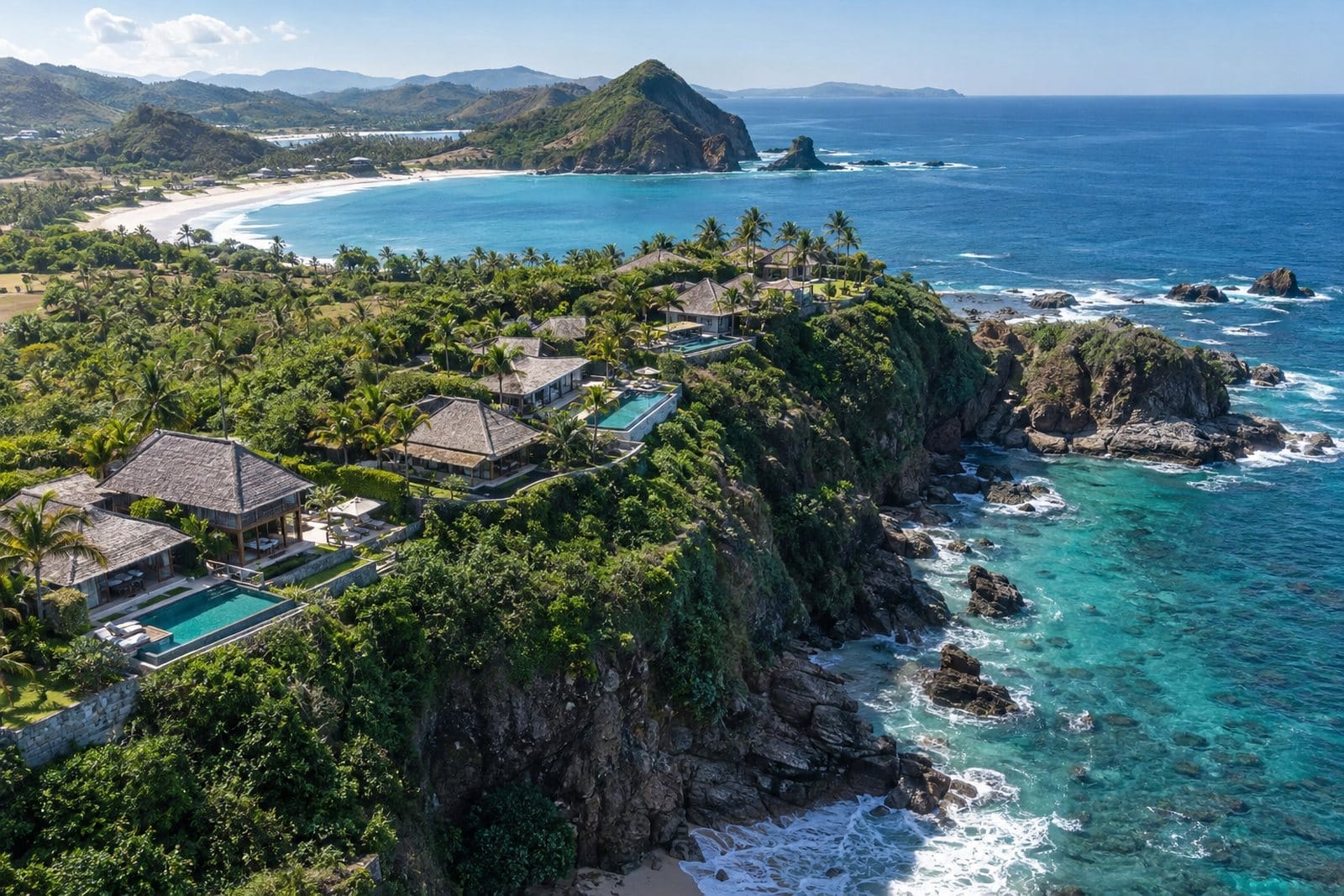 Indonesia’s Steady Rate · Illustration: HubLombok (AI-generated)
The policy trade-off behind the decision
The central bank’s explanation is not simply that inflation is low and rates can therefore stay put. It is that inflation is within its target range while growth remains below potential, and that a rate increase could weigh on economic activity. That combination helps explain the preference for holding the benchmark and using other tools to encourage foreign capital.
For property investors, this offers context about policymakers’ priorities. It says the bank is trying to preserve room for domestic expansion while maintaining confidence in inflation and attracting capital. But it does not establish the future path of rates. Nor does it resolve whether the national growth gap will close, whether inflation will remain comfortable, or how those conditions may change financing and demand for any particular asset.
There is also a difference between an instrument and its transmission. The BI-Rate is a policy setting. A villa purchase may involve a developer’s payment schedule, a commercial loan, cash, or another arrangement. The source announcement does not quantify the effect of the rate hold on any of these. Investors should compare the actual financing terms available to them, rather than treating a policy decision as a proxy for their cost of capital.
Likewise, the foreign-capital figure warrants precise reading. The reported $6 billion relates to hedging transactions through DNDF and swaps, following the introduction of incentives. It is evidence that the central bank says the measure has attracted inflows. It is not a property transaction total, a commitment to Lombok, or a forecast of additional demand. The distinction between financial-market flows and local real-estate activity is essential for an investment thesis built around a specific island or zone.
What This Means for Investors
The rate hold is best treated as background information. It provides a snapshot of Bank Indonesia’s current assessment: inflation is within range, the economy has room to expand, and a rate increase could carry a growth cost. That context may matter when investors assess Indonesia as a whole. It is not enough to underwrite a property purchase.
A disciplined review should separate national policy from asset-level evidence. For a Lombok villa, that means testing the purchase price against comparable options, using net rather than gross rental assumptions, and examining realistic occupancy and operating costs. It also means asking what financing is actually available and how changes in currency values could affect the investor’s own cash flows. The September statement supplies no substitute for these checks.
The decision to hold at 5.75% is therefore neither a green light nor a warning specific to Lombok. It is one part of the economic setting. The more useful conclusion is modest: policymakers see room to support growth without tightening at this meeting, while taking steps to attract foreign capital through hedging incentives. Whether that translates into a sound investment depends on evidence at the level of the property and the investor’s own circumstances.
For international buyers, the practical discipline is to keep the layers separate. National inflation and rate policy describe the macroeconomic backdrop. Villa pricing, legal structure, rental performance and transaction costs determine whether a particular opportunity makes sense. A thoughtful investment case connects those layers without claiming that one automatically proves the other.
Stay informed: subscribe to the free Lombok Briefing, published twice a month (the 1st and 15th), for market intelligence like this.
Does Bank Indonesia’s rate hold predict Lombok villa returns?
No. The September decision describes national monetary policy, not local property performance. It does not forecast villa prices, occupancy, rental income or an individual buyer’s financing cost. Investors should assess each property using its price, operating assumptions, costs and actual financing terms.
What did Bank Indonesia say about inflation and growth?
Bank Indonesia kept its benchmark at 5.75%, citing inflation within its target range and an economy operating below full potential. Core inflation was 2.92% year on year in August. The bank estimated that a 25-basis-point rate increase could reduce national growth by approximately 0.1 percentage point.
Does the reported $6 billion in inflows mean capital went to Lombok property?
No. The central bank attributed approximately $6 billion in inflows to Domestic Non-Deliverable Forward and currency swap transactions after hedging incentives were introduced. That reported figure concerns financial transactions and does not establish investment into Lombok real estate or future property demand.

The Lombok Buyer's Field Guide
Legal structures ranked by risk, the honest ROI math line by line, all six zones ranked, and the 24-point due-diligence checklist. The whole book, free in your inbox.
See what's inside