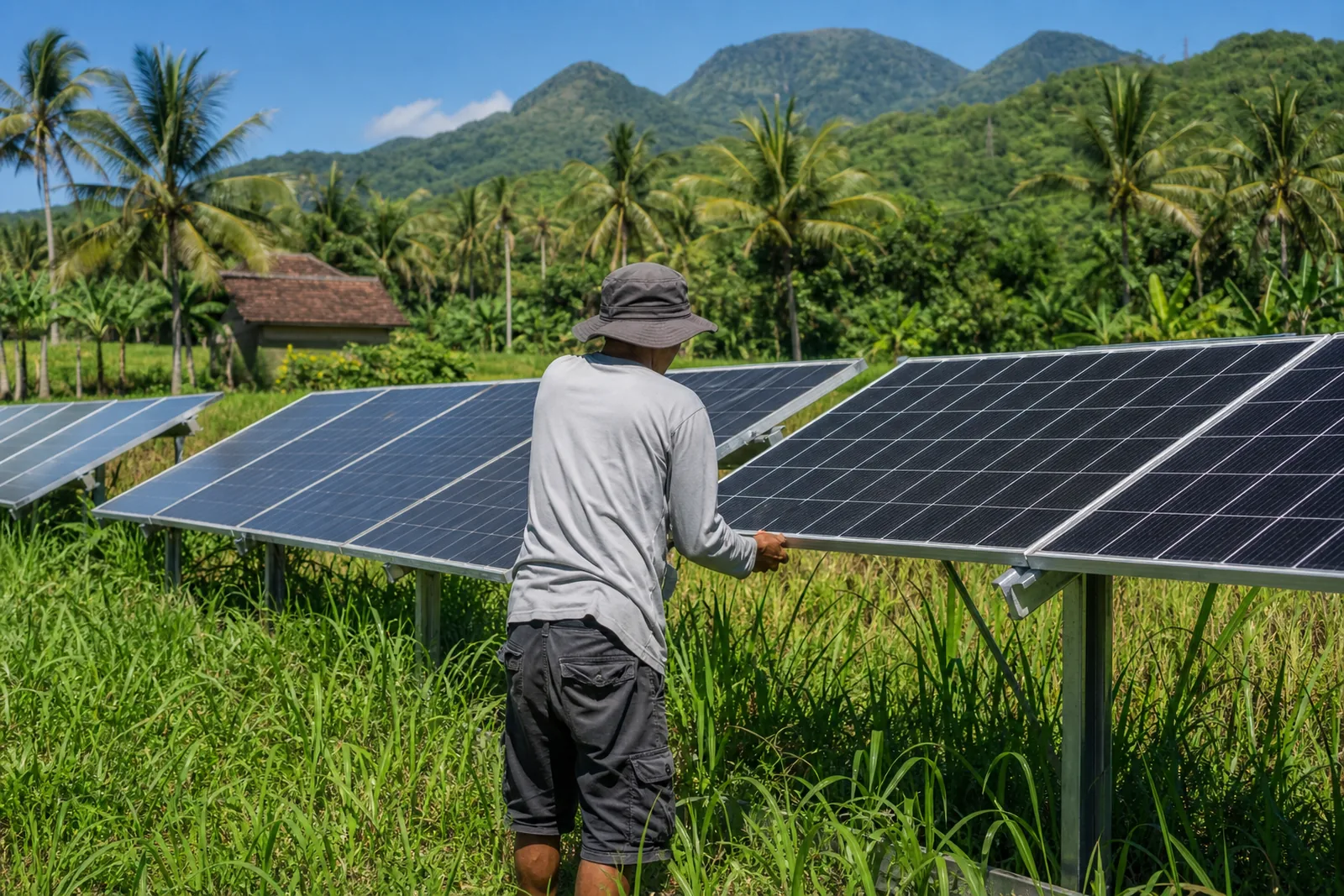
Lombok Notebook: Indonesia’s Solar Push Is a Test of Delivery
Indonesia’s solar programme signals extraordinary policy ambition. For Lombok investors, the key question is whether tendering and construction convert targets into operating assets.
Quick answer: Indonesia has launched and tendered a substantial pipeline of solar projects, led by a stated ambition to add 100 GWp within three years. For Lombok investors, this is not yet a local property catalyst; it is a useful test of whether national energy ambition can move reliably from announcement and tender to commercial operation.
For investors, energy policy is often most interesting when it ceases to be a slogan and becomes an operating system. President Prabowo Subianto’s latest solar announcements offer both the scale of the ambition and a clear way to judge it: projects must progress from groundbreakings and tender documents into functioning capacity.
The Context
Jakarta Post Business reports that President Prabowo has broken ground on three solar power projects with combined capacity of 396.4 megawatt-peak (MWp), while unveiling six tender-ready projects as part of a plan to add 100 GWp of solar capacity over the next three years.
The statement is deliberately expansive. At the launch event at the Gilimanuk Operation Monument in Jembrana regency, Bali, the President said the target could be reached in less than three years, and challenged the energy team to move faster still. He drew a comparison with the government’s food self-sufficiency programme, which he said achieved its four-year target within one year.
The immediate investment lesson is not to treat the largest headline figure as an outcome. It is to separate three distinct stages:
- political ambition: the 100 GWp objective;
- procurement readiness: six projects opened for tender, with combined capacity of 4.55 GWp;
- physical delivery: projects that have broken ground or are under construction.
That distinction matters because each stage answers a different question. A target indicates direction. A tender-ready project signals a nearer-term opportunity for execution. Groundbreaking shows that a project has moved into a more tangible phase, although it remains different from commercial operation.
The reported pipeline is nevertheless sizeable. Across Indonesia, 14 projects with combined capacity of 5.22 GWp have either broken ground or are under construction, representing US$7.7 billion in investment. Those figures give investors something more useful than rhetoric: a starting point for following whether construction advances and whether planned capacity comes online.
The relevant signal is not simply how much solar capacity is announced, but how consistently announced capacity becomes operating infrastructure.
From Bali’s Tender Pipeline to an Execution Question
The main launch site is Gilimanuk in Bali, where the source describes a programme intended to replace fuel-based power generation with clean energy. The Gilimanuk project is tender-ready and is expected to combine 198 MWp of solar capacity with a 666 megawatt-hour (MWh) battery energy storage system across 211 hectares. Its target for commercial operation is 2028.
Storage is central to the significance of that proposal. The source does not provide a forecast for its performance, nor does it establish a direct effect on Lombok. But the pairing of solar capacity and a battery system makes the project more than a simple capacity headline: it makes delivery, procurement and eventual operation the relevant milestones to watch.
The other large tender-ready projects named in the report are floating solar developments at Jatiluhur and Cirata reservoir:
| Project | Reported capacity | Status described in source | |---|---:|---| | Gilimanuk, Bali | 198 MWp solar; 666 MWh BESS | Ready for tender | | Jatiluhur floating solar | 1.69 GWp | Ready for tender | | Cirata floating solar expansion | 1.25 GWp | Ready for tender |
There is an important discipline in reading this table. Capacity, tender status and expected commercial operation are not interchangeable. A tender-ready scheme may establish a route to procurement, but it does not by itself confirm final construction, commissioning or output. Likewise, a groundbreaking is an advance in project development, not evidence that the wider three-year target has been met.
The source also reports groundbreakings in Banyuwangi and Pasuruan in East Java, and at Gajah Mungkur Reservoir in Central Java. Together, these projects are included within the stated 396.4 MWp combined capacity. The geographic spread is notable because the announced programme is national rather than confined to one destination market.
For a Lombok-focused reader, that is precisely why the story deserves measured attention. It is a national-policy development with a Bali launch site, not an announcement of a specific Lombok energy project. The prudent conclusion is neither to dismiss it as distant nor to capitalise it prematurely into local asset assumptions.
 Lombok Notebook · Illustration: HubLombok (AI-generated)
What Investors Should Watch Next
A useful Lombok Notebook approach is to follow the programme through its observable transitions. The Jakarta Post Business report supplies a clean baseline: six projects, 4.55 GWp of tender-ready capacity; 14 projects, 5.22 GWp either under construction or at groundbreaking stage; and a national objective of 100 GWp over three years.
Those reference points allow investors to ask better questions when later updates emerge.
First, does tender readiness become awarded and built capacity? The reported Gilimanuk, Jatiluhur and Cirata projects are important not merely because of their scale, but because they can demonstrate whether procurement machinery is translating policy intent into projects.
Second, does the delivery timetable remain credible? Gilimanuk has a stated target of commercial operation by 2028. That is a concrete benchmark against which investors can assess progress, without assuming an outcome in advance.
Third, how does the balance between generation and storage develop? Gilimanuk’s proposed 666 MWh battery system is explicitly part of the announced design. It is therefore appropriate to monitor it as part of the project, rather than regarding the solar capacity in isolation.
Fourth, does the national programme maintain clarity about categories? The source distinguishes projects that are tender-ready from those that have broken ground or are under construction. Investors should retain that distinction when comparing later official announcements or marketing materials.
This is especially relevant in property analysis, where infrastructure narratives can quickly become overly broad. South Lombok’s investment case has its own market considerations, including legal structure, asset quality, price and realistic operating assumptions. Indonesia’s solar programme may form part of the wider national context, but the source does not show that it changes any particular Lombok property’s revenues, land value or operating costs.
That restraint is not a weakness in the thesis; it is what makes it investable. A serious investor can recognise that a national push towards clean-energy capacity may be strategically meaningful while still requiring project-specific evidence before changing an underwriting model.
What This Means for Investors
The announcement is most valuable as a scorecard for state capacity and project execution. It offers substantial numerical markers, a named tender pipeline and one stated operating target. It does not yet justify a direct, quantified conclusion about Lombok real estate.
Investors with exposure to Indonesia, or considering Lombok alongside other parts of the country, can treat this as a context signal. The programme’s importance will be clarified by subsequent evidence that tender-ready schemes move forward, projects under construction continue to progress, and the stated capacity is delivered on the terms announced.
For now, the balanced reading is straightforward: the solar push is ambitious, material in announced scale and worth tracking closely. Its investment significance will be earned through delivery.
Stay informed, subscribe to the free Lombok Briefing for market intelligence like this, published twice a month.
What is Indonesia’s stated solar capacity target?
President Prabowo Subianto stated an ambition to add **100 GWp** of solar capacity within three years. The Jakarta Post Business report presents this as a national target; it should be distinguished from projects that are tender-ready, under construction or already at groundbreaking stage.
Which solar projects are ready for tender?
The source says six projects with combined capacity of **4.55 GWp** are ready for tender. Named examples include Gilimanuk in Bali, Jatiluhur floating solar at **1.69 GWp**, and an expansion of Cirata floating solar at **1.25 GWp**.
Does the solar announcement directly change Lombok property returns?
No direct change to Lombok property returns is established by the source. The announcement concerns a national solar programme and named projects elsewhere in Indonesia. Lombok investors should follow delivery milestones, but should not treat the announcement alone as evidence of altered local revenues or land values.

The Lombok Buyer's Field Guide
Legal structures ranked by risk, the honest ROI math line by line, all six zones ranked, and the 24-point due-diligence checklist. The whole book, free in your inbox.
See what's inside