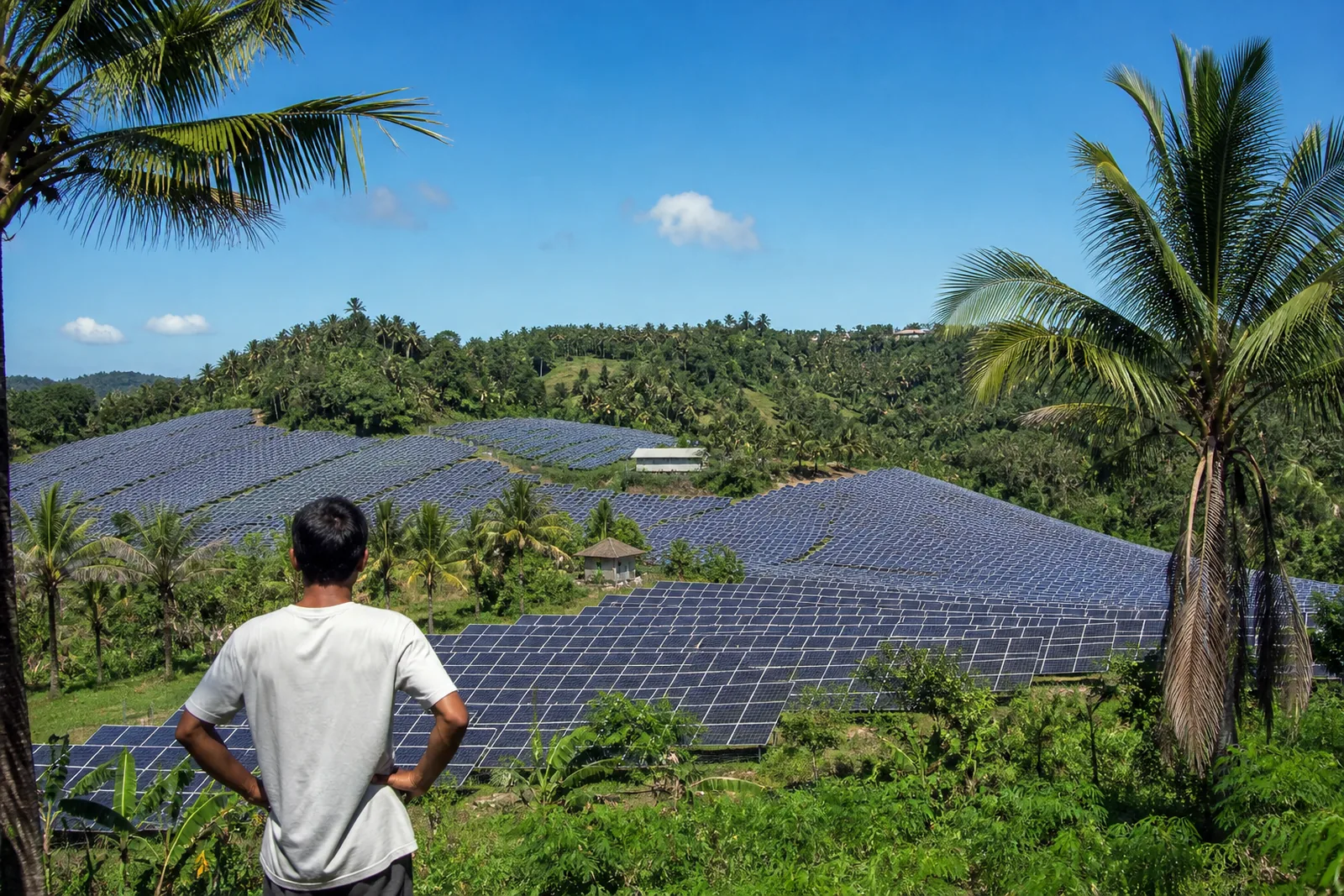
Indonesia’s Solar Push Sets a New Benchmark for Investor Confidence
Indonesia’s solar expansion is ambitious. For Lombok investors, its significance lies in execution, tender discipline and the credibility of the wider investment climate.
Quick answer: Indonesia’s new solar programme does not directly change Lombok property economics, but it gives investors a useful signal: the government is pairing large clean-energy ambitions with tenders, construction and battery storage. The opportunity for Lombok investors is to watch delivery closely, because execution will matter more than headline capacity.
Lombok Notebook
Indonesia’s latest solar announcement is easy to read as a national energy story: large capacity targets, ceremonial groundbreakings and a presidential demand for speed. Yet for investors considering Lombok, it also deserves to be read as a test of institutional execution.
That distinction matters. A target can shape sentiment; an operating asset changes the investment environment. The government has now put both language and projects on the table, giving investors a clearer framework through which to judge whether Indonesia’s clean-energy ambitions are becoming investable infrastructure rather than simply an attractive policy narrative.
The Context
President Prabowo Subianto has launched a push to add 100 GWp of solar capacity over the next three years. Speaking at Gilimanuk in Bali, he suggested that the target could be achieved more quickly, drawing a parallel with the government’s food self-sufficiency programme and challenging the energy team to deliver at greater pace.
The immediate programme is more concrete than the headline alone. The President broke ground on solar projects in Banyuwangi and Pasuruan in East Java, and at Gajah Mungkur Reservoir in Central Java. Together, those projects have a combined capacity of 396.4 MWp.
At the same time, the government unveiled tender-ready projects, including the Gilimanuk scheme in Jembrana regency, Bali. That project is intended to form part of the “fat burning Bali” programme, which is designed to replace fuel-based power generation with clean energy.
“Today is an important day. We’re launching, and I believe we’ll reach 100 GW in less than three years,” President Prabowo said at the launch event.
For investors, the important point is not to treat every announced capacity figure as equivalent. Groundbreakings, projects under construction, projects ready for tender and commercial operations are different stages of development. Each carries a different level of certainty, financing need and delivery risk.
The Jakarta Post reports that 14 projects with combined capacity of 5.22 GWp have either broken ground or are under construction, representing US$7.7 billion in investment. Separately, six projects with combined capacity of 4.55 GWp have been opened for tender.
Those figures establish a useful analytical baseline. Indonesia’s ambition is not confined to a single site or a single technology. It is being expressed through projects at different stages of the pipeline, across solar formats and locations.
From Ambition to a Project Pipeline
Gilimanuk illustrates both the scale of the policy intention and the complexity of the task ahead. The project is ready for tender and is expected to feature 198 MWp of solar capacity paired with a 666 MWh battery energy storage system across 211 hectares. Its targeted commercial-operation date is 2028.
Battery storage is especially notable in an investor reading of the announcement. Solar generation is inherently linked to daylight; a battery system points to the operational question of how energy can be stored and deployed. The source does not provide a detailed commercial structure for Gilimanuk, but the combination signals that the programme is not framed solely around installing panels.
The tender list also includes two large floating-solar projects:
| Project | Capacity | Status described in the source | |---|---:|---| | Jatiluhur floating solar plant | 1.69 GWp | Ready for tender | | Cirata floating-solar expansion | 1.25 GWp | Ready for tender | | Gilimanuk solar and BESS project | 198 MWp and 666 MWh storage | Ready for tender |
The comparison is instructive. Floating solar at Jatiluhur and Cirata represents very large individual capacity proposals, while Gilimanuk combines solar generation with storage and is tied to a Bali-specific programme to displace fuel-based power generation.
Investors should resist the temptation to convert this into an immediate conclusion about local electricity costs, grid reliability or asset values in Lombok. The supplied information does not establish those outcomes. Nor does it say that these projects will serve Lombok directly.
What it does establish is a broader policy direction: the Indonesian government is promoting solar capacity at scale, presenting defined projects for tender and connecting part of the programme to the replacement of fuel-based generation. That is a more meaningful signal than an abstract aspiration, while remaining short of proof of successful delivery.
 Indonesia’s Solar Push Sets a New Benchmark for Investor Confidence · Illustration: HubLombok (AI-generated)
The Execution Questions That Matter
A national target of 100 GWp in less than three years is deliberately ambitious. It is also far larger than the capacity figures attached to the projects described in the source. That gap is not a criticism in itself; it is the central question investors should examine.
The relevant discipline is to separate policy momentum from completed infrastructure. A groundbreaking can mark political commitment and project mobilisation. A tender-ready project can show that a scheme has advanced to a stage where developers and financiers may engage. Construction indicates a further step. Commercial operation is the test that an asset is producing as intended.
The Gilimanuk timetable makes this distinction particularly clear. The source says the facility is ready for tender and targets commercial operation by 2028. It therefore belongs in a future pipeline, not in the present operating system.
For a Lombok-based investor, the most useful questions are practical rather than rhetorical:
- Which projects move from tender to award, construction and commercial operation?
- How consistently does the government maintain the stated pace after the launch event?
- Does the use of battery storage at Gilimanuk become an isolated design choice or part of a wider approach?
- How are large projects, including floating solar schemes, translated from announced capacity into functioning assets?
- Do the announced investment and capacity totals continue to be matched by visible project progress?
These questions are relevant because infrastructure credibility is cumulative. Investors do not need to assume that every announced project will have the same timetable or outcome. They need to observe whether the programme repeatedly clears its own milestones.
There is also a useful distinction between Bali’s project-specific context and Lombok’s investment proposition. Gilimanuk is in Bali and is linked by the source to the “fat burning Bali” programme. Lombok should not be casually folded into that claim. The national policy setting is relevant to Lombok because Indonesia’s investment climate is national; the direct operational implications for Lombok require separate evidence.
That restraint is important in a market where polished narratives can travel faster than underlying detail. Investors assessing tourism, property or operating businesses on Lombok should avoid treating a national announcement as a substitute for diligence on a particular asset, location, utility arrangement or development plan.
What This Means for Investors
The solar announcement is best understood as a positive but incomplete macro signal for investors with an interest in Lombok. It shows a government willing to attach a large national capacity objective to a pipeline containing projects in construction, at groundbreaking stage and ready for tender.
It does not, on the evidence available, justify a forecast for Lombok electricity prices, local supply conditions, property returns or tourism demand. Those would be separate claims requiring separate evidence.
The more durable investor takeaway is about process. Indonesia is seeking to expand solar generation while using tender mechanisms for a defined group of projects. Gilimanuk also places energy storage alongside solar capacity, indicating that the official programme recognises the operational challenge of integrating renewable generation.
For investors, that creates a sensible watchlist rather than an immediate pricing conclusion:
- Track whether the six tender-ready projects progress beyond the tender stage.
- Follow Gilimanuk towards its stated 2028 commercial-operation target.
- Distinguish the national 100 GWp objective from the 5.22 GWp already described as broken ground or under construction.
- Treat the reported US$7.7 billion investment figure as a measure of the current programme’s stated scale, not a guarantee of future asset performance.
- Keep Lombok-specific underwriting anchored in local, asset-level evidence.
For internationally minded investors, this is the right balance between optimism and discipline. Energy policy can influence the background conditions in which hotels, villas, businesses and infrastructure operate. But a strong investment case still depends on the details that a national launch cannot settle: legal structure, site-specific due diligence, operating assumptions and the actual delivery of relevant infrastructure.
Indonesia’s solar push is therefore worth watching not because it offers an instant answer for Lombok, but because it offers a live test of whether ambition can be converted into investable execution. The most valuable signal will emerge over time, in tenders awarded, projects built and facilities that reach commercial operation.
Stay informed, subscribe to the free Lombok Briefing for market intelligence like this, published twice a month.
Does Indonesia’s solar push directly affect Lombok property investment?
Not directly on the evidence available. The announcement concerns national solar projects, including Gilimanuk in Bali and projects in Java. For Lombok investors, it is chiefly a signal to monitor government execution, while property decisions should remain based on local, asset-level diligence.
What solar projects are ready for tender in Indonesia?
The source says six projects with combined capacity of 4.55 GWp are ready for tender. They include the 198 MWp Gilimanuk project with a 666 MWh battery system, Jatiluhur floating solar at 1.69 GWp and a 1.25 GWp Cirata floating-solar expansion.
When is the Gilimanuk solar project expected to operate?
The Gilimanuk project in Jembrana regency, Bali, is ready for tender and targets commercial operation by 2028. It is expected to include 198 MWp of solar capacity, a 666 MWh battery energy storage system and cover 211 hectares.

The Lombok Buyer's Field Guide
Legal structures ranked by risk, the honest ROI math line by line, all six zones ranked, and the 24-point due-diligence checklist. The whole book, free in your inbox.
See what's inside