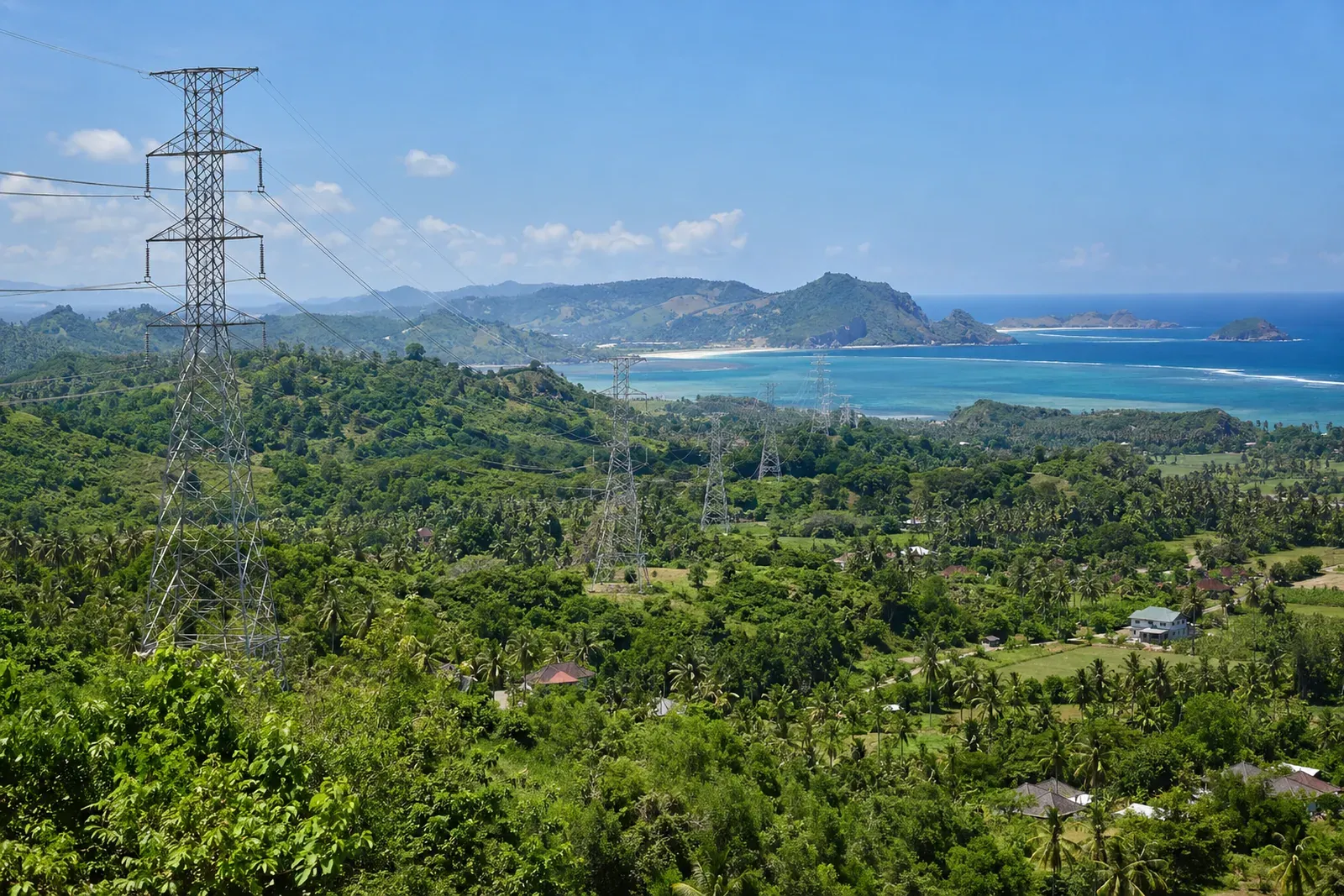
Indonesia’s Solar Ambition Turns on the Grid, Not the Headline Target
Indonesia’s proposed 100 GWp solar build-out is an investment signal, but grid capacity, storage and domestic manufacturing will shape whether ambition becomes delivery.
Quick answer: Indonesia’s proposed 100 GWp solar build-out signals a clear policy direction, but it does not yet establish a deliverable investment opportunity. A researcher cited by Antara identifies transmission and battery storage as the binding constraints, with coal still dominant in the power sector. For Lombok investors, the useful test is execution: infrastructure, sequencing and local economic capacity, not the headline target alone.
A large clean-energy target can suggest a new direction for capital, industry and employment. Yet the account reported by Antara Business is as notable for its caveat as for its ambition: solar generation is only useful at scale if the electricity system can absorb it. That distinction matters to investors seeking context rather than a simple read-through from a national announcement to local returns.
The Context
As the administration approaches its two-year mark, Indonesia’s clean-energy direction is being described positively by a researcher quoted by Antara. The clearest expression of that direction is a government target to build 100 gigawatt-peak (GWp) of solar power capacity, alongside plans for a gradual phase-out of fossil fuels. The researcher says this would place Indonesia among the world’s largest solar programmes. That is a statement about the ambition’s scale, not proof that the capacity has been built or that its delivery path is settled.
The existing power mix sets the challenge. Coal accounts for roughly 80 of the 120 GW of national electricity capacity, according to the report. Emissions from the electricity sector remain above 350 million metric tons of carbon dioxide equivalent per year. These figures describe a system with a substantial coal presence and a significant emissions burden. They do not, by themselves, tell investors how quickly that balance can change, what projects will be developed first, or how costs and returns will be distributed.
| Antara’s reported context | What it tells an investor | |---|---| | Government target of 100 GWp of solar capacity | The scale of the stated ambition | | Coal at roughly 80 of 120 GW of national electricity capacity | The power sector remains coal-dominated | | Electricity-sector emissions above 350 million metric tons of CO₂ equivalent a year | The transition challenge is material |
The table is a snapshot of the reported context, not a forecast. In particular, the solar target and the current national electricity capacity use different units: the former is expressed in gigawatt-peak, while the latter is given in gigawatts. They should not be treated as a like-for-like comparison. Nor does the report provide a project timetable, financing plan or location map from which to infer when or where new capacity will appear.
For investors, this is the difference between a policy signal and an investable pipeline. A target may help frame questions about future demand for equipment, grid upgrades and skills. It cannot answer them. Those answers depend on implementation details that the report does not supply, including sequencing, procurement, transmission planning and the practical arrangements for storage. Reading the ambition as a settled forecast would give it more precision than the source supports.
The Grid Is the Real Test
The central caution in the report concerns the network that must carry electricity from generators to users. Solar output varies with weather, the researcher notes, so a power system needs both a resilient grid and adequate battery storage to accommodate a large increase in solar generation. Without them, absorbing additional power into the national system becomes difficult. He describes this infrastructure gap as “the most binding constraint”, putting system readiness ahead of funding or the size of the target as the immediate test.
That diagnosis shifts the investment question. Instead of asking only how many panels may be installed, investors should ask what has to be ready for those panels to contribute reliable electricity. Transmission and storage are not decorative additions to a solar programme: in the researcher’s account, they are enabling conditions. The distinction is commercially relevant because generation capacity can be announced or proposed before all the supporting infrastructure is in place. A target is therefore a starting point for diligence, rather than a proxy for completed projects or dependable output.
This is a framework for assessing execution, not a claim that a particular grid project is delayed or that any named investment will benefit. The Antara report does not identify the locations where transmission or storage will be built, give their capacities, or set out a delivery schedule. It does not say whether the constraints are identical across Indonesia. Investors considering an energy-linked proposition would need project-specific information before drawing conclusions about access, timing or risk.
For Lombok-focused investors, the same discipline is useful. The report concerns Indonesia’s national energy direction and does not describe a solar project on Lombok, a local grid upgrade or an effect on property demand. A national target cannot establish that a particular site will receive more reliable electricity, or that energy infrastructure will change local operating costs. Such possibilities may be relevant questions in an investment review, but the source does not answer them. Any local conclusion would need evidence tied to the location and the asset under consideration.
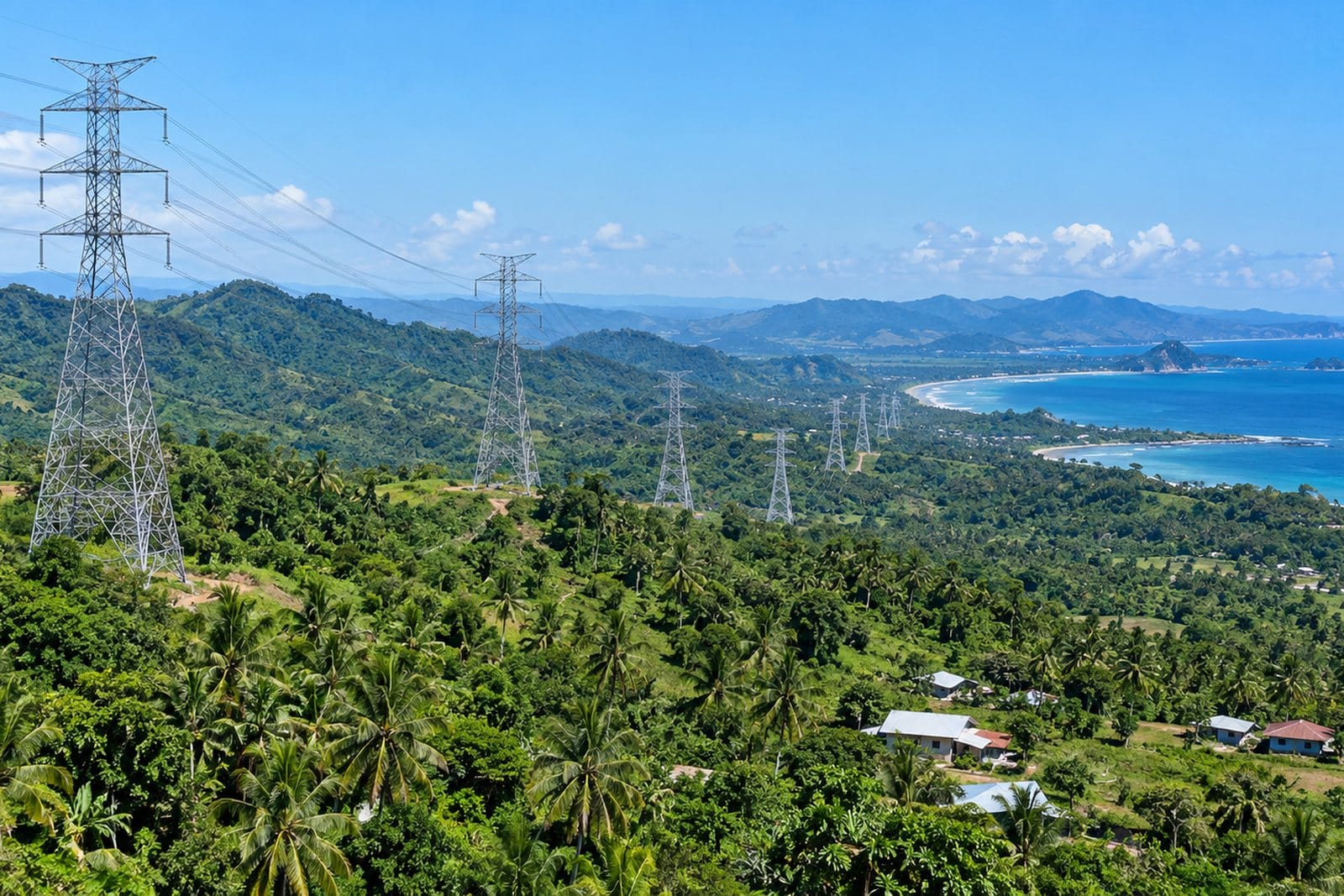 Indonesia’s Solar Ambition Turns on the Grid, Not the Headline Target · Illustration: HubLombok (AI-generated)
From Target to Industrial Capacity
The researcher’s recommendation reaches beyond electricity generation. He argues that demand associated with the solar target should support domestic solar-panel and battery manufacturing, while the workforce is upskilled. In his view, this could connect clean energy with higher-value economic growth. The proposal treats the transition as an industrial question as well as an energy one: whether demand for equipment and infrastructure can help build capabilities within the country.
That is a potential pathway, not an outcome established by the report. It does not identify manufacturing facilities, state that they have been approved, or quantify jobs, local sourcing or investment requirements. The distinction matters because a large equipment programme could create demand without necessarily creating domestic production capacity. The researcher’s point is that the policy should be used to build that bridge; investors still need evidence that the bridge is being constructed.
A useful reading of the recommendation is to look for alignment between three parts of the programme. The first is the generation target. The second is the infrastructure needed to move and balance electricity. The third is the domestic capability to supply equipment and train workers. If one element advances without the others, the economic effects could differ from the ambition described. That is analysis of the conditions the researcher raises, not a forecast about how Indonesia’s programme will unfold.
This also suggests a more careful way to assess claims about the opportunity. A prospective investor can separate policy intent from evidence of implementation: Is a proposal a stated target, a planned project or an operating asset? What information supports claims about the grid connection, storage and equipment supply? Are domestic manufacturing and workforce development described as goals, or supported by specific project details? Antara’s account gives a reason to ask these questions, but does not supply the answers for individual projects.
What This Means for Investors
Indonesia’s solar ambition deserves attention because it is large and sits alongside a stated direction to phase down fossil fuels. The reported figures also show why delivery should not be assumed: coal still accounts for roughly 80 of 120 GW of national electricity capacity, while electricity-sector emissions remain above 350 million metric tons of carbon dioxide equivalent per year. The proposed 100 GWp target is meaningful as a signal of intent, but the system required to turn it into usable power is central to the story.
Investors should therefore distinguish exposure to the idea of a transition from exposure to projects capable of delivering it. The researcher’s emphasis on transmission and battery systems gives a clear diligence lens. His recommendation to build domestic manufacturing and upskill workers adds a second lens: whether energy investment can support wider economic capability. Neither point establishes a schedule or a return. Both identify issues that should be tested against documentation for the particular investment being considered.
For Lombok, the restrained conclusion is the most useful one. This is national energy context, not evidence of a local project or a forecast for the island’s property market. It can inform the questions investors bring to a review of infrastructure-dependent assets, while leaving local conclusions to local evidence. The distinction between ambition, enabling infrastructure and delivery is likely to matter more than the headline figure when assessing what the transition means in practice.
Stay informed: subscribe to the free Lombok Briefing, published twice a month (the 1st and 15th), for market intelligence like this.
What is Indonesia’s solar power target?
The Antara report says the government has a target to build 100 GWp of solar power capacity. The report presents this as a policy ambition; it does not provide a delivery timetable or establish that the capacity has been built.
What does the report identify as the main constraint on solar expansion?
A researcher cited by Antara identifies transmission-grid readiness and battery storage as the key constraints. Solar output varies with weather, and the report says a resilient grid and adequate storage are needed to absorb more solar power into the national system.
Does this solar target show that Lombok property investors will benefit?
No. The report discusses Indonesia’s national energy direction and does not identify a solar project or grid upgrade on Lombok, or an effect on property demand. Investors would need location-specific evidence before drawing conclusions about a particular asset.

The Lombok Buyer's Field Guide
Legal structures ranked by risk, the honest ROI math line by line, all six zones ranked, and the 24-point due-diligence checklist. The whole book, free in your inbox.
See what's inside