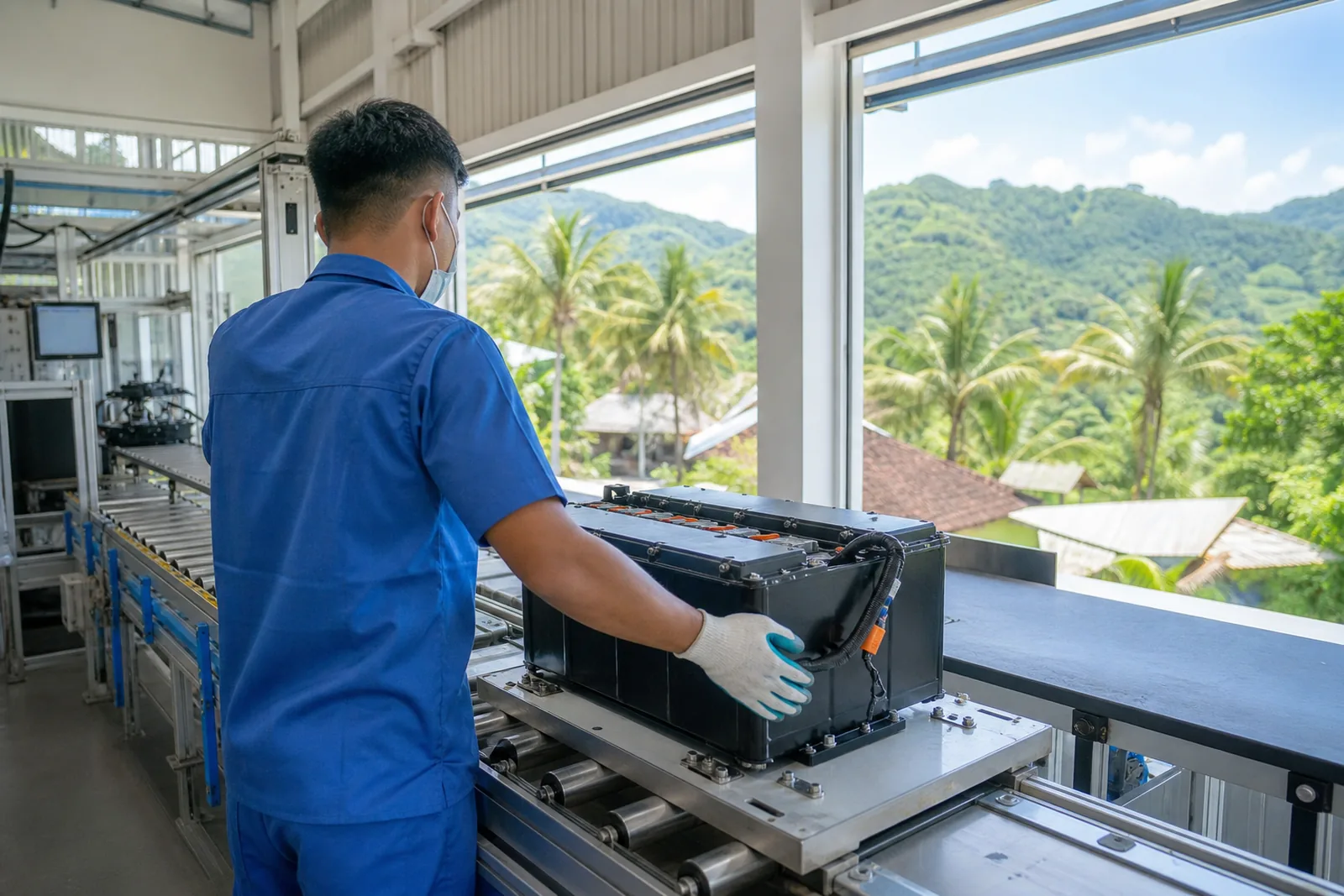
Indonesia’s E-Motorcycle Push Puts Nickel Value Chains in Focus
Indonesia’s new e-motorcycle programme offers investors a clearer view of how nickel policy may move from extraction into domestic industry.
Quick answer: Indonesia’s new Molinas e-motorcycle initiative is an industrial-policy signal, not an immediate Lombok investment catalyst. For investors, its importance lies in the attempt to link nickel processing, battery production, vehicle assembly and supporting services into a domestic value chain, an ambition whose execution will matter more than its launch.
A production facility in Cikarang, West Java, is an unlikely place to begin a Lombok notebook. Yet President Prabowo Subianto’s announcement of a national electric-motorcycle ecosystem offers a useful lens on the wider Indonesian investment story: the country is seeking not merely to extract resources, but to turn them into more complex economic activity.
For investors with exposure to Indonesia, whether through property, tourism, consumer demand or the broader national economy, the question is not whether electric motorcycles will transform every region at once. It is whether the state can translate abundant raw materials and policy ambition into a commercially durable industrial system.
The Context
The programme, known as Molinas, is intended to develop a national electric-motorcycle industry spanning vehicle manufacturing, batteries, charging infrastructure and after-sales services. It brings together government, state-owned companies and private businesses, according to Jakarta Post Business.
The stated policy objectives are clear: reduce fuel imports, increase electric-vehicle adoption and strengthen domestic production. The more consequential element, however, is the proposed connection to nickel. Indonesia has the world’s largest nickel reserves, with about 46 percent of global reserves located in the country, according to Danantara chief executive Rosan Roeslani.
That resource position has long made Indonesia central to the conversation around battery materials. Molinas presents the next step in the government’s preferred narrative: keeping more of the industrial process within Indonesia rather than relying on imported components.
“EV bikes can be affordable and high quality,” Rosan said, if nickel can be processed into battery cells and packs for future Molinas production.
The distinction matters. A resource endowment is not, by itself, an industrial ecosystem. The latter requires coordination between material processing, component manufacturing, vehicle assembly, infrastructure and the consumer experience after purchase. Molinas is notable because it explicitly names those linked layers.
An Ecosystem, Not Simply a Vehicle Programme
The launch took place at the Alva electric-motorcycle production facility. Alva is produced by PT Ilectra Motor Group, a subsidiary of mining conglomerate PT Indika Energy. The programme’s design also assigns roles to several large institutions: state asset fund Danantara, state-owned PT Len Industri and participating national motorcycle companies.
Rosan said at least 10 national motorcycle companies had met local-content requirements and would participate. PT Len Industri has been appointed lead integrator, working alongside Danantara.
This institutional architecture indicates that the initiative is intended to be broader than a single manufacturer or product line. In practical terms, it seeks to connect several commercial questions that are often treated separately:
- Can battery cells and packs be made locally from domestically processed nickel?
- Can locally produced electric motorcycles meet expectations on price and quality?
- Can charging and after-sales services make adoption workable for users?
- Can state-led coordination and private manufacturing reinforce one another?
None of these questions is answered merely by announcing a programme. They are, nevertheless, the right questions to place together. Battery supply chains depend on technical capability as well as access to materials. Vehicles depend on reliability as well as assembly capacity. Adoption depends on the ownership experience as well as the product itself.
For outside investors, that is the more sober reading of Molinas. It is a declaration of direction: Indonesia wants a larger share of the value created from its nickel resources to remain within the domestic economy. It is not evidence, on its own, that every part of that chain has already been secured.
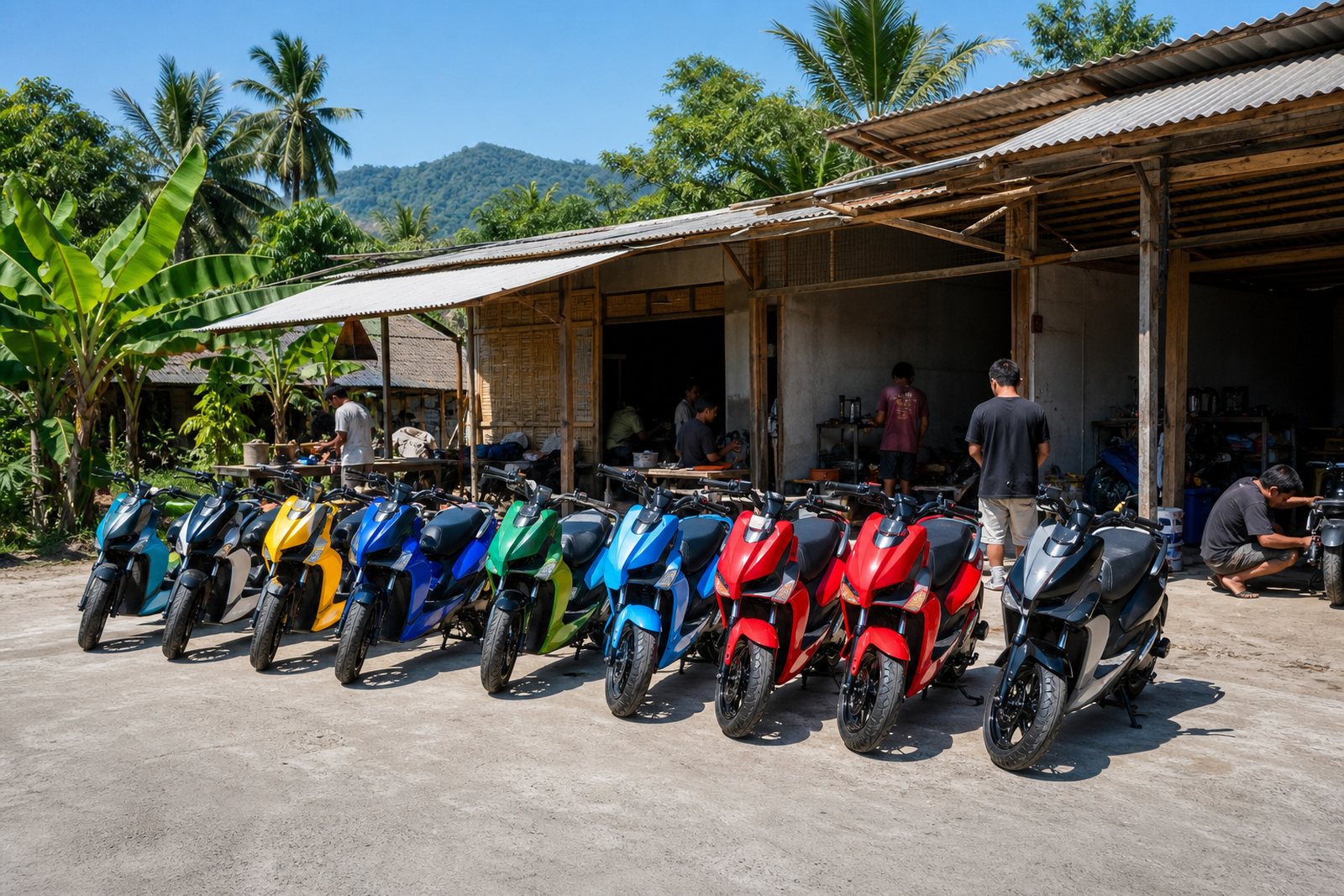 Indonesia’s E-Motorcycle Push Puts Nickel Value Chains in Focus · Illustration: HubLombok (AI-generated)
Nickel’s Strategic Test
Nickel gives the policy its strategic weight. The government hopes to process the resource into battery cells and packs for electric motorcycles rather than depend on imported components. That ambition turns a familiar commodity story into an execution story.
The economic appeal is understandable. Moving from raw-resource extraction towards processed materials and finished products can, in principle, broaden domestic industrial activity. But the chain is only as credible as its weakest link. A locally assembled motorcycle still depends on the quality, availability and commercial viability of its components and supporting services.
The initiative should therefore be assessed through evidence of progression rather than rhetoric alone. Investors may wish to distinguish between four levels of development:
| Layer | What Molinas seeks to connect | |---|---| | Materials | Nickel processing for battery inputs | | Manufacturing | Battery cells, packs and electric motorcycles | | Use infrastructure | Charging provision | | Customer support | After-sales services |
That framework is useful beyond the electric-motorcycle sector. Indonesia’s investment case frequently combines domestic scale, resource wealth and policy support. The difficult work lies in converting those advantages into businesses that can compete on product quality, cost and dependable service.
Molinas also sits within a broader question about the role of state coordination. Danantara and PT Len Industri are not peripheral participants; they are part of the programme’s operating design. This may help align a complex group of stakeholders. It also means investors should pay close attention to how responsibilities are carried out in practice, including the interaction between public bodies and private companies.
The launch offers a starting point for that assessment, rather than a conclusion.
What This Means for Investors
For Lombok-focused investors, Molinas is principally macro context. It does not create a direct investment thesis for South Lombok property, nor does the source suggest a specific local rollout, development or commercial outcome for the island. Its relevance is indirect: it illustrates the national government’s effort to shape domestic value creation around strategic industries.
A measured investor response would be to watch for proof that the ecosystem is becoming operational across its stated components. Useful questions include:
- Whether participating manufacturers move from programme membership to sustained production;
- Whether nickel processing is translated into battery cells and packs used in Molinas production;
- Whether charging and after-sales services develop alongside vehicle manufacturing; and
- Whether the resulting motorcycles are affordable and high quality, as Rosan envisaged.
This is also a reminder that Indonesian policy announcements should be read in layers. The headline may concern a national initiative; the investable insight lies in the practical mechanisms behind it. Who is responsible? What part of the chain is domestic? Which elements still depend on execution? And does the programme make the end product more compelling for users?
Molinas offers no shortcut around those questions. It does, however, make the government’s industrial preference unusually explicit: nickel should be a foundation for domestic battery and vehicle production, not simply a resource exported before its wider value is captured.
For investors, that is worth noting with neither exuberance nor cynicism. Indonesia’s e-motorcycle initiative is best understood as a strategic experiment in building an ecosystem. Its significance will be determined not by the launch-stage promise, but by the degree to which materials, manufacturing, infrastructure and service ultimately work together.
Stay informed, subscribe to the free Lombok Briefing for market intelligence like this, published twice a month.
What is Indonesia’s Molinas e-motorcycle programme?
Molinas is a government-backed initiative to develop a domestic electric-motorcycle ecosystem. According to Jakarta Post Business, it spans vehicle manufacturing, batteries, charging infrastructure and after-sales services, involving government, state-owned companies and private businesses.
Why is nickel central to the Molinas initiative?
The programme aims to use Indonesia’s nickel resources for locally produced battery cells and battery packs used in electric motorcycles. Danantara chief executive Rosan Roeslani said Indonesia holds about 46 percent of global nickel reserves.
Does Molinas directly change the Lombok property investment case?
No direct Lombok property impact is established in the source. For Lombok investors, Molinas is broader Indonesian economic context: an indication of efforts to build domestic industrial value chains around strategic resources and electric-vehicle adoption.

The Lombok Buyer's Field Guide
Legal structures ranked by risk, the honest ROI math line by line, all six zones ranked, and the 24-point due-diligence checklist. The whole book, free in your inbox.
See what's inside