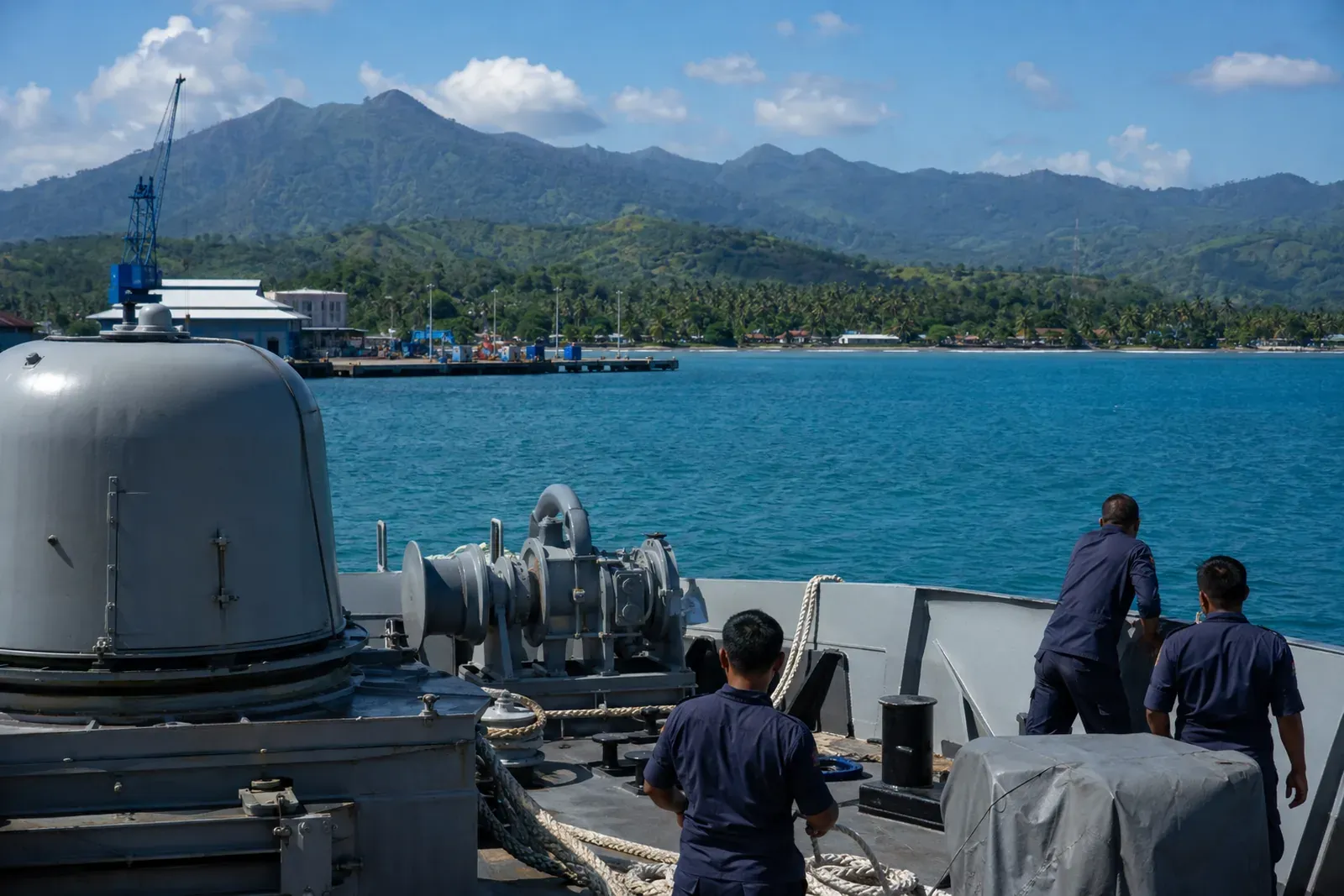
Indonesia Plans Disaster-Response Aircraft Carrier: Investor Implications
Indonesia plans to refit ITS Giuseppe Garibaldi as KRI Gajah Mada for helicopter and drone disaster operations. What Lombok investors should watch.
Quick answer: Indonesia plans to refit the Italian vessel ITS Giuseppe Garibaldi as KRI Gajah Mada, a helicopter-and-drone carrier for disaster response. For Lombok investors, it is a live signal of national preparedness policy, but the announcement establishes no confirmed local deployment, timetable, budget or property-market effect.
Indonesia’s President Prabowo Subianto has set out a plan to transform a vessel arriving from Italy into a platform for helicopter and drone operations supporting disaster mitigation. The announcement matters less as an immediate property-market catalyst than as a revealing statement of how Jakarta intends to prepare for hazards across an archipelago where mobility can determine the pace of an emergency response.
The Context
The proposal was unveiled by President Prabowo while chairing a limited meeting on the ongoing response to natural disasters through video conference from Merdeka Palace in Jakarta. According to Antara, the government intends to commission ITS Giuseppe Garibaldi into the Indonesian Navy and refurbish it as a carrier for helicopters and drones.
The vessel is due to be renamed KRI Gajah Mada. The President described it as Indonesia’s first carrier and said that, after customisation, it is projected to accommodate up to 10 medium-class helicopters.
That is the operational core of the announcement. Rather than presenting the ship principally as a conventional naval aviation asset, the government is framing it as a mobile site from which aircraft can land and launch in support of disaster mitigation. The stated emphasis is on helicopters and drones, with the former intended to support firefighting and wider emergency operations.
“We should not wait for a disaster to occur. It is crucial that we take preparatory steps well in advance,” President Prabowo said, according to Antara.
The backdrop is pressing. Indonesia is mobilising numerous institutions against widespread forest and land fires, with major cases reported across Sumatra and Kalimantan. Authorities have also responded to volcanic eruptions in several regions, while communities in East Nusa Tenggara are recovering from the deadly earthquake reported in August.
For investors assessing Indonesia, this is an important distinction: the report concerns a national preparedness initiative, not a project announcement for Lombok, a tourism development scheme, or an assurance of local emergency-service capacity. It should be read at its stated scale.
A Mobile Platform for Helicopters and Drones
The President said the adapted vessel would function as a mobile landing and launching site for helicopters including the Black Hawk and MI-17. In the account provided by Antara, these aircraft are capable of carrying four to five metric tons of water.
The immediate use case described by the government is wildfire suppression. President Prabowo said that a force of 10 helicopters could be deployed quickly towards areas most affected by wildfires, strengthening the government’s response capacity.
The planned operating model, as described, has several components:
- a shipborne platform for helicopter landings and launches;
- drone operations in support of disaster mitigation;
- water-carrying helicopter missions for wildfire response; and
- a mobile asset designed to improve readiness before a disaster occurs.
This is a plan, not yet an operational capability. Antara reports that the vessel will “soon” be commissioned under the Indonesian Navy and that it will be refurbished, but the supplied report gives no completion date, cost, basing arrangement, deployment pattern or confirmed disaster-response protocol. Investors should resist filling those gaps with assumptions.
The same discipline applies to geography. Indonesia’s disaster exposure is vast and varied, and the source identifies fires in Sumatra and Kalimantan, volcanic eruptions in several regions, and earthquake recovery in East Nusa Tenggara. It does not identify South Lombok as a planned operating location for KRI Gajah Mada, nor does it say the vessel will be assigned to a particular island or province.
 Indonesia Plans Disaster-Response Aircraft Carrier · Illustration: HubLombok (AI-generated)
What the Announcement Does, and Does Not, Establish
The policy signal is clear: Indonesia’s leadership is placing visible emphasis on pre-disaster readiness, rapid aviation access and the ability to move firefighting and response capability by sea. The operational detail, however, remains narrow.
| Confirmed in the report | Not confirmed in the report | |---|---| | ITS Giuseppe Garibaldi is to be commissioned and renamed KRI Gajah Mada | A completion timetable for refurbishment | | The vessel is intended for helicopter and drone operations | A budget or final technical specification | | It is projected to carry up to 10 medium-class helicopters | A permanent operating base or local deployment plan | | Helicopters are envisaged for wildfire suppression | Any direct effect on Lombok property values or tourism |
This distinction is especially relevant for international buyers accustomed to treating infrastructure announcements as a direct proxy for asset performance. A government initiative may be strategically meaningful without producing an immediate, measurable change in local real-estate economics.
The source does not claim that the carrier will reduce insurance costs, alter travel patterns, improve a specific airport or port, or change the value of property in Lombok. Nor does it establish a date by which the vessel will be ready to operate. Those may become investable questions later, but they are not answered by this dispatch.
What can reasonably be observed now is the direction of policy language. The President linked the vessel’s prospective role to disaster mitigation, the battle against wildfires and advance preparedness. This is a national resilience narrative, delivered while authorities confront several active disaster-related challenges.
For a reader considering Indonesian exposure, that narrative should be treated as one part of a wider due-diligence picture. It is neither a substitute for location-specific assessment nor a reason to infer operational outcomes that have not been announced.
What This Means for Investors
For Lombok investors, the immediate implication is informational rather than transactional. The announcement is relevant because natural-disaster preparedness is a material element of the operating environment in any Indonesian island market. Yet the disclosed facts do not support a conclusion that any particular Lombok asset, development zone or tourism business will benefit from KRI Gajah Mada.
A sensible reading is therefore measured.
First, the initiative demonstrates that disaster response is receiving direct attention from the President at a time of active fires, volcanic activity and earthquake recovery. That is a meaningful policy signal, particularly for investors who assess governance and resilience alongside location, rental strategy and legal structure.
Second, the proposed carrier could eventually broaden the government’s options for moving helicopters and drones during emergencies. But the report does not specify where it will operate, how it will be deployed, or when its conversion will be complete. A prospective capability is not the same as a confirmed local service.
Third, the story reinforces why buyers should ask practical, local questions before committing capital. Those questions concern a property’s physical setting, access, construction approach, emergency planning and the contractual allocation of risk. They cannot be answered by a national announcement alone.
For buyers already conducting due diligence in Lombok, the appropriate response is not to re-price an opportunity around this news. It is to keep the development in view while distinguishing clearly between confirmed policy, prospective capability and local evidence.
The most durable investment lesson is simple: preparedness announcements deserve attention, but precision matters. Indonesia’s planned conversion of ITS Giuseppe Garibaldi into KRI Gajah Mada may become an important component of disaster response. Today, the confirmed development is the government’s intention to create a helicopter-and-drone platform; the local consequences remain unconfirmed.
Stay informed, subscribe to the free Lombok Briefing for market intelligence like this, published twice a month.
What is Indonesia planning to do with ITS Giuseppe Garibaldi?
Indonesia plans to commission ITS Giuseppe Garibaldi into the Indonesian Navy, rename it KRI Gajah Mada and refurbish it for helicopter and drone operations supporting disaster mitigation. The President said the customised vessel is projected to carry up to 10 medium-class helicopters.
Will the planned carrier be deployed in Lombok?
The supplied report does not confirm a Lombok deployment, operating base or regional assignment for KRI Gajah Mada. It describes a national disaster-mitigation initiative and references fires in Sumatra and Kalimantan, volcanic eruptions in several regions, and earthquake recovery in East Nusa Tenggara.
Does this announcement change Lombok property investment prospects?
No direct property-market effect is established in the report. The announcement signals national attention to disaster preparedness, but it provides no confirmed timetable, budget, Lombok deployment plan, insurance impact or evidence of changed tourism or real-estate conditions.

The Lombok Buyer's Field Guide
Legal structures ranked by risk, the honest ROI math line by line, all six zones ranked, and the 24-point due-diligence checklist. The whole book, free in your inbox.
See what's inside