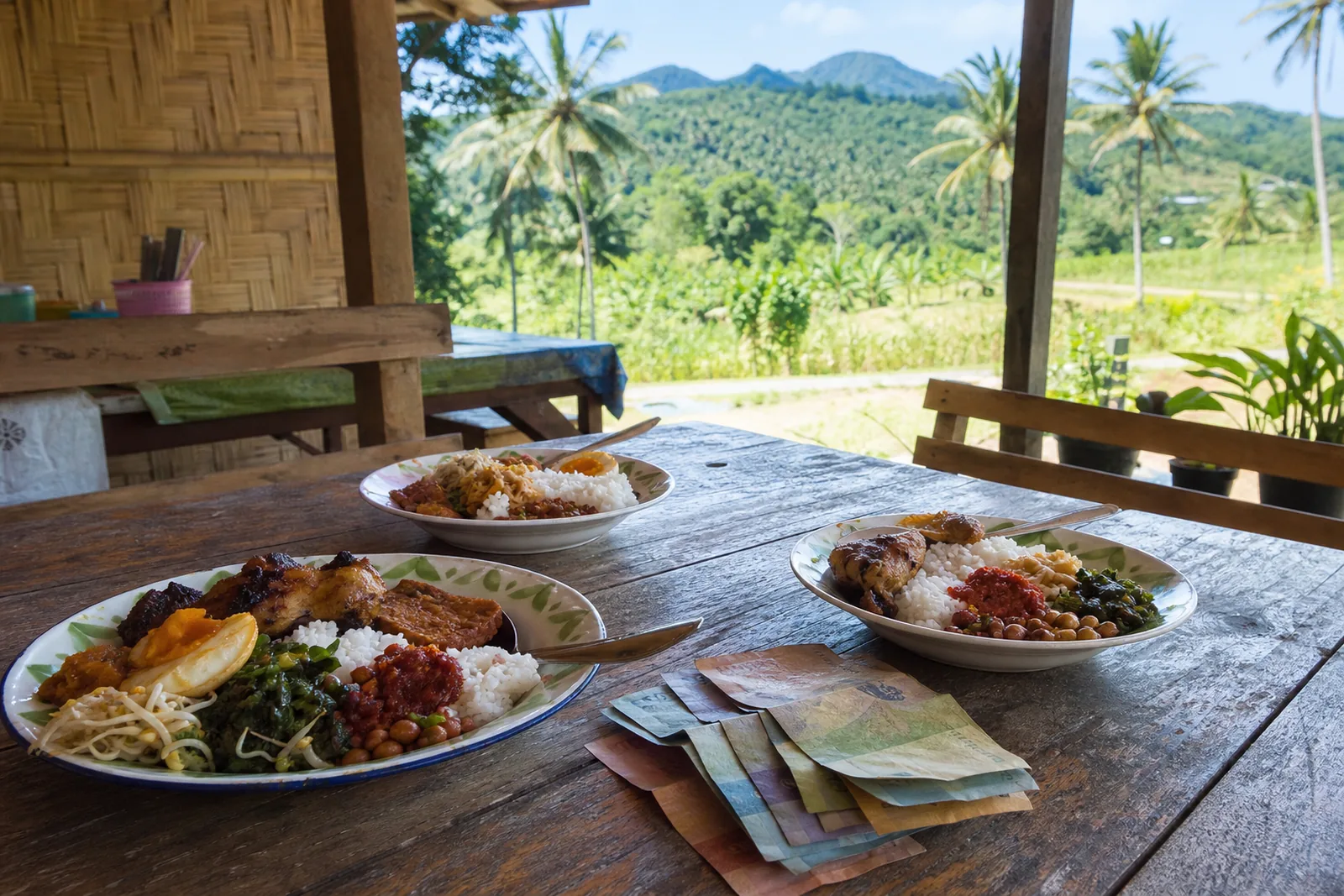
Indonesia’s Controlled Deficit Offers Lombok Investors a Useful Macro Signal
Indonesia’s deficit remained contained through July, offering Lombok investors a measured read on fiscal discipline, spending priorities and risk context.
Quick answer: Indonesia’s contained budget deficit through July 2026 gives Lombok investors a constructive, but not conclusive, macroeconomic signal: the government reports rising revenue alongside higher spending on households, infrastructure and subsidies. It does not guarantee local property returns, yet it supports a more informed assessment of Indonesia-wide fiscal risk.
The Context
For an overseas buyer considering South Lombok, national budget data can feel remote from a villa, a land title or a beach road. It is not. Property investment is local in its execution, but it sits inside a national framework of public finances, policy priorities and consumer confidence.
Antara Business reports that Indonesia’s State Budget deficit stood at 0.91% of GDP through the end of July 2026. President Prabowo Subianto presented the figure alongside an argument that fiscal discipline and increased social spending can coexist. His formulation was deliberately simple: public support need not come at the expense of prudence.
“We are not choosing between growth and prudence. We are choosing both,” President Prabowo said, according to Antara.
The immediate significance is not that one deficit figure predicts a Lombok investment outcome. It does not. Rather, the report offers a snapshot of the fiscal environment in which foreign investors are assessing Indonesian assets.
The government said state revenue had grown 21.3% year on year by the end of July, ahead of an 18.2% increase in state spending over the same period. Separately, figures cited from the Financial System Stability Committee put revenue at Rp1,459.4 trillion and expenditure at Rp1,656.0 trillion by the end of the second quarter of 2026. Central government expenditure was reported at Rp1,298.6 trillion, after growth of 29.4%.
These are national aggregates, not a Lombok-specific balance sheet. They should therefore be read as context, not as a substitute for underwriting a particular purchase. A buyer still needs to examine title, zoning, construction obligations, operating assumptions and exit liquidity asset by asset.
For Lombok, the most useful takeaway is the character of the message. Indonesia is presenting itself as willing to spend on strategic programmes and household support while maintaining a deficit the President describes as controlled. That combination matters to investors because it speaks to the policy backdrop rather than to a single quarter’s property demand.
A Fiscal Signal, Not a Property Forecast
The source identifies the areas receiving higher central government spending: purchasing power, the free nutritious meals programme, social assistance, infrastructure, holiday allowances and energy subsidies. Each can matter economically. None should be converted into an automatic forecast for South Lombok land values, rental occupancy or villa rates.
That distinction is worth making because emerging-market property narratives can become overly linear. A contained deficit is sometimes presented as proof that every local development will prosper. Conversely, a higher spending programme is sometimes treated as proof of impending instability. Both readings ask too much of one set of public-finance figures.
A more disciplined approach separates three layers of analysis:
- National fiscal setting: the deficit, revenue trajectory and government spending priorities reported by Antara.
- Regional market conditions: tourism recovery, visitor demand and the relative maturity of Lombok’s submarkets.
- Asset-level execution: legal structure, land due diligence, build quality, management fees, booking costs and realistic occupancy.
Lombok’s investment case has its own measurable features. Foreign arrivals are reported as rising 40-50% year on year, reflecting tourism recovery and the MotoGP effect. In Kuta and Mandalika, villa rates are about 38% higher year on year. Are Guling has recorded momentum of about 47% year on year, the strongest among the six tracked zones and consistent with its earlier-cycle positioning.
Those indicators may help explain why investors are studying Lombok rather than treating it solely as Bali’s quieter neighbour. The broader thesis is “Bali-overflow”: rising Bali prices and congestion can push demand towards a less expensive, earlier-cycle market. Yet a thesis is not a guarantee, and the current fiscal report does not alter that basic rule.
The local pricing spread is one reason due diligence must remain geographically precise. Prime tourist-zone land across South Lombok is about Rp150-400 million per are, while the full range across the tracked zones is about Rp30-400 million per are. An are is 100 m²; local transactions should be assessed in the local convention of price per are.
| Zone | Authoritative land range | Approximate USD per are | Market character | |---|---:|---:|---| | Kuta | Rp300-400M/are | $18,200-24,200/are | Demand and liquidity leader | | Selong Belanak | Rp150-250M/are | $9,100-15,200/are | Family-tourism and capital-growth market | | Are Guling | Rp120-180M/are | $7,300-10,900/are | Early-cycle frontier | | Mandalika | Rp100-150M/are | $6,100-9,100/are | SEZ around the MotoGP circuit | | Mawun | Rp50-80M/are | $3,000-4,800/are | Quiet bay west of Kuta | | Bumbang | Rp30-50M/are | $1,800-3,000/are | Emerging, lowest entry |
The table does not suggest that the national budget will move each zone in the same way. It illustrates the opposite: Lombok is not one homogeneous market. National fiscal discipline may improve the setting in which investment decisions are made; local scarcity, access, planning and operating execution determine far more of the individual outcome.
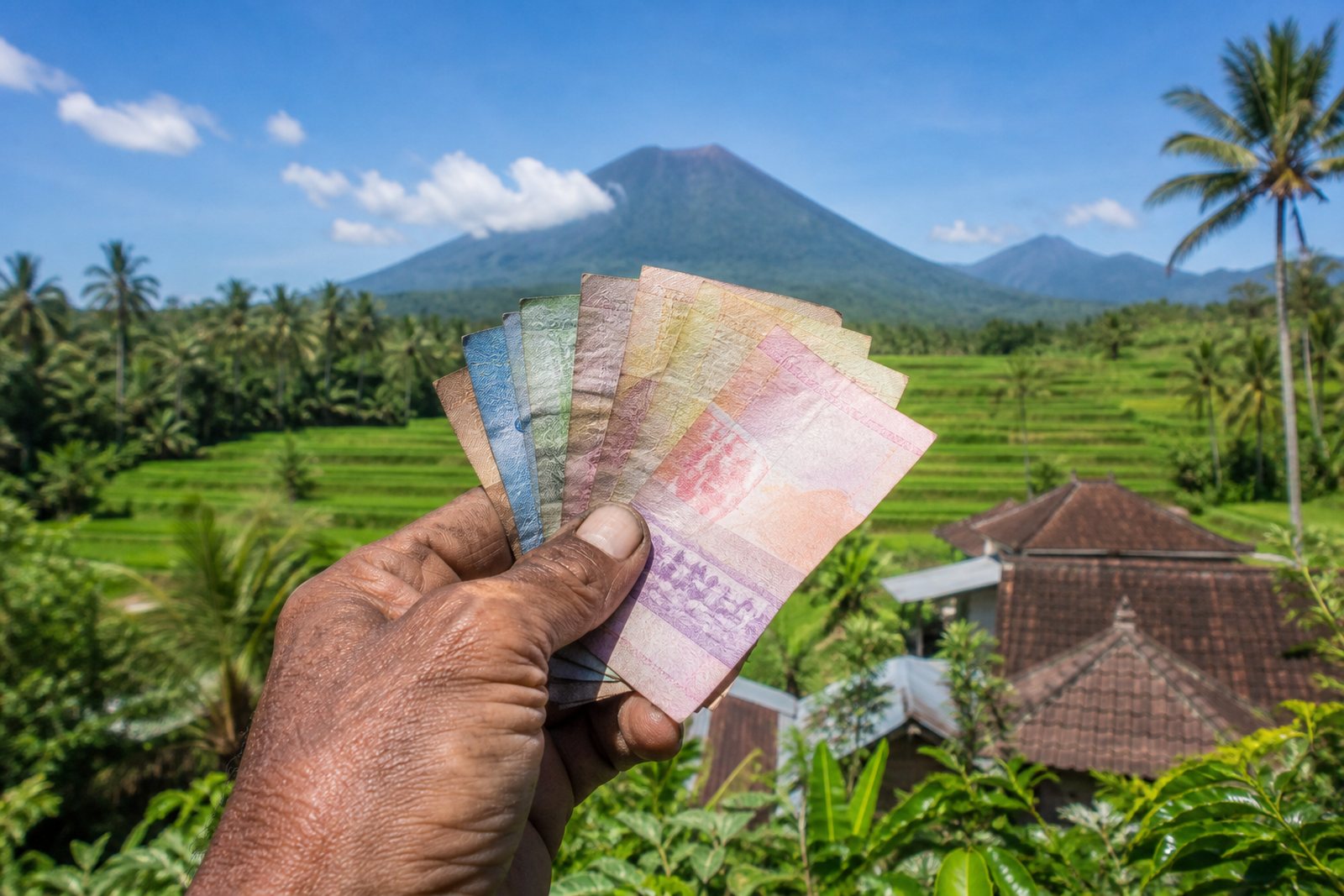 Indonesia’s Controlled Deficit Offers Lombok Investors a Useful Macro Signal · Illustration: HubLombok (AI-generated)
Where the National Story Meets the Local One
The report’s emphasis on public purchasing power and infrastructure is relevant to the way investors should frame risk. It points to a government attempting to sustain economic activity while keeping its fiscal position in view. For a foreign buyer, that is a more useful starting point than a promotional claim that a destination is somehow insulated from national conditions.
It is also an invitation to test assumptions. A strong macro narrative should make an investor more exacting, not less so. If the national context is stable enough to merit attention, then the asset-level details are deserving of equal seriousness.
Rental income is a clear example. Developer-quoted gross yields of 12-22% exclude important costs. Honest net yields of 7-12% come after management fees and realistic occupancy, while top-performing assets can reach about 15% net. Management fees are typically 18-22% of gross rental revenue, and OTA or booking commissions are 15-20%.
Realistic stabilised occupancy in the first three years is 55-70%. That is below Bali’s 70-85% range, and it should remain below an investor’s headline assumptions unless an operator can demonstrate a credible, asset-specific basis for something stronger.
The contrast is not a criticism of Lombok. It is what a market at an earlier stage looks like when described honestly. The potential reward may be higher, but so is the need to distinguish a marketing forecast from an operating result.
A comparable discipline applies to acquisition structure. Foreigners cannot hold freehold, or Hak Milik/SHM; it is reserved for Indonesian citizens. Available routes include leasehold, typically 25-30 years with extensions; Hak Pakai, a personal right-to-use requiring KITAS or KITAP residency; and a PT PMA, a foreign-owned company that can hold Hak Guna Bangunan for 30 years, extendable.
Nominee arrangements, in which an Indonesian citizen holds freehold on a foreigner’s behalf, are illegal and void in court. This is not an administrative footnote. It is a core investment-risk question, particularly when a compelling macro story creates pressure to act quickly.
A licensed PPAT notary executes the relevant deeds; the deed of sale is the AJB, and the land agency is BPN. Buyer transfer duty, BPHTB, is about 5% of assessed value, while annual land-and-building tax, PBB, is modest. TerraNusa Advisory, HubLombok’s legal and notary advisory partner, supports foreign buyers through due diligence on certificates, ownership history, zoning and encumbrances, as well as PT PMA setup, tax matters and title transfer at BPN. Its role is advisory: legal execution must be part of the investment case, not an afterthought.
HubLombok is the editorial arm of Samudra Villas, an active developer in Are Guling, South Lombok. That relationship is relevant here because fiscal context should never obscure the need for independent legal and commercial scrutiny of any development, including those in the market areas we cover.
What This Means for Investors
The prudent reading of Indonesia’s 0.91% of GDP deficit is neither triumphal nor alarmist. It is a positive macro signal insofar as the government reports revenue growth exceeding spending growth while maintaining social and strategic expenditure. It is not evidence that a particular Lombok project will achieve its projected yield or sell at a desired price.
For investors in Europe, Australia and the United States, the report is best used as one line in a wider investment memorandum. It can inform the country-risk discussion. It cannot complete it.
A robust decision process would ask:
- Is the local market thesis supported by current land pricing and realistic operating assumptions?
- Is the quoted return gross or net, and are management and booking costs fully included?
- Is the chosen legal route appropriate for the buyer’s residency and ownership objectives?
- Has an independent review confirmed certificate status, ownership history, zoning and encumbrances?
- Does the asset’s position within Kuta, Selong Belanak, Are Guling, Mandalika, Mawun or Bumbang match the investor’s tolerance for liquidity and early-cycle risk?
That is the value of a Lombok Notebook view. The national budget story adds useful texture: Indonesia’s leaders are presenting a case for growth alongside fiscal restraint. The local property story remains more granular. It depends on land, law, operations and the particular demand pattern of each zone.
Investors who keep those two levels separate are better placed to see the opportunity clearly. A disciplined fiscal backdrop can support confidence. It cannot replace disciplined underwriting.
Stay informed, subscribe to the free Lombok Briefing for market intelligence like this, published twice a month.
What does Indonesia’s budget deficit mean for Lombok investors?
Indonesia’s reported 0.91% of GDP deficit through July 2026 is a constructive macroeconomic signal because revenue growth outpaced spending growth. It does not predict a Lombok property’s return, occupancy or resale value; those depend on the individual asset, legal structure and local market.
Can Indonesia’s fiscal position guarantee Lombok villa rental returns?
No. National fiscal data provides country-level context, not an operating guarantee. Lombok investors should distinguish developer-quoted gross yields of 12-22% from honest net yields of 7-12% after management fees and realistic occupancy, with top-performing assets reaching about 15% net.
What legal route can a foreigner use to buy in Lombok?
Foreigners cannot hold freehold Hak Milik/SHM. Common routes are leasehold, typically 25-30 years with extensions; Hak Pakai for eligible residents; or a PT PMA holding Hak Guna Bangunan for 30 years, extendable. Nominee freehold arrangements are illegal and void in court.

The Lombok Buyer's Field Guide
Legal structures ranked by risk, the honest ROI math line by line, all six zones ranked, and the 24-point due-diligence checklist. The whole book, free in your inbox.
See what's inside