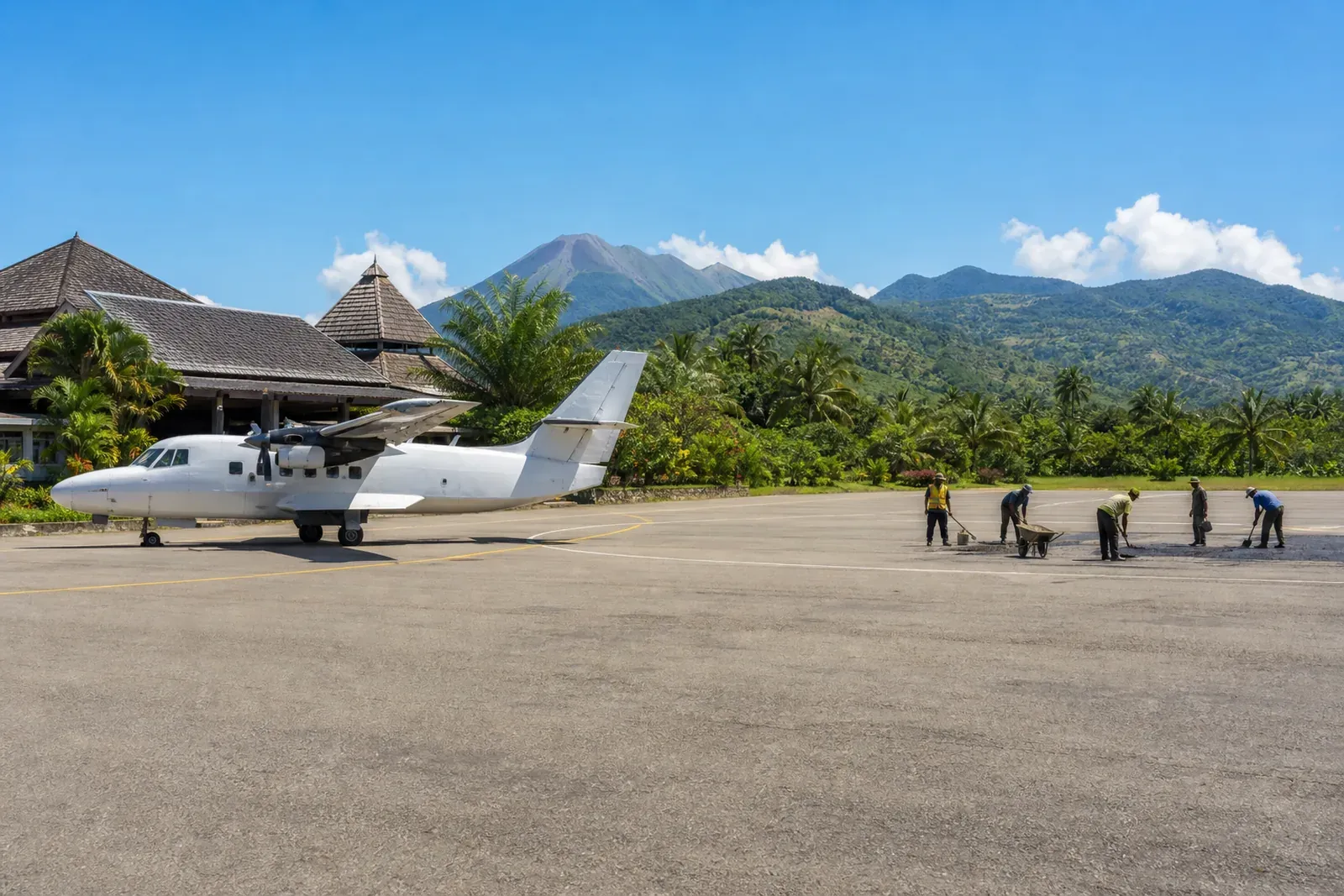
Indonesia Accelerates Repairs at Quake-Damaged NTT Airports
Indonesia is accelerating repairs at earthquake-damaged airports in East Nusa Tenggara, with safety and operational recovery at the centre of its response.
Indonesia is accelerating repairs at airports damaged by the magnitude 7.7 earthquake that struck East Nusa Tenggara on Aug. 15, 2026. The immediate policy priority is clear: restore safe, reliable air connectivity while recovery plans are shaped by on-the-ground inspections.
For investors following eastern Indonesia, the development is chiefly a reminder that transport infrastructure is both an economic enabler and a resilience issue. The Ministry of Transportation has framed the programme around safety, operational needs and repairs targeted according to the severity of damage.
Inspections shape the recovery plan
Following the earthquake, the Directorate General of Civil Aviation inspected several regional facilities in East Nusa Tenggara. The exercise was intended to assess structural damage, identify immediate operational requirements and determine where rehabilitation should be directed.
The airports inspected were:
- Komodo International Airport
- Fransiskus Xaverius Seda Airport
- H. Hasan Aroeboesman Airport
- Soa Airport
- Frans Sales Lega Airport
The Ministry of Transportation said the inspection findings will guide its official recovery strategy. That is an important distinction for market observers: the authorities have announced an accelerated recovery effort, but the practical scope of work will be determined by the condition found at each site.
The Directorate General of Civil Aviation is using field inspections to evaluate damage, establish immediate operational needs and target rehabilitation across the province.
Soa Airport is the stated priority
Restoration work at Soa Airport in Bajawa, Ngada District, has been designated as a top priority. Officials said damage at all affected sites will be addressed according to severity, with the aim of speeding the return to full capacity.
Lukman F. Laisa, Director General of Civil Aviation, said the government is prioritising repairs to building structures and supporting facilities. These include passenger terminals and facilities used for flight operations.
The emphasis matters because an airport recovery programme extends beyond visible building repairs. Passenger-facing areas and operational infrastructure both sit within the ministry's stated focus, while aviation safety and security standards are to be maintained throughout restoration.
“We are prioritizing the repair of building structures and supporting facilities, including passenger terminals and flight operations facilities,” Lukman F. Laisa said, according to the Ministry of Transportation.
Safety remains the operating principle
The government has presented restoration as a safety-led process rather than simply a construction timetable. Officials said they are working to ensure that requirements at each location are properly identified before the ministry finalises its recovery strategy.
This approach places the inspection process at the centre of decision-making. It also means that investors and tourism-sector businesses should distinguish between the policy commitment to accelerate repairs and any assumptions about the sequence or timing of individual airport works. The source confirms the priority framework; it does not provide a completion timetable.
The ministry is coordinating relief efforts with regional stakeholders while repairs proceed. During visits to the affected airports, Lukman also distributed aid to airport staff affected by the disaster.
Regional connectivity under pressure
Airports are critical infrastructure for East Nusa Tenggara, particularly when earthquake damage affects passenger terminals or facilities supporting flight operations. In this case, the government has explicitly linked its recovery effort to restoring air connectivity and ensuring flight safety.
For the wider investment conversation around eastern Indonesia, the lesson is not a new forecast but an enduring due-diligence principle. Connectivity supports tourism, business travel, logistics and workforce movement, yet physical infrastructure also requires robust maintenance, emergency response and clear operational oversight after a disaster.
The current announcement provides evidence of active central-government involvement. It does not, however, establish a wider economic impact, a forecast for visitor activity, or a direct implication for Lombok property values. Those conclusions would require evidence beyond the ministry's statement.
What this means for investors
Investors with exposure to tourism, hospitality or infrastructure-linked businesses in eastern Indonesia should watch the recovery process closely, while keeping their analysis anchored in disclosed facts.
- Prioritisation is visible: Soa Airport has been identified as a top restoration priority.
- Scope remains assessment-led: Works across the inspected airports will be addressed based on the severity of damage.
- Safety is central: The ministry has placed aviation safety and security standards at the core of the restoration programme.
- Timelines are not yet disclosed: The announcement does not specify when individual facilities will return to full capacity.
- Avoid unsupported spillover assumptions: The statement concerns airports in East Nusa Tenggara and does not quantify consequences for Lombok or other markets.
For disciplined investors, that last point is especially useful. Natural-disaster headlines can tempt markets into broad regional narratives, but location, asset quality, operating exposure and verified transport conditions should be assessed separately. The government’s response is material because it seeks to restore critical connectivity; the investment significance of that response will become clearer as the official recovery strategy and project-level updates emerge.
The next meaningful signal will be evidence of how the inspection findings translate into rehabilitation priorities and restored operations across the affected network.
Stay informed, subscribe to the free Lombok Briefing for analysis like this, published twice a month.
Which East Nusa Tenggara airports were inspected after the earthquake?
The Directorate General of Civil Aviation inspected Komodo International Airport, Fransiskus Xaverius Seda Airport, H. Hasan Aroeboesman Airport, Soa Airport and Frans Sales Lega Airport after the magnitude 7.7 earthquake on Aug. 15, 2026.
Which airport has been made the top repair priority?
Soa Airport in Bajawa, Ngada District, has been designated a top priority for restoration. The Ministry of Transportation said damage at all affected airports will be addressed according to severity as it works towards a return to full capacity.
Does the announcement give a reopening timetable for the airports?
No. The Ministry of Transportation confirmed accelerated recovery efforts and inspection-led rehabilitation, but the source does not provide a timetable for individual repairs or for the return of any airport to full capacity.

The Lombok Buyer's Field Guide
Legal structures ranked by risk, the honest ROI math line by line, all six zones ranked, and the 24-point due-diligence checklist. The whole book, free in your inbox.
See what's inside