Gawah Bongak’s VCO Finds a European Tourist Market
A village coconut resource in Central Lombok is being processed into VCO and related products aimed at European tourists.
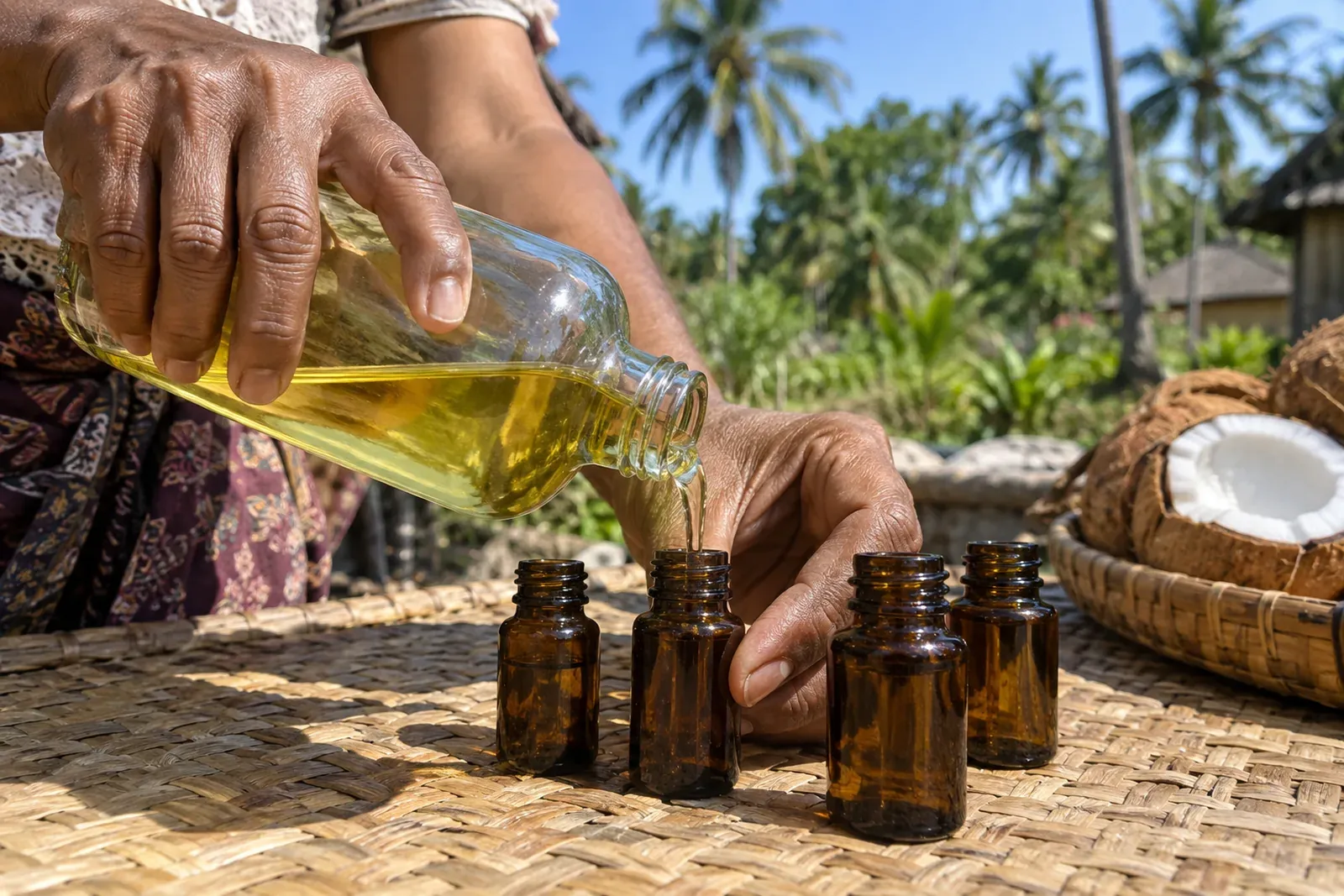
A small village industry in Central Lombok is turning a familiar agricultural resource into a more differentiated product. Suara NTB reports that residents of Dusun Gawah Bongak in Tumpak Village, Pujut, are processing coconuts into virgin coconut oil, or VCO, and related products for European tourists.
The story is modest in scale, but it speaks to a larger investment question for Lombok: how tourism demand can support local value creation beyond accommodation, land and leisure infrastructure.
From household use to a visitor-facing product
According to Suara NTB, coconuts in Gawah Bongak had previously been processed into oil for local needs. The reported shift is towards VCO and a range of derivative products aimed at the European visitor market.
That distinction matters. A coconut sold or used in a basic local form has one economic role. Processing it into VCO creates a product with a clearer identity for visitors, particularly where provenance, local production and practical use are part of the appeal. The source does not provide production volumes, revenue, pricing, export arrangements or visitor-sales data, so the commercial scale of the initiative should not be overstated.
Reported development: Gawah Bongak residents are processing coconuts into VCO and derivative products, with European tourists identified as the market.
For investors, however, the significance lies less in a single product line than in the direction of travel. Tourism economies become more resilient when visitor spending can circulate through local suppliers, producers and small enterprises rather than remaining confined to accommodation and transport.
Tourism’s economic footprint is broader than room nights
Lombok’s investment narrative is often framed through villas, land and tourism-led property demand. In South Lombok, verified market figures point to foreign-arrivals growth of 40-50% year on year, linked to tourism recovery and the MotoGP effect. Kuta and Mandalika villa rates are reported at about +38% year on year.
Those figures do not establish a direct causal link to Gawah Bongak’s VCO activity. Nor does the Suara NTB report claim that the local initiative depends on the property market. But they provide useful context for why visitor-oriented enterprises may attract attention: a tourism destination is not simply a collection of hotel rooms and villas. It is also a network of products, services and experiences that visitors can encounter beyond their accommodation.
For European tourists, locally made VCO products may offer a tangible connection to Lombok’s agricultural economy. For the village, the opportunity described by Suara NTB is to add processing and product development to an existing coconut resource. Whether that becomes a durable commercial channel will depend on factors not covered in the report, including consistent quality, distribution and sustained demand.
The value of local processing
The economic logic of processing is straightforward, even where the available evidence remains limited. Turning raw coconuts into VCO and derivative products can create a more specialised offer than oil intended solely for local use. It can also make the village’s production more visible to visitors seeking locally rooted goods.
This is relevant to the development of Lombok’s tourism economy because the island’s appeal increasingly rests on more than beach access. The Bali-overflow thesis, reflected in HubLombok’s market coverage, is that rising Bali prices and congestion may push demand towards earlier-cycle Lombok. Yet a destination’s long-term appeal is not measured only by lower entry prices or new construction. Its local economic texture matters too.
The source offers no basis for projecting sales, employment, margins or export growth from the Gawah Bongak initiative. A careful reading therefore treats it as an emerging economic story, not proof of a mature consumer brand. Still, it illustrates how local agricultural resources can be positioned for tourism consumption when producers move beyond basic processing.
A complementary signal for property investors
Property investors should distinguish between a village-product story and an investable property thesis. VCO production is not evidence that any particular villa, land parcel or tourism project will generate higher returns. Rental income, occupancy and capital values remain dependent on asset quality, location, management, legal structure and market conditions.
In South Lombok, honest net rental-yield estimates are 7-12% after management fees and realistic occupancy, while top-performing assets can reach about 15% net as an outlier. Developer-quoted gross yields of 12-22% are a different measure and exclude important costs. Realistic stabilised occupancy in the first three years is 55-70%.
For investors assessing tourism-linked property, local enterprise should therefore be viewed as a qualitative indicator. A destination with distinctive local products and community-led commercial activity may offer visitors a richer experience, but it does not remove the need for underwriting discipline.
Developments like Samudra Villas in Are Guling, South Lombok, sit within this wider tourism economy. Are Guling is identified in verified market data as an early-cycle frontier, with land at Rp 120-180 million per are, approximately $7,300-10,900 per are, and momentum of about +47% year on year. Such figures describe the market context, not a promise of future performance for any development.
What this means for investors
The Gawah Bongak report offers several practical takeaways:
- Tourism spending can support local production. The reported VCO initiative shows an attempt to connect a village agricultural resource with European visitors.
- Local differentiation matters. Products tied to Lombok’s own materials and communities can complement the island’s tourism offer without relying solely on conventional retail or imported goods.
- Evidence should remain proportionate. The source does not provide sales, output, margins or export figures, so investors should avoid treating the story as a quantified commercial benchmark.
- Property analysis still requires discipline. Tourism momentum can be supportive, but buyers should separate destination appeal from rental-return assumptions, legal due diligence and asset-specific risk.
Foreign buyers considering Lombok property should also use lawful ownership routes. Foreigners cannot hold Hak Milik, or SHM, which is reserved for Indonesian citizens. Available structures include leasehold, Hak Pakai for eligible residents, and a PT PMA holding Hak Guna Bangunan. Nominee arrangements are illegal and void in court. TerraNusa Advisory is HubLombok’s advisory partner for due diligence, PT PMA setup, taxes, deeds and title transfer at BPN.
HubLombok is the editorial arm of Samudra Villas, an active developer in South Lombok. That relationship is disclosed here because it shapes what we cover, not what we conclude.
The next test for Gawah Bongak’s VCO initiative will be whether its visitor appeal can become a sustained local commercial presence as Lombok’s tourism economy evolves.
Stay informed: subscribe to our free Lombok Briefing, published twice a month (the 1st and 15th), for analysis like this.
What is the Gawah Bongak VCO story about?
Suara NTB reports that residents of Dusun Gawah Bongak in Tumpak Village, Pujut, Central Lombok, are processing coconuts into virgin coconut oil and derivative products for European tourists. The source does not provide sales, output, pricing or revenue figures.
Does the VCO initiative prove stronger Lombok property returns?
No. The reported VCO activity is a local economic development story, not evidence of returns for a specific property. In South Lombok, honest net rental-yield estimates are 7-12% after management fees and realistic occupancy, while performance remains asset-specific.
How can a foreign investor legally buy property in Lombok?
Foreigners cannot hold Hak Milik or SHM, which is reserved for Indonesian citizens. Legal routes include leasehold, Hak Pakai for eligible residents, or a PT PMA holding Hak Guna Bangunan. Nominee structures are illegal and void in court.
The Lombok Buyer's Field Guide
Legal structures ranked by risk, the honest ROI math line by line, all six zones ranked, and the 24-point due-diligence checklist. The whole book, free in your inbox.
See what's inside