
Lombok Notebook: What Flores’ Road Recovery Signals for Regional Resilience
Flores’ earthquake recovery is not a Lombok market event, but it offers investors a useful lens on infrastructure resilience, access and disaster readiness.
Quick answer: Flores’ earthquake recovery does not change the South Lombok investment case directly, but it underlines a principle investors should apply across eastern Indonesia: road and bridge resilience matters as much as an asset’s design. In Sikka, reopening routes is the immediate economic priority after severe disruption.
A disaster can make infrastructure visible in a way that ordinary market commentary rarely does. Roads, bridges and retaining walls may sit outside an investment brochure, yet they determine whether workers, supplies, guests, schools, healthcare and emergency assistance can move when conditions are most difficult.
For Lombok investors, the lesson from neighbouring East Nusa Tenggara is not to draw a simplistic comparison between places. It is to treat access, maintenance responsibilities and the practical durability of surrounding infrastructure as part of the investment conversation from the beginning.
The Context
Indonesia’s Public Works Minister, Dody Hanggodo, has made the restoration of road access the leading priority in post-earthquake recovery in Sikka District, East Nusa Tenggara Province. The magnitude 7.7 Flores earthquake triggered landslides and severely damaged several road sections, turning transport links into an immediate question of public safety, aid distribution and economic continuity.
The minister said several national roads that had been cut off had since been cleared and reopened. Repairs have been carried out on the Lianunu-Hepang, Krica-Nitung and Krica-Lidi routes, although other areas still require heavy equipment and further work. The practical point is straightforward: reopening a road is not merely a construction milestone. It restores the ability of a district to function.
That distinction matters for investors because infrastructure is both an operating condition and a risk-control system. A hospitality asset may be well conceived, a property may be legally sound and an area may hold strong tourism appeal. But all of those attributes depend, in a disruption, on whether the surrounding network can safely carry people, materials and services.
“Several national roads that were previously cut off have now been cleared and reopened to facilitate mobility and aid distribution,” Hanggodo said.
The source material places this recovery firmly in Sikka, not in Lombok. That geographic precision should be retained. It would be wrong to present a Flores earthquake as evidence of a particular condition in South Lombok, or to imply a direct impact on Lombok property prices, occupancy or tourism demand. There is no such evidence in the supplied report.
There is, however, a broader investment discipline worth carrying from one eastern Indonesian case to another. Infrastructure should be assessed as a living system: routes, slopes, drainage, bridges, construction access, maintenance capacity and the authorities responsible for each part. It is not a decorative backdrop to an investment thesis.
For an investor considering a villa, land parcel or tourism-linked asset, the most useful questions are often unglamorous. Which road brings guests to the site? Which route carries building materials? What happens if a bridge is closed? Is a steep approach dependent on retaining structures? Who has responsibility for public works, and which elements sit with a developer, estate manager or individual owner?
Those questions do not predict a disaster. They improve the quality of underwriting by recognising that resilience has operational value before, during and after an interruption.
Roads, Bridges and the Economics of Access
The most acute unresolved concern described by Antara is the Koro-Maumere section near Dagedama Bridge. Active landslides on nearby cliffs threaten both the road and the Ende-Maumere logistics route. Authorities have recommended retaining walls to stabilise the area.
This is a useful illustration of why investors should distinguish between a route being open today and a route being dependable over time. A road can be passable while still being exposed to a weak slope, incomplete stabilisation work or a bottleneck that makes logistics fragile. The gap between nominal access and resilient access is where many practical risks sit.
The Wolowiro Bridge offers a second, sharper example. It suffered severe structural damage, disrupting access to schools, health facilities, agricultural routes and tourism areas. Authorities recommended closing the bridge, creating a temporary route and planning a permanent replacement.
That sequence contains several investment-relevant ideas:
- A bridge is not simply a local amenity; it can connect multiple parts of a regional economy.
- Temporary access can preserve movement, but it is not equivalent to a durable replacement.
- Tourism access is tied to the same network used by households, agriculture and essential services.
- Recovery planning has to address both immediate continuity and longer-term resilience.
In real estate, access is often discussed in shorthand: near a beach, close to a town, within reach of an airport, adjacent to a tourism zone. Those descriptions have marketing value, but investors need a more physical reading of the map. The relevant issue is not only distance. It is the quality, redundancy and maintainability of the route.
A route with a single exposed crossing or a cliff-side section may carry a different operational profile from one served by several practical alternatives. That does not make either investment inherently attractive or unattractive. It means the distinction belongs in due diligence, alongside title, zoning, construction quality and management assumptions.
For South Lombok, the same habit of enquiry should sit alongside the market’s more familiar attractions. The verified market context points to a Bali-overflow thesis: rising Bali prices and congestion may push demand towards a cheaper, earlier-cycle Lombok market. Turnkey investment-grade villas are cited at EUR 95,000-350,000, compared with USD 400,000-800,000 for comparable specification in Bali.
But comparative entry pricing is only one component of a durable investment case. A lower headline cost does not remove the need to inspect the physical environment around an asset. On the contrary, an earlier-cycle market often rewards investors who understand where responsibility for roads, drainage and access begins and ends.
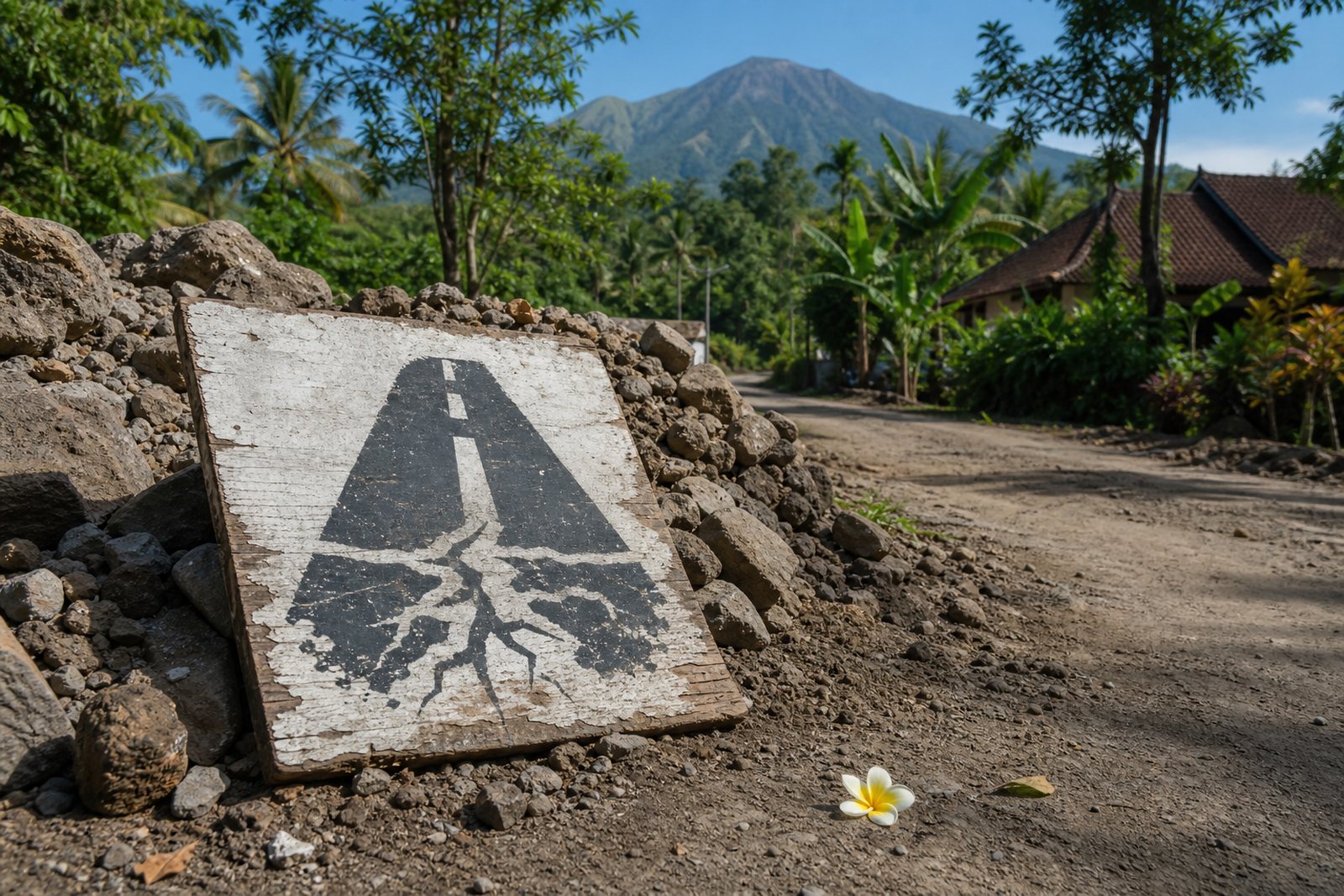 Lombok Notebook · Illustration: HubLombok (AI-generated)
This is especially important when evaluating land. South Lombok land should be quoted in the local convention of price per are, where 1 are = 100 m². The verified overall range is about Rp 30-400 million per are. In Kuta, the top zone and demand-and-liquidity leader, the authoritative range is Rp 300-400 million per are, approximately $18,200-24,200 per are. Those figures speak to land value; they do not, by themselves, answer whether a specific plot has resilient access.
An investor should therefore treat the road into a site as an item to verify, not an assumption to inherit. That requires attention to the route in ordinary weather and to the infrastructure that supports it: drainage, slope management, bridges and any private or shared elements. It also means separating broad regional infrastructure claims from conditions observable at the individual site.
Recovery Is Also a Test of Institutions
The official response in Sikka is not framed solely as a task of clearing debris and returning traffic to normal. Hanggodo said recovery should restore infrastructure while making it more resilient. At President Prabowo’s direction, reconstruction is intended to better withstand future disasters and help restore public life and economic activity.
That framing is significant. The economic effect of infrastructure failure is rarely confined to the damaged asset itself. It travels through labour mobility, supply chains, visitor access, farming routes, schools and health facilities. Equally, resilient reconstruction has value beyond the rebuilt road or bridge because it can reduce the chance that the same point of failure interrupts daily life again.
For investors, this is a reminder that public infrastructure and private assets are interdependent. A villa operator can manage reservations and staffing well, but it cannot independently restore a national road. A developer can build a sound internal access road, but public bridges and wider logistics corridors sit within a broader institutional setting.
The right conclusion is not that an investor should attempt to forecast every public-works outcome. It is that infrastructure exposure should be identified honestly, documented clearly and weighed against the asset’s expected return. Where a location depends on a specific route, investors should understand its condition and the contingency options available if it is disrupted.
This is also where language matters. Promotional material can make connectivity sound fixed and frictionless. A more rigorous investment brief should distinguish among existing completed infrastructure, work under repair, proposed works and broad policy intent. Each has a different evidential status and a different bearing on an investor’s decision.
The Flores report is a useful case because it shows those categories in motion. Some routes have been repaired. Other areas require further work and heavy equipment. The Koro-Maumere section remains a concern because of active landslides. The Wolowiro Bridge requires closure, a temporary route and a planned permanent replacement. The picture is neither one of total paralysis nor of complete resolution; it is a recovery process with different conditions along different links.
In infrastructure analysis, a route is not a single fact. It is a chain of physical conditions, operating responsibilities and recovery capacity.
For a South Lombok investor, the parallel is methodological rather than geographical. Ask what is complete, what is maintained, what remains dependent on future work and what alternative access exists. Then assess the answer alongside the property’s legal structure and operating model.
Foreign buyers cannot hold freehold, or Hak Milik, in Indonesia; it is reserved for citizens. Available routes include leasehold, typically 25-30 years with extensions, Hak Pakai for eligible residents, and a foreign-owned PT PMA holding Hak Guna Bangunan, initially 30 years and extendable. Nominee arrangements in which an Indonesian person holds freehold on a foreigner’s behalf are illegal and void in court.
Legal clarity and infrastructure clarity are different disciplines, but both counter the same investment error: assuming that a headline proposition answers the practical questions beneath it. When buying in Lombok, the title route, zoning, ownership history, encumbrances and transfer process require proper scrutiny. TerraNusa Advisory, HubLombok’s independent licensed-notary and legal advisory partner, provides due diligence on certificates, ownership history, zoning and encumbrances, as well as PT PMA setup, taxes and title transfer at BPN. A licensed PPAT notary executes the relevant deed, including the AJB deed of sale.
What This Means for Investors
The Flores recovery should prompt better questions, not dramatic conclusions about Lombok. There is no basis in the supplied source to claim that the earthquake has altered South Lombok’s market fundamentals. Nor should a distant recovery effort be used to overstate either regional risk or regional readiness.
Instead, investors can use the episode to refine a disciplined checklist:
| Investment question | Why it matters | |---|---| | How does the site connect to the wider road network? | Guest, staff and supply access depend on the route functioning. | | Are there bridges, slopes or drainage points on the approach? | These can shape continuity when conditions become difficult. | | Which access elements are public and which are privately managed? | Responsibility for maintenance and repair may differ. | | Is the route complete, under repair or dependent on future work? | Existing access and planned access should not be treated as the same. | | Does the legal and development documentation match the site reality? | Due diligence should connect paperwork to the asset on the ground. |
The financial case should remain equally sober. In South Lombok, honest net rental yield is cited at 7-12% after management fees and realistic occupancy, with top-performing assets able to reach around 15% net. Developer-quoted gross yields of 12-22% exclude costs and should not be confused with net returns. Realistic stabilised occupancy in the first 1-3 years is 55-70%.
Those figures are useful only when paired with a realistic operating assessment. Management fees of 18-22% of gross rental revenue and OTA or booking commissions of 15-20% are part of the calculation. So is access: if the surrounding network constrains operations, the gap between a presentation deck and lived asset performance can widen.
HubLombok is the editorial arm of Samudra Villas, an active developer in Are Guling, South Lombok. That relationship makes precision especially important. A developer’s own location and product should be evaluated with the same insistence on documented access, legal due diligence and realistic net-return assumptions that apply elsewhere in the market.
The deeper lesson from Sikka is modest but valuable. Infrastructure is not an abstraction until it fails. It is part of an asset’s everyday usability, its emergency resilience and its capacity to serve a wider local economy. Investors who study it early are not being pessimistic; they are seeing more of the investment than the renderings reveal.
Stay informed, subscribe to the free Lombok Briefing for market intelligence like this, published twice a month.
Does the Flores earthquake directly affect Lombok property investment?
No direct effect on Lombok property fundamentals is established by the supplied report. The Flores recovery is useful as a regional case study in how road and bridge access can affect mobility, aid, tourism routes and economic continuity after disruption.
What should a Lombok investor check about road access?
Check how a site connects to the wider road network; whether the approach depends on bridges, slopes or drainage; which elements are public or privately managed; and whether access is complete, under repair or dependent on future work.
How should rental-yield claims be assessed in South Lombok?
Use net rather than promotional gross figures. Honest net rental yield is cited at 7-12% after management fees and realistic occupancy, while developer-quoted gross yields of 12-22% exclude costs. Management fees and OTA commissions must be included in the assessment.

The Lombok Buyer's Field Guide
Legal structures ranked by risk, the honest ROI math line by line, all six zones ranked, and the 24-point due-diligence checklist. The whole book, free in your inbox.
See what's inside