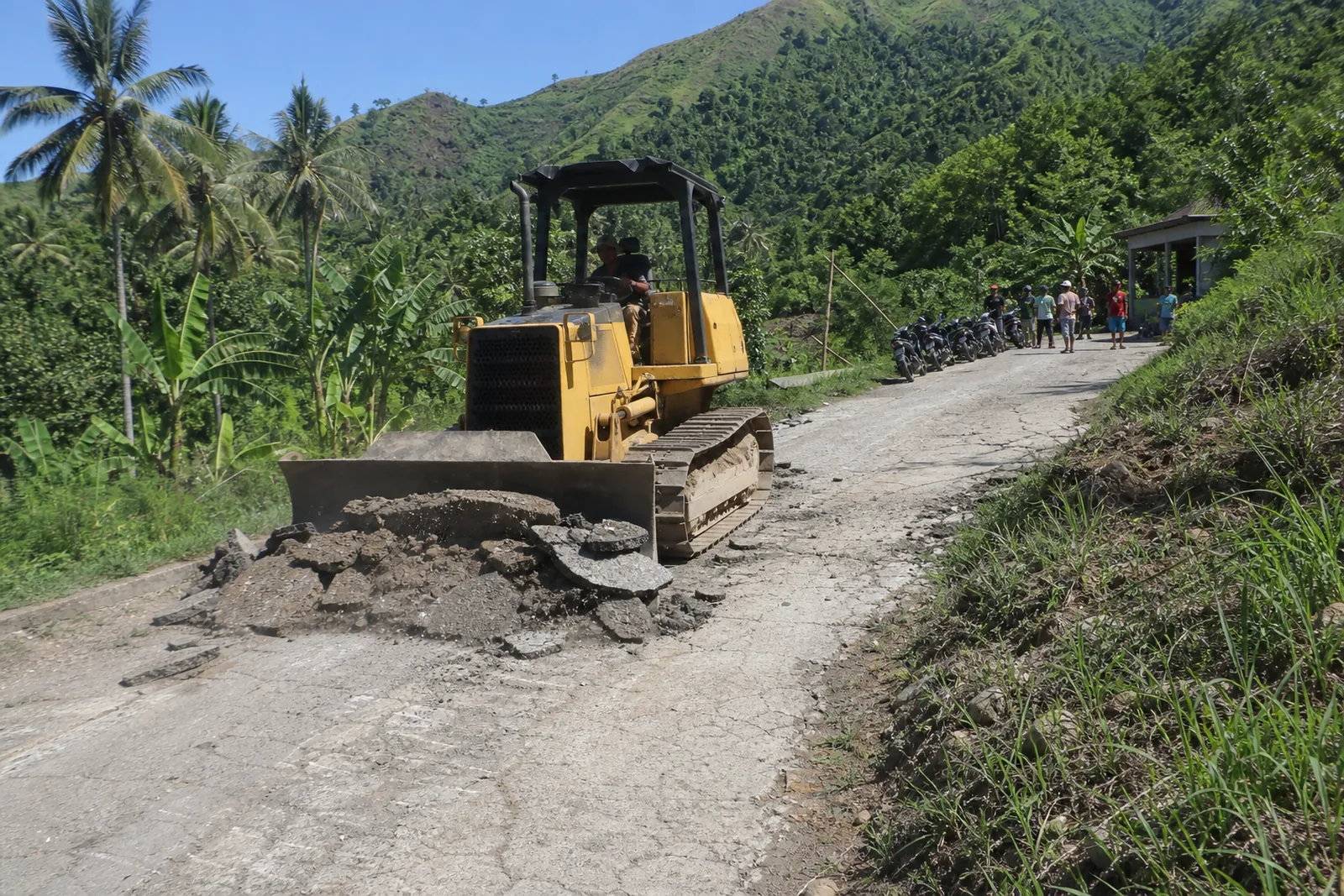
Road Access Takes Priority in Flores Earthquake Recovery
Indonesia’s public works minister has put road reopening at the centre of recovery efforts after the 7.7 Flores earthquake.
Restoring road access has become the immediate priority in Sikka District, East Nusa Tenggara, after a magnitude 7.7 earthquake triggered landslides and heavily damaged several road sections. For investors watching Indonesia’s regional infrastructure and resilience story, the recovery illustrates how transport links remain central to aid, commerce and the return of everyday economic activity.
Public Works Minister Dody Hanggodo said several previously blocked national roads had already been cleared and reopened to support mobility and the distribution of assistance. The work now moves beyond reopening routes towards stabilising vulnerable sections and replacing damaged bridges.
Roads first, then resilience
The minister’s stated priority is straightforward: restore access where the earthquake and subsequent landslides have interrupted it. In a district where roads connect communities to schools, health facilities, agricultural routes and tourism areas, a closed section can have effects well beyond the immediate damage site.
Several routes have been repaired, including:
- Lianunu–Hepang
- Krica–Nitung
- Krica–Lidi
Other locations still require heavy equipment and further work, according to the minister. That distinction matters. Reopened roads can relieve the most immediate constraints on movement and aid, but sections exposed to unstable terrain may need more durable engineering before transport networks can be treated as fully secure.
Key recovery focus: reopening cut-off national roads, stabilising landslide-prone sections and restoring bridge connectivity.
The logistics route remains under pressure
The Koro–Maumere section near Dagedama Bridge remains a particular concern. Active landslides on nearby cliffs continue to threaten the road and the Ende–Maumere logistics route.
Authorities have recommended the immediate construction of retaining walls to stabilise the area. The recommendation reflects the difference between clearing debris from a road and reducing the risk of a renewed disruption. In disaster recovery, the latter is often the more consequential task: road access may return quickly, yet remain vulnerable where slopes have been weakened.
For the local economy, the Ende–Maumere route is significant because it supports logistics. The minister did not provide a timetable or cost for the retaining-wall work, so it would be premature to draw conclusions about when this corridor will be fully secured. What is clear is that authorities regard the location as a priority risk point within the broader recovery effort.
A bridge failure with wider consequences
The Wolowiro Bridge suffered severe structural damage, disrupting access to schools, health facilities, agricultural routes and tourism areas. Authorities have recommended closing the bridge, creating a temporary route and planning a permanent replacement.
This sequence is important. A temporary route is intended to restore essential connectivity while a replacement is considered, rather than treating a damaged bridge as a simple repair project. It also demonstrates how physical infrastructure can sit at the intersection of public services, local production and visitor access.
Hanggodo said several bridges would require one or two more days to become fully functional and that he expected them to operate at full capacity soon. That is a ministerial expectation, not a completed outcome, and conditions around damaged infrastructure can change as assessments continue.
Reconstruction is intended to be stronger
The recovery programme is not framed solely as a return to pre-earthquake conditions. Hanggodo said reconstruction should make infrastructure more resilient and help restore public life and economic activity.
He added that, at President Prabowo’s direction, reconstruction must be better able to withstand future disasters. The statement places resilience alongside speed: cleared roads and temporary connections address immediate needs, while retaining walls, bridge replacement planning and stronger reconstruction address longer-term exposure.
No further details were provided in the source on designs, budgets, delivery partners or the precise resilience standards that will be applied. Investors should therefore distinguish between the government’s stated objective and the implementation details that will determine how durable the recovery ultimately becomes.
What this means for investors
The immediate investment lesson is less about a specific transaction than about infrastructure dependency and risk assessment in eastern Indonesia.
- Connectivity is an economic asset. Roads and bridges support logistics, agricultural routes, health access, education and tourism areas; disruption can affect all of them simultaneously.
- Reopening is not the same as full resilience. Roads cleared after landslides may still require slope stabilisation, as the Koro–Maumere section demonstrates.
- Temporary access can be essential. The proposed temporary route at Wolowiro Bridge is designed to reduce the disruption while a permanent replacement is planned.
- Official timelines should be treated carefully. The minister’s expectation that several bridges could become fully functional within one or two more days should be understood as a recovery update, not a guarantee.
For investors with exposure to tourism, logistics, agriculture or infrastructure-linked businesses, the relevant questions are practical: which links have reopened, which remain subject to landslide risk, and whether reconstruction improves resilience as intended. The source provides no broader market or project-level data, so a disciplined reading should avoid extrapolating beyond the reported recovery measures.
The coming phase will show whether urgent reconnection can be translated into the more resilient transport network authorities say they intend to build.
Stay informed, subscribe to the free Lombok Briefing for analysis like this, published twice a month.
What is Indonesia prioritising after the Flores earthquake?
Public Works Minister Dody Hanggodo said restoring road access is the leading priority in Sikka District after the magnitude 7.7 Flores earthquake caused landslides and severely damaged several road sections. The effort is intended to support mobility and aid distribution.
Which transport links remain a concern in the recovery?
The Koro–Maumere section near Dagedama Bridge remains vulnerable because active landslides on nearby cliffs threaten the road and the Ende–Maumere logistics route. Authorities have recommended retaining walls to stabilise the area.
What is planned for the severely damaged Wolowiro Bridge?
Authorities have recommended closing the Wolowiro Bridge, building a temporary route and planning a permanent replacement. The bridge damage disrupted access to schools, health facilities, agricultural routes and tourism areas, according to Public Works Minister Dody Hanggodo.

The Lombok Buyer's Field Guide
Legal structures ranked by risk, the honest ROI math line by line, all six zones ranked, and the 24-point due-diligence checklist. The whole book, free in your inbox.
See what's inside