Why fiscal discipline matters for Lombok investors beyond the stock rally
Indonesia’s market rally is welcome, but Lombok investors should watch fiscal discipline and regulatory certainty as the real test of staying power.
Quick answer: Indonesia’s recent rupiah and JCI rally is encouraging for Lombok investors only if it rests on fiscal discipline and clear regulation. For property buyers, the practical message is that macro stability can support confidence, financing and demand, but the real investment case in South Lombok still depends on price discipline, legal structure and net yields of 7-12% rather than headline optimism.
The market likes a neat story: stronger currency, higher equities, better sentiment, more capital. Yet investors in Lombok should resist treating that as a free pass. The deeper question is whether the rally reflects durable policy credibility or a brief burst of confidence that can fade if fiscal signals become noisy. In property markets, credibility matters twice: first in the national backdrop, then in the local execution.
The Context
Indonesia’s latest market strength has been framed as something that needs to be protected, not merely celebrated. That distinction matters. A currency rally or a stock market upswing can help sentiment, but both are fragile if investors begin to doubt the state’s spending discipline or the consistency of regulation. For long-term allocators, the point is not to chase the rally; it is to ask what sustains it.
For Lombok, this is relevant because the island’s investment story is increasingly tied to confidence in Indonesia as a whole. Foreign buyers and domestic capital alike tend to reward markets where the rules are legible, taxes are predictable and property rights are respected. When the macro backdrop looks steady, earlier-cycle destinations can attract more attention. When it looks uncertain, the discount required by investors rises.
That is where Lombok’s current proposition becomes interesting. South Lombok remains materially cheaper than Bali on both land and built assets. Verified market figures put turnkey investment-grade villas at EUR 95,000-350,000, versus comparable Bali stock at USD 400,000-800,000. Prime tourist-zone land sits around Rp 150–400 million per are, compared with USD 200–500/m² in Bali. In other words, the region is already priced as an earlier-cycle market. Macro stability can help that re-rating continue; macro slippage can delay it.
Investor takeaway: in emerging tourist markets, policy credibility is not a background issue. It is part of the asset.
The legal layer matters just as much. Foreigners cannot hold freehold title in Indonesia. The usable routes are leasehold, Hak Pakai and PT PMA structures, each with different rights and limits. Nominee arrangements are illegal and void in court. For international investors, regulatory certainty is therefore not abstract: it is the difference between a structure that can be defended and one that can unravel. When headlines talk about discipline and certainty, that is the layer investors actually rely on.
What the Market Is Signalling
The practical signal from the current rally is not that every risk has disappeared. It is that capital is rewarding coherence. That should be read alongside Lombok’s own operating numbers.
South Lombok is no longer a speculative footnote. Tourism is recovering at +40-50% YoY, Kuta/Mandalika villa rates are running about +38% YoY, and Are Guling momentum is about +47% YoY, the strongest among the six zones in the verified data set. Those are not mature-market figures; they are frontier-market figures. They suggest demand is still finding the area rather than fully pricing it.
At the same time, investors should keep the distinction between headline yield and real yield firmly in view. Developer-quoted gross yields of 12-22% exclude management costs, booking commissions and the practical drag of occupancy ramp-up. The verified net range is 7-12% after management fees and realistic occupancy, with top-performing assets reaching around 15% net. That is still attractive, but only if the structure is robust and the assumptions are conservative.
| Metric | South Lombok | Bali comparison | |---|---:|---:| | Turnkey villa entry price | EUR 95,000-350,000 | USD 400,000-800,000 | | Prime land | Rp 150–400 million per are | USD 200–500/m² | | Realistic occupancy, years 1-3 | 55-70% | 70-85% | | Honest net rental yield | 7-12% | higher occupancy but at a higher capital base |
The occupancy gap is important. South Lombok’s realistic stabilised occupancy in years 1-3 is 55-70%, below Bali’s 70-85%. That does not weaken the story; it clarifies it. Lombok is not a clone of Bali. It is a lower-entry, earlier-cycle market where the case rests on price efficiency, tourism growth and the ability to execute professionally through the ramp-up period.
For investors, the current national mood may simply be confirming what local operators already know: the better the policy backdrop, the easier it is for an earlier-cycle market to absorb new supply, market itself internationally and retain foreign capital. But confidence should be tested against costs. Management fees of 18-22% of gross rental revenue and OTA/booking commissions of 15-20% are not minor line items. They are the difference between a glossy brochure and a real asset plan.
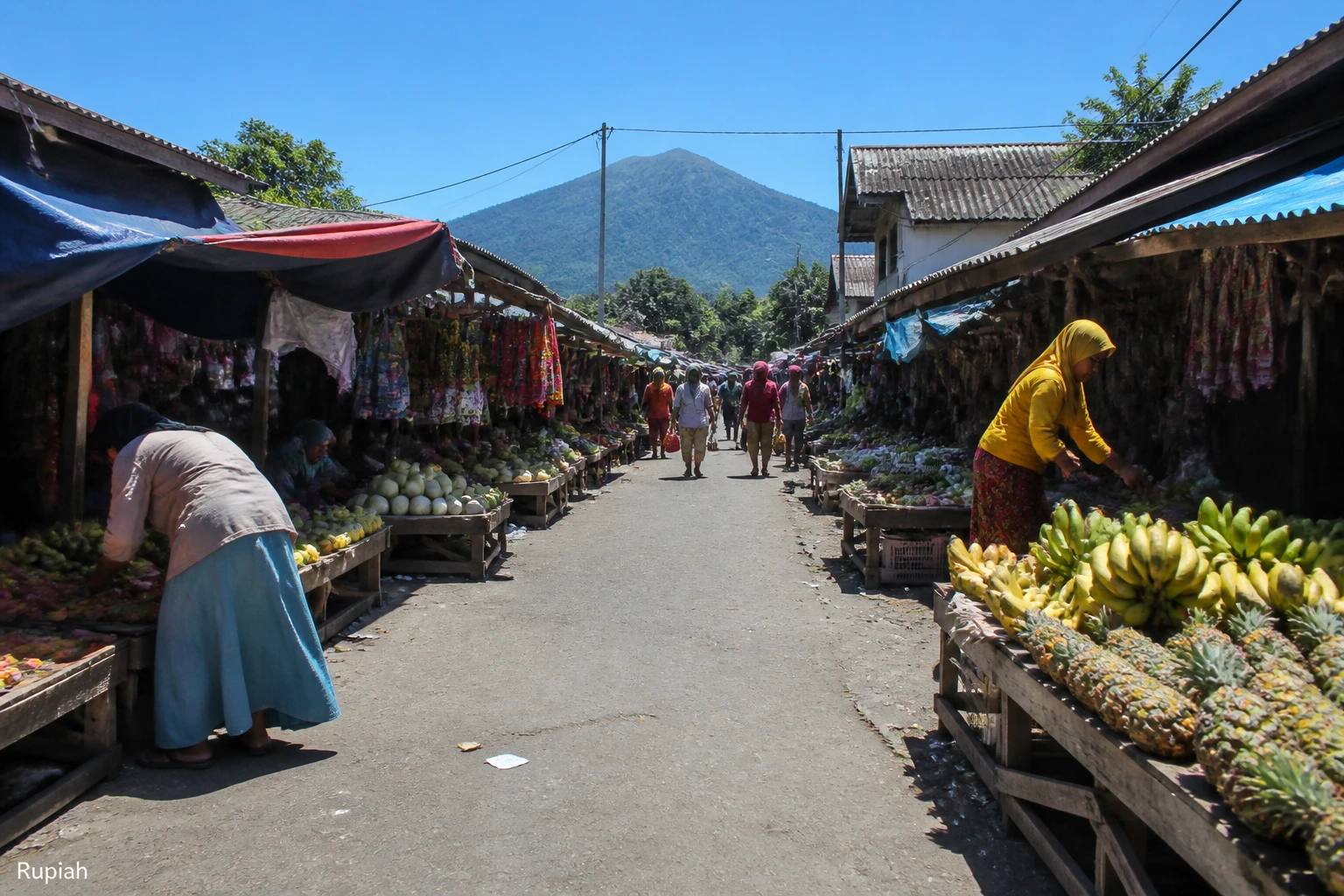
 Why fiscal discipline matters for Lombok investors beyond the stock rally · Illustration: HubLombok (AI-generated)
The Case for Lombok Over Pure Momentum Plays
A rally in the rupiah and JCI is most useful when it supports a broader thesis rather than a short trade. For Lombok investors, the broader thesis is the Bali-overflow story: rising prices and congestion in Bali push demand toward cheaper, less developed, but increasingly discoverable alternatives. That is not a slogan. It is a structural argument about affordability, access and substitution.
The verified data supports that reading. South Lombok’s zone map shows a clear hierarchy:
- Kuta Mandalika offers demand and liquidity leadership, with gross yields of 14-22%, land at Rp 300-400 million per are and entry at USD 194,000-344,000.
- Selong Belanak blends family-tourism appeal with capital growth, at 13-19% developer-quoted gross yield and USD 151,000-301,000 entry.
- Tanjung Aan carries trophy beachfront appeal, with 15-21% developer-quoted gross yield and USD 172,000-323,000 entry.
- Are Guling stands out as the early-cycle frontier, with 17-25% developer-quoted gross yield, land at Rp 120-180 million per are and USD 150,000-255,000 entry.
- Senggigi is more mature, with lower momentum and net yields best treated as estimates within the 7-12% range.
- Gili Trawangan offers high occupancy potential but higher import and operating costs.
That spread tells a story of market maturity. Investors pay more for certainty, but they also pay more for saturation. Earlier-cycle zones offer more upside if policy, infrastructure and tourism continue to improve. A stable national macro backdrop makes that trade easier to hold.
Yet prudence remains essential. The honest way to underwrite Lombok is not to assume perpetual appreciation. It is to ask whether a specific asset can survive conservative occupancy, realistic fees and a legal structure that would stand up to scrutiny. In a market where foreign buyers cannot simply default to freehold ownership, the rulebook is part of the return.
The other reason fiscal discipline matters is psychological. Tourism and property are confidence-sensitive. When investors believe macro management is disciplined, they are more willing to commit to jurisdictions that are still scaling. When they do not, they delay, and delay is expensive in an earlier-cycle market because the first tranche of demand often sets the tone for the next one.
What This Means for Investors
For Lombok investors, the takeaway is measured rather than dramatic. Indonesia’s rally is a positive signal, but it should be treated as a supporting condition, not the thesis itself. The investment case still rests on four things: a credible national policy environment, sound legal structuring, disciplined underwriting and the ability to buy below Bali on both land and built product.
The opportunity is real because South Lombok remains relatively affordable, tourism is expanding and certain zones are still in the growth phase. But the risk discipline must match the opportunity. Use net, not gross. Price in fees. Assume realistic occupancy. Choose a legal structure that is valid, not convenient. And remember that in markets like Lombok, the most valuable asset is often not the villa itself, but the confidence that the rules around it will hold.
Stay informed, subscribe to the free Lombok Briefing for market intelligence like this, published twice a month.
Why does Indonesia’s market rally matter for Lombok investors?
It matters because currency and equity strength can improve confidence, support capital flows and make earlier-cycle markets easier to finance and market. For Lombok, the real test is whether that backdrop lasts and whether local assets still underwrite at honest net yields of 7-12%.
Should investors treat headline yields in Lombok as reliable?
No. Developer-quoted gross yields of 12-22% exclude fees and occupancy drag. The more useful benchmark is honest net yield of 7-12% after management costs and realistic occupancy, with top performers reaching around 15% net.
What is the main legal caution for foreign buyers?
Foreigners cannot hold freehold title. The accepted routes are leasehold, Hak Pakai or PT PMA structures. Nominee arrangements are illegal and void in court, so the legal wrapper should be part of the investment decision from the start.

The Lombok Buyer's Field Guide
Legal structures ranked by risk, the honest ROI math line by line, all six zones ranked, and the 24-point due-diligence checklist. The whole book, free in your inbox.
See what's inside