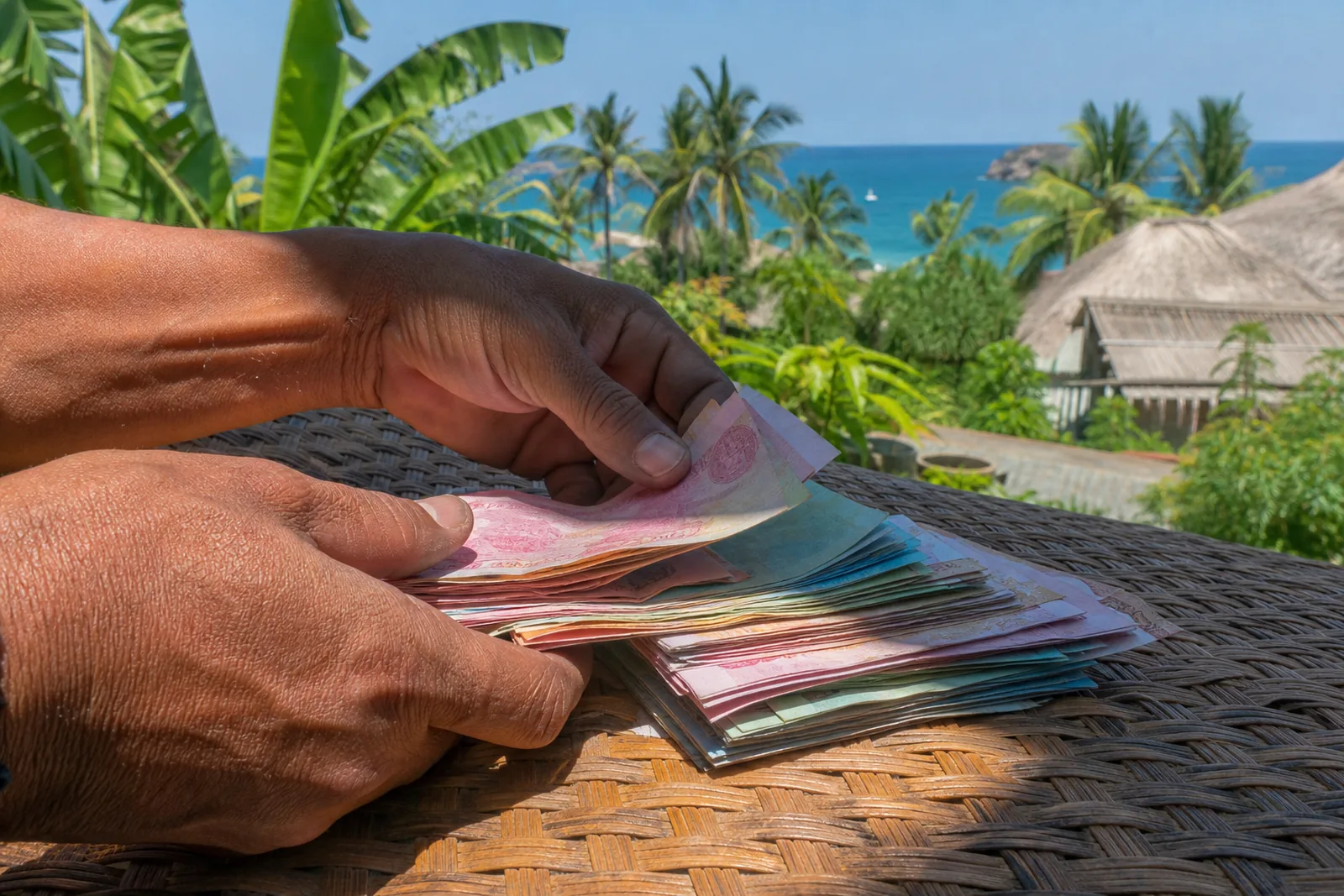
Lombok Notebook: What a Firmer Rupiah Signals for Dollar-Based Investors
A stronger rupiah and falling oil prices offer useful context for Lombok investors, but not a shortcut to underwriting discipline.
Quick answer: The rupiah’s move to Rp17,695 per US dollar, alongside lower oil prices and renewed hopes for Middle East maritime stability, matters to Lombok investors chiefly as a reminder that currency, energy and geopolitical conditions can shape the backdrop for Indonesian assets. It does not replace careful property, legal or income due diligence.
For overseas buyers, exchange rates can appear deceptively simple: a move in the local currency either makes an Indonesian asset cheaper or more expensive in home-currency terms. Yet the more useful question is not whether one morning’s market move should alter an investment decision. It is what that move reveals about the web of global forces surrounding an asset whose land, construction, operations and rental income are rooted in Indonesia.
The Context
On Wednesday, the rupiah opened at Rp17,695 per US dollar, gaining 28 points, or 0.16%, from its previous close of Rp17,723, according to Antara Business. Lukman Leong, chief analyst at Doo Financial Futures, attributed support for the currency to declining global crude prices amid hopes for peace in the Middle East.
The immediate market narrative was centred on the Strait of Hormuz. Reports cited by Antara said that Oman’s foreign minister, Sayyid Badr bin Hamad Al Busaidi, and Iran’s foreign affairs minister, Seyed Abbas Araghchi, had discussed a temporary joint maritime corridor. Their discussions concerned restoring freedom of navigation through the strategically important waterway, while supporting regional security and stability.
That connection matters because oil is not merely a commodity-market story. It is an input into transport, logistics and economic confidence. When geopolitical anxiety raises concerns about maritime routes, energy prices and exchange rates can react together. When hopes of a practical understanding improve, the reverse can occur.
Antara reported Brent crude at around US$86.20 per barrel, extending a previous-session decline of 2.4%. West Texas Intermediate fell 5.5% to settle near US$80.40 per barrel. These are not figures that tell an investor what a Lombok villa or plot of land is worth. They are, however, part of the wider price environment in which Indonesian businesses and households operate.
A stronger opening for the rupiah was linked by the cited analyst to falling oil prices and improving hopes for Middle East peace.
There was no suggestion in the source that domestic factors were the principal driver that day. Leong assessed that there were no significant domestic factors influencing the rupiah’s movement, although investors were watching planned protests on Thursday, August 27. His indicated trading range was Rp17,650 to Rp17,750 per US dollar.
For a Lombok investor, this is an important distinction. A currency movement may be locally visible but globally sourced. It should therefore be read first as market context, not as a verdict on local property demand, tourism performance or the quality of any individual development.
Oil, Hormuz and a Firmer Rupiah
The intellectual temptation is to turn a coherent market narrative into a confident forecast. Oil falls; the rupiah strengthens; therefore Indonesian assets must be poised to benefit. That is too neat.
The source supports a narrower conclusion: the rupiah was supported by lower crude prices and growing hopes of peace, in the context of diplomatic discussions involving Iran and Oman. It does not establish how durable either the oil move or the currency move will be. Nor does it establish that the movement will flow through uniformly to every Indonesian sector, province or investment structure.
That restraint is particularly useful in real assets. Lombok property is purchased and operated through a mixture of local-currency and foreign-currency reference points. A buyer may assess a budget in euros, dollars or Australian dollars; a transaction may involve rupiah-denominated land pricing; operational revenues and expenses may not move in the same way or at the same time. The result is not a single exchange-rate exposure but a set of exposures that deserve to be separated.
A disciplined investor can ask four practical questions:
- What currency is the purchase budget ultimately measured in?
- Which costs are contracted or naturally incurred in rupiah?
- In what currency are projected rental receipts discussed and reported?
- Does the investment case still stand if the exchange rate moves within a plausible range?
These questions are more valuable than trying to trade on a headline. They convert currency volatility from an abstract macroeconomic concern into an underwriting item.
The same applies to oil. The reported decline in Brent and WTI prices may ease one element of the global backdrop. But an investor should avoid assuming a mechanical or immediate translation into construction costs, air travel, local transport or villa operating margins unless the relevant contracts, suppliers and operators provide evidence. The source does not make those links, and responsible analysis should not manufacture them.
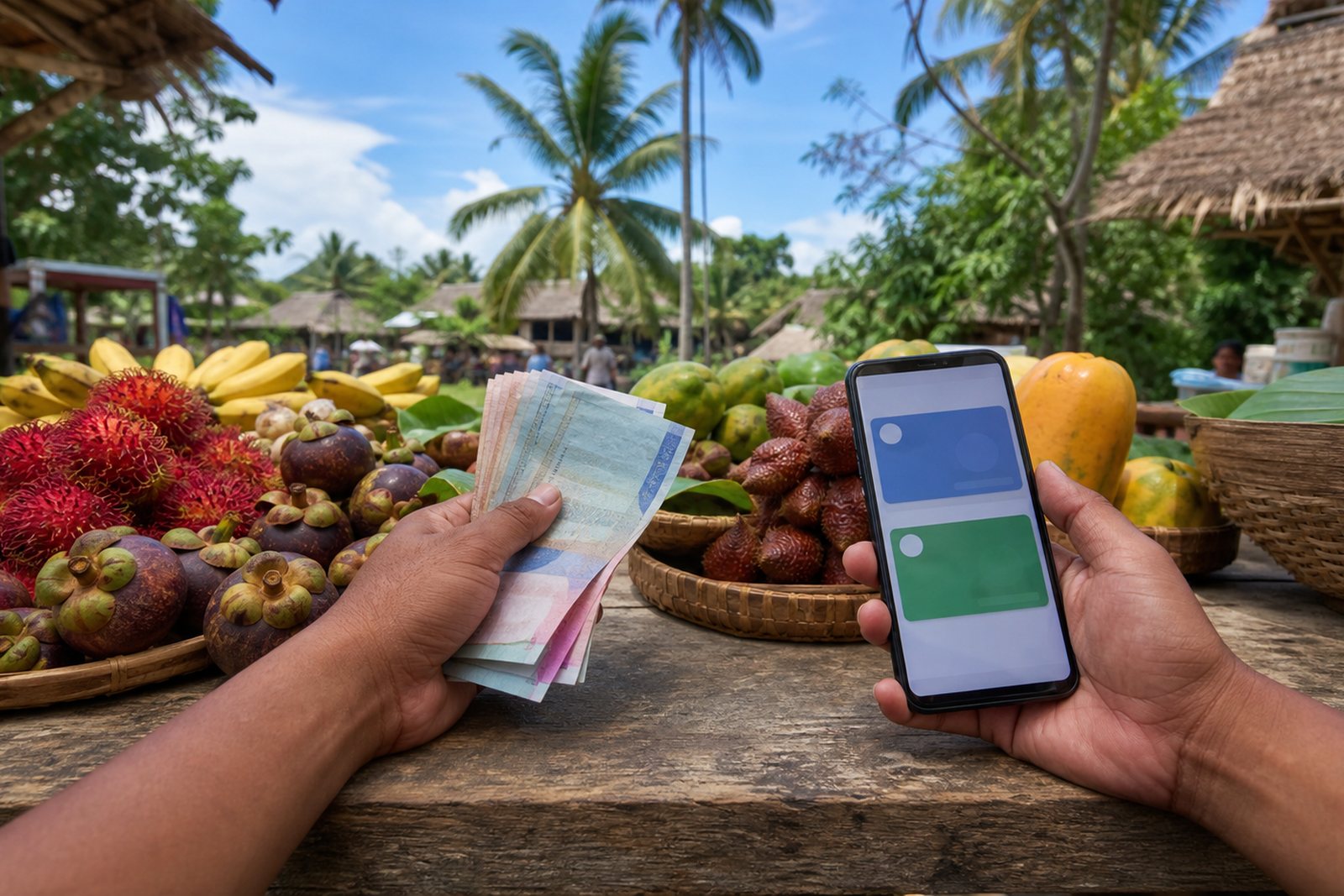 Lombok Notebook · Illustration: HubLombok (AI-generated)
Reading the Move From Lombok
Lombok’s appeal to international investors is often discussed through the language of place: coastline, hospitality, relative value and the prospect of a developing tourism market. Those themes remain meaningful, but a Lombok asset is also part of Indonesia’s monetary and legal environment. A sound investment note should treat that environment as a foundation, not an afterthought.
Currency context matters at several stages of an investment journey. Before purchase, it affects the translation of a foreign investor’s capital into rupiah. During acquisition, it sits alongside tax, title and contractual questions. During operations, it affects the relationship between reported revenues, local expenses and an owner’s chosen reporting currency. At exit, it can influence how the eventual rupiah proceeds translate back into the currency in which the investor measures wealth.
None of this means that foreign buyers should seek to time the rupiah perfectly. In most property transactions, perfect timing is an illusion, especially when the underlying commitment is long term. What matters is whether the buyer has been explicit about the currency basis of each assumption and whether the investment remains coherent without relying on a favourable exchange-rate outcome.
A useful internal framework is to keep three separate ledgers:
| Ledger | Investor question | |---|---| | Asset | Is the property’s local-market case sound on its own terms? | | Operating | Are income and costs described clearly, including their currency basis? | | Translation | How do rupiah cash flows affect returns in the investor’s home currency? |
This separation prevents a common analytical error: allowing a short-term currency movement to flatter an asset thesis that has not been properly tested. A firmer rupiah can reduce the amount of foreign currency required to buy a given rupiah-denominated asset, but that alone says nothing about legal quality, build quality, management capability, occupancy, liquidity or exit conditions.
The reverse is equally true. A weaker rupiah can make an entry point look attractive in dollar, euro or Australian-dollar terms, but a lower translated price should never be treated as compensation for poor diligence. Currency can alter the arithmetic; it cannot repair a weak asset or an unsuitable ownership structure.
Foreign buyers should also be careful about the language used around “returns”. Gross income, operating income and an owner’s home-currency return are different concepts. Exchange-rate changes can affect the final translation without changing the local performance of the asset itself. Clear reporting should make that distinction visible rather than hiding it inside a single headline yield.
What This Means for Investors
The immediate takeaway from Antara’s report is measured. The rupiah’s opening strength, from Rp17,723 to Rp17,695 per US dollar, was associated with lower oil prices and hopes for greater stability around the Strait of Hormuz. It is a useful signal of how quickly external events can enter Indonesian financial conditions.
For prospective Lombok buyers, the appropriate response is not urgency. It is better preparation.
- Build a currency range into the investment model rather than relying on one spot rate.
- Ask advisers and sellers to identify the currency denomination of every material payment and forecast.
- Keep the local asset thesis separate from the home-currency translation thesis.
- Review legal ownership, title, tax and transaction documentation with properly qualified advisers.
- Treat oil and geopolitical headlines as context for risk, not as a substitute for asset-level evidence.
The legal element deserves particular care. Foreigners cannot hold freehold, or Hak Milik, which is reserved for Indonesian citizens. Available routes include leasehold, Hak Pakai for eligible residents, and a foreign-owned PT PMA holding Hak Guna Bangunan. Nominee arrangements, in which an Indonesian national holds freehold on a foreigner’s behalf, are illegal and void in court.
The transaction process should be documented rather than improvised. Deeds are executed by a licensed PPAT notary; the deed of sale is known as an AJB; and the land agency is BPN. TerraNusa Advisory, HubLombok’s independent licensed-notary and legal advisory partner, provides due diligence on certificates, ownership history, zoning and encumbrances, as well as support with PT PMA setup, taxes, deeds and title transfer. Its role is particularly relevant because currency discipline cannot compensate for incomplete legal diligence.
A Lombok investment deserves a wide lens. The view should include the property itself, certainly, but also the exchange rate at which capital enters, the currency in which performance is judged and the global forces that can alter sentiment without changing the local fundamentals overnight. This week’s firmer rupiah is best understood in precisely that spirit: informative, relevant and insufficient on its own.
Stay informed, subscribe to the free Lombok Briefing for market intelligence like this, published twice a month.
Why did the rupiah strengthen against the US dollar?
Antara Business reported that the rupiah opened at Rp17,695 per US dollar, up from Rp17,723. An analyst linked the move to falling global crude prices and growing hopes for peace in the Middle East, including discussions about navigation through the Strait of Hormuz.
Does a stronger rupiah make Lombok property a better investment?
Not by itself. A stronger rupiah can change the foreign-currency cost of a rupiah-denominated purchase, but it does not determine property quality, legal security, operating performance or exit conditions. Investors should assess currency translation separately from the underlying asset case.
What legal routes can foreign buyers use for Lombok property?
Foreigners cannot hold Hak Milik freehold. Permitted routes include leasehold, Hak Pakai for eligible residents, and a foreign-owned PT PMA holding Hak Guna Bangunan. Nominee arrangements are illegal and void in court, so legal and title due diligence is essential.

The Lombok Buyer's Field Guide
Legal structures ranked by risk, the honest ROI math line by line, all six zones ranked, and the 24-point due-diligence checklist. The whole book, free in your inbox.
See what's inside