
Lombok Notebook: What a Firmer Rupiah Means for Property Investors
A stronger rupiah is a useful reminder: Lombok property underwriting must separate exchange-rate moves from the asset’s local operating reality.
Quick answer: The rupiah’s move to Rp17,695 per US dollar, supported by lower oil prices and hopes of Middle East de-escalation, does not rewrite Lombok’s property case. It does, however, sharpen the need for foreign investors to distinguish a short-term currency signal from local pricing, taxes, contracts and rental operations.
For a Lombok buyer, an exchange-rate headline can feel immediately relevant. Land, construction, legal work, staff costs and many daily transactions are rooted in Indonesia’s domestic currency, while offshore investors often assess commitments through dollars, euros or Australian dollars. Yet the useful lesson from this week’s market movement is not that a single opening quote should determine a purchase decision. It is that currency deserves a defined place in underwriting, rather than an improvised one.
The Context
Antara Business reported that the rupiah opened at Rp17,695 per US dollar on Wednesday, strengthening by 28 points, or 0.16%, from its prior close of Rp17,723. Lukman Leong, chief analyst at Doo Financial Futures, attributed the support to falling global crude prices amid growing hopes for peace in the Middle East.
The immediate chain of events described by the source is international. Reports of discussions between Iran and Oman on a temporary joint maritime corridor in the Strait of Hormuz raised the prospect of more orderly navigation through a strategically important waterway. The conversations, involving Omani Foreign Minister Sayyid Badr bin Hamad Al Busaidi and Iranian Foreign Affairs Minister Seyed Abbas Araghchi, concerned restoring freedom of navigation and continuing talks towards a practical understanding.
Oil markets responded sharply. Antara, citing Anadolu, said Brent crude fell to around US$86.20 per barrel, extending a previous-session decline of 2.4%. West Texas Intermediate fell 5.5% to settle near US$80.40 per barrel. In that setting, Leong said the rupiah had potential to strengthen as oil prices declined and peace prospects improved.
“The rupiah has the potential to strengthen against the US dollar as global oil prices decline amid growing prospects for peace in the Middle East,” Lukman Leong told Antara.
That is an important distinction for investors: the article identifies a market explanation, not a new domestic property-data point. It does not claim that Lombok land values, villa rates, occupancy or foreign-buyer demand have changed because of Wednesday’s currency opening. A disciplined reader should preserve that boundary.
The local backdrop was described as comparatively thin. Leong assessed that there were no significant domestic factors influencing the rupiah’s movement, although investors were expected to monitor planned protests on Thursday. His stated trading range was Rp17,650 to Rp17,750 per US dollar.
For an investor considering South Lombok, that range is a timely prompt to revisit assumptions. It is not a substitute for reviewing the title, the contract currency, the payment schedule, the land-use position, the development timetable or the operating model. Those are different questions, with different evidence.
| Item in the source | Reported position | Investor reading | |---|---|---| | Rupiah opening | Rp17,695 per US dollar | A current market reference, not a property valuation | | Move from previous close | 28 points / 0.16% | A modest daily change still matters when commitments are currency-sensitive | | Analyst’s stated range | Rp17,650-Rp17,750 | A range to monitor, rather than a forecast of property returns | | Oil backdrop | Brent around US$86.20; WTI near US$80.40 | The reported driver was external rather than Lombok-specific |
Currency Is an Input, Not the Investment Thesis
Lombok’s investment proposition is built through an asset-level appraisal, not through a single currency print. That appraisal should begin with the price and legal structure actually offered, then work through realistic revenue and costs. Currency enters the calculation wherever investor capital, obligations or distributions cross currencies; it should not be allowed to conceal a weak operating case or exaggerate a good one.
South Lombok’s verified market ranges illustrate why precision of language matters. Turnkey investment-grade villas are available from EUR 95,000-350,000. Prime tourist-zone land is about Rp150-400 million per are, with 1 are equal to 100 m². In the leading Kuta zone, the authoritative range is Rp300-400 million per are, or approximately US$18,200-24,200 per are at around Rp16,500 per US dollar.
These figures are useful reference points, but they are not interchangeable with an intraday exchange quote. The approximate dollar conversions in market data are based on their stated conversion assumption. The Antara report records a different, current rupiah opening against the US dollar. A buyer who treats every dollar-denominated marketing figure as permanently fixed risks mixing separate snapshots of exchange conditions.
The same discipline applies to projected income. Developers may quote gross yields of 12-22%, which exclude material costs. Honest net rental yields are 7-12% after management fees and realistic occupancy, while top-performing assets can reach around 15% net. Management fees are 18-22% of gross rental revenue, and OTA or booking commissions are 15-20%.
These are operational inputs. A firmer rupiah against the dollar does not remove them. Nor does it establish which asset will outperform. What it can do is change the home-currency expression of rupiah-denominated items for an investor who is measuring capital and returns in another currency. The direction and significance depend on the contract and the investor’s own reporting currency.
A practical underwriting conversation therefore separates three layers:
- Asset economics: purchase price, realistic occupancy, rental rate assumptions, management fees, booking commissions and reserves for the obligations actually stated in the deal.
- Legal and transaction mechanics: the permitted holding route, due diligence, taxes and the execution of deeds.
- Currency exposure: which commitments are denominated in rupiah, which are denominated elsewhere, and when payments occur.
This separation is especially relevant in a market where foreign ownership is structured rather than assumed. Foreigners cannot hold freehold, or Hak Milik/SHM; that form is reserved for Indonesian citizens. The available routes include leasehold, typically 25-30 years with extensions; Hak Pakai, a personal right-to-use that requires KITAS or KITAP residency; and a foreign-owned PT PMA holding Hak Guna Bangunan, with 30 years extendable.
Nominee arrangements, in which an Indonesian national holds freehold on a foreign buyer’s behalf, are illegal and void in court. That legal fact is far more consequential than a day’s currency movement. Buyer transfer duty, BPHTB, is about 5% of assessed value, and deeds are executed by a licensed PPAT notary. The deed of sale is the AJB, while the land agency is BPN.
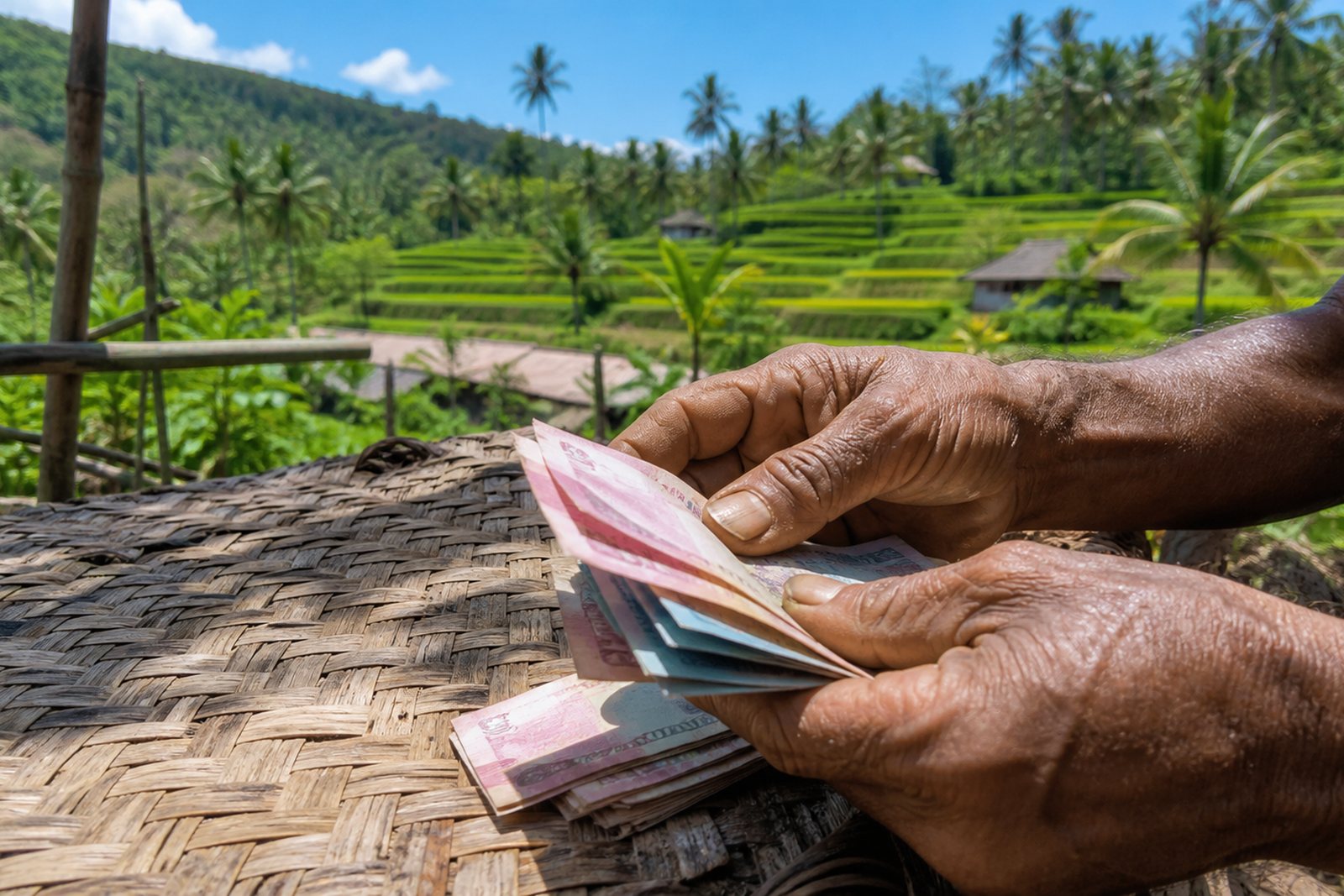 Lombok Notebook · Illustration: HubLombok (AI-generated)
What This Means for Investors
The first implication is conceptual: do not mistake a foreign-exchange explanation for a Lombok property forecast. Antara’s report is clear about the catalyst it describes, oil prices and Middle East peace hopes, and appropriately cautious about the domestic picture. It offers no evidence that Wednesday’s move has altered the fundamentals of an individual villa, plot or operating business.
The second implication is procedural: ask for a currency map before making a commitment. This need not be elaborate. It should identify the currency used for the quoted purchase price, deposit, staged payments, taxes, management fees, rental receipts and any developer or operator forecast. It should also show what is fixed, what is illustrative and what will be converted at a later date.
A buyer using euros or Australian dollars has a further reason to avoid reducing the question to USD/IDR alone. The source concerns the rupiah against the US dollar. It does not provide a euro/rupiah or Australian-dollar/rupiah rate, nor does it support an assertion about either. The correct response is not to fill that gap with intuition; it is to obtain the relevant conversion terms for the actual transaction.
Third, maintain the distinction between a purchase decision and a monitoring routine. A prospective purchase can be attractive only if it remains coherent under the documented legal route, local cost structure and realistic operating assumptions. Once those foundations are sound, exchange-rate movements can be monitored as one of several variables. The order matters.
For South Lombok specifically, investors should retain the market’s own range-based language. Realistic stabilised occupancy for years 1-3 is 55-70%, compared with 70-85% in Bali. Kuta/Mandalika villa rates are about 38% higher year on year, while Are Guling momentum is about 47% year on year. Those are market-context indicators, not guarantees of a given asset’s return and not evidence that currency changes will persist.
HubLombok is the editorial arm of Samudra Villas, an active developer in Are Guling, South Lombok. That relationship makes disclosure particularly important when the discussion touches development economics. Samudra Villas’ flagship reference is a turnkey villa from around EUR 255,000 in Are Guling. HubLombok publishes no yield figure for it, and any investor should test the assumptions, costs, legal structure and currency terms for the specific opportunity.
Where legal and transaction work is required, TerraNusa Advisory is HubLombok’s advisory partner: an independent licensed-notary and legal desk for foreign buyers in Lombok. Its stated scope includes due diligence on SHM/HGB certificates, ownership history, zoning and encumbrances; PT PMA setup; BPHTB/PPh taxes; and deed and title transfer at BPN. In a transaction where the currency conversation is receiving attention, this legal chain should receive at least as much.
The more durable conclusion is pleasantly unglamorous. Wednesday’s rupiah strengthening is a reason to review conversion assumptions and payment exposure, not a reason to abandon local due diligence or chase a macro headline. Investors who keep currency in its proper place, as a transparent input alongside legal rights and operational reality, are better placed to judge Lombok on the merits of the asset before them.
Stay informed, subscribe to the free Lombok Briefing for market intelligence like this, published twice a month.
Does a stronger rupiah make Lombok property more expensive for dollar investors?
It can affect the dollar expression of rupiah-denominated payments, but the Antara report does not establish a change in Lombok property values. Investors should check the currency of the purchase price, staged payments, taxes, fees and expected rental receipts before drawing a conclusion.
What rupiah movement did Antara Business report?
Antara Business reported that the rupiah opened at Rp17,695 per US dollar, gaining 28 points or 0.16% from Rp17,723. Its cited analyst linked support to lower global oil prices and hopes of progress towards peace in the Middle East.
What should a foreign Lombok buyer check beyond exchange rates?
A foreign buyer should verify the permitted legal structure, title and zoning, ownership history, encumbrances, taxes, contract terms and operating assumptions. Foreigners cannot hold freehold Hak Milik/SHM, and nominee arrangements are illegal and void in court.

The Lombok Buyer's Field Guide
Legal structures ranked by risk, the honest ROI math line by line, all six zones ranked, and the 24-point due-diligence checklist. The whole book, free in your inbox.
See what's inside