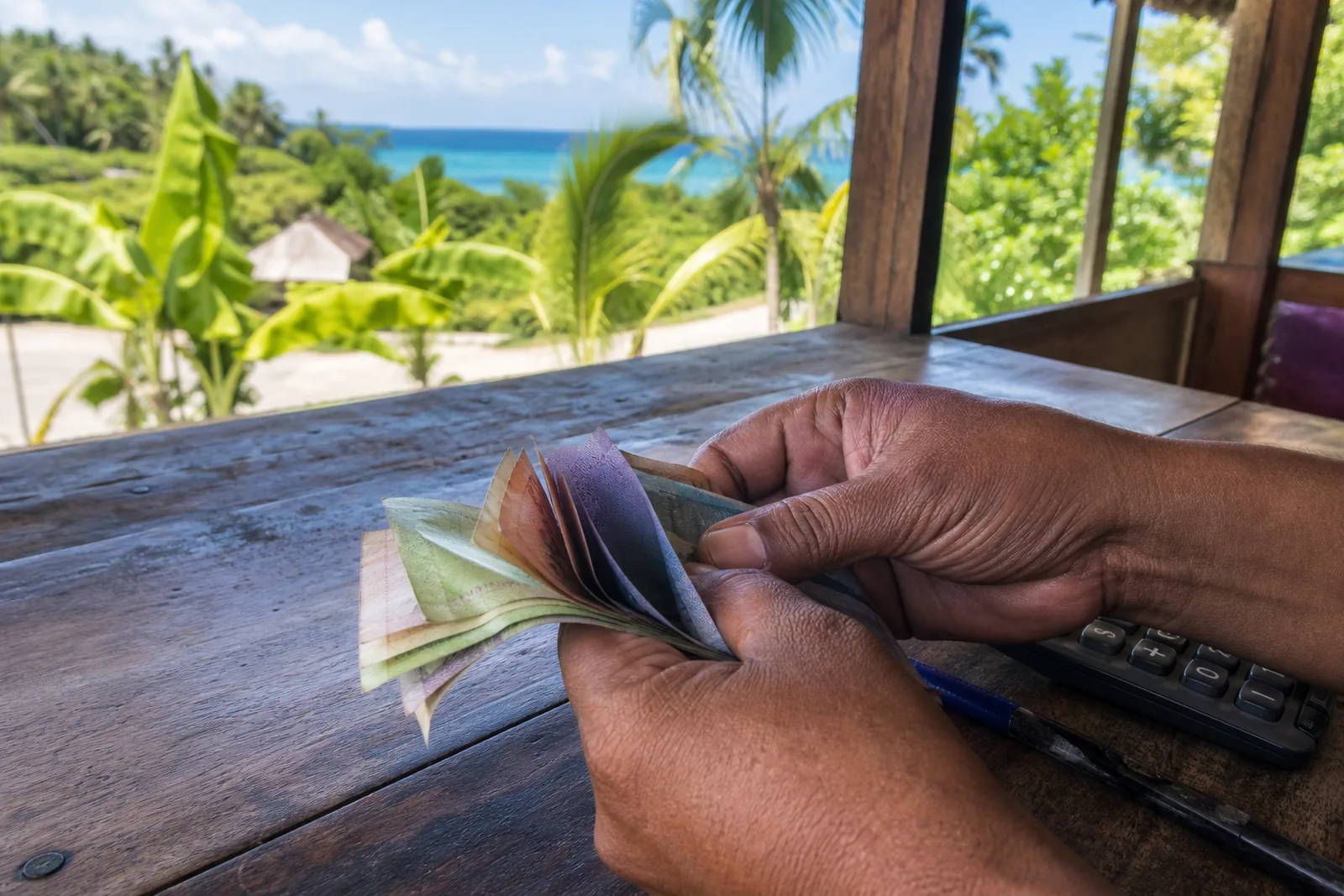
Lombok Notebook: What a Firmer Rupiah Means for Property Investors
A stronger rupiah offers a useful reminder: Lombok property returns depend on currency, costs and legal structure, not headline yields alone.
Quick answer: A firmer rupiah can improve the local purchasing power of foreign currency already converted into Indonesian rupiah, but it can also reduce the foreign-currency value of rupiah rental income. For Lombok investors, the practical lesson is to underwrite currency exposure, operating costs and legal ownership as carefully as the property itself.
A one-day move in a currency is rarely an investment thesis. Yet it can be an unusually useful prompt. Indonesia’s rupiah opened at Rp17,695 per US dollar, up 28 points, or 0.16%, from its previous close of Rp17,723, according to Antara Business. The immediate explanation was international rather than Lombok-specific: lower oil prices and renewed hopes of progress towards safer shipping through the Strait of Hormuz.
The Context
The reported move came as global energy markets responded to geopolitical signals. Antara Business cited Doo Financial Futures chief analyst Lukman Leong, who linked support for the rupiah to falling crude prices amid hopes for peace in the Middle East. Reports of discussions between Iran and Oman on a temporary joint maritime corridor in the Strait of Hormuz fed that change in sentiment.
The route matters because uninterrupted navigation through the waterway has implications for the wider energy market. The two governments discussed restoring freedom of navigation and continuing talks intended to support smooth shipping, regional security and stability. That is not a Lombok property story in itself. It is, however, the sort of external development that can reach an Indonesian buyer or villa owner through exchange rates, imported inputs and investor confidence.
Brent crude was reported at around US$86.20 per barrel, extending a previous-session decline of 2.4%. West Texas Intermediate was reported near US$80.40 per barrel, after settling 5.5% lower. These are market snapshots, not a forecast. Their relevance is simply that energy prices and currency markets can move together when the outlook for global supply routes changes.
For an overseas buyer, the direction of the rupiah changes the arithmetic at the moment funds are converted. A stronger rupiah means each unit of foreign currency buys fewer rupiah than before; a weaker rupiah means it buys more. The effect is straightforward, but the decision is not. Property transactions unfold through deposits, construction milestones, furnishing, operating expenses and eventual income distributions. A currency screen should therefore be built into the investment memorandum rather than treated as an afterthought on signing day.
Antara Business reported a projected rupiah trading range of Rp17,650 to Rp17,750 per US dollar.
That range is a near-term market assessment attributed to Lukman Leong, not a valuation tool for a villa. Still, it illustrates why buyers should avoid presenting a single exchange rate as if it were permanent. The purchase may be priced in a foreign currency, in rupiah, or through a structure where the economic exposure is mixed. The essential question is not whether the rupiah moved on one Wednesday, but which cash flows are actually denominated in which currency.
Currency Is Part of the Underwriting
Lombok’s property proposition is often discussed in real-estate language: land, design, tourism demand, occupancy and exit liquidity. Those remain central. But an international investor is purchasing a stream of local rights and costs through a foreign-currency balance sheet. Currency is therefore not a side note; it is one of the variables that determines how local performance translates into a home-currency result.
Consider the distinction between the main stages of ownership:
| Stage | Core currency question | |---|---| | Acquisition | How many rupiah does the buyer’s capital convert into when payment falls due? | | Development | Are contractor, imported-item and contingency costs exposed to different currencies? | | Operations | Are rental receipts and management costs received and paid in the same currency? | | Repatriation | What is the exchange rate when rupiah income is converted for the investor? | | Exit | In which currency is the sale agreed, and which market sets the buyer’s reference price? |
This is not an argument for trying to trade the rupiah. Most long-term property buyers are ill served by turning a physical asset into a daily foreign-exchange wager. It is an argument for scenario discipline. An investor should understand whether a favourable conversion at acquisition is being mistaken for a sustainable yield, or whether a later currency move could alter the foreign-currency value of otherwise stable rupiah income.
The distinction between gross and net rental yield is particularly important. In South Lombok, developer-quoted gross yields of 12-22% exclude costs. Honest net rental yields of 7-12% are after management fees and realistic occupancy, while top-performing assets can reach around 15% net. Management fees are typically 18-22% of gross rental revenue, and OTA or booking commissions are typically 15-20%.
Those local operating realities do not disappear because the exchange rate is favourable at purchase. Nor should a weaker rupiah automatically be described as positive for every foreign investor: it may lower the foreign-currency cost of rupiah-priced spending, but it may also lower the foreign-currency value of rupiah rental receipts. The net outcome depends on timing, denomination and the investor’s own reporting currency.
For market context, South Lombok’s realistic stabilised occupancy in the first 1-3 years is 55-70%, compared with 70-85% in Bali. Foreign arrivals are trending 40-50% year on year, while Kuta/Mandalika villa rates are about 38% year on year higher. These figures may support a long-run demand case, but they should not be used to erase execution risk or currency risk.
 Lombok Notebook · Illustration: HubLombok (AI-generated)
Ownership Structure and Local Cost Matter Too
Currency analysis becomes more valuable when it is combined with the legal and transactional structure. Foreigners cannot hold Indonesian freehold, known as Hak Milik or SHM; it is reserved for citizens. The available routes include leasehold, or Hak Sewa, typically 25-30 years with extensions; Hak Pakai, a personal right-to-use requiring KITAS or KITAP residency; and a PT PMA, a foreign-owned company that can hold Hak Guna Bangunan, or HGB, for 30 years with extensions.
That structure affects more than paperwork. It frames who owns the economic interest, what rights are being acquired, how the investment is operated and what needs to be reviewed before funds are committed. Nominee arrangements, where an Indonesian citizen holds freehold on a foreigner’s behalf, are illegal and void in court. They are not a shortcut around the ownership rules; they are a legal exposure.
A proper transaction also has its own local costs and process. Buyer transfer duty, BPHTB, is about 5% of assessed value. Annual land-and-building tax, PBB, is modest. Deeds are executed by a licensed PPAT notary; the deed of sale is the AJB, and the land agency is BPN.
For legal due diligence and transaction support, HubLombok’s advisory partner TerraNusa Advisory provides a licensed-notary and legal desk for foreign buyers in Lombok. Its stated scope includes reviewing SHM and HGB certificates, ownership history, zoning and encumbrances; supporting PT PMA setup; addressing BPHTB and PPh taxes; and managing deed and title transfer at BPN. This is relevant because legal diligence and currency planning serve the same purpose: reducing the gap between an attractive brochure price and the asset actually acquired.
The Lombok land market itself offers a wide entry range, which makes precision about location especially important. Overall land spans about Rp30-400 million per are. An are is 100 m². Kuta, the town, is the demand and liquidity leader at Rp300-400 million per are, approximately US$18,200-24,200 per are. Mandalika is a separate adjacent special economic zone around the MotoGP circuit, at Rp100-150 million per are, approximately US$6,100-9,100 per are.
Other zones occupy different positions on the risk-and-maturity spectrum:
- Selong Belanak: Rp150-250 million per are (approximately US$9,100-15,200), associated with family tourism and capital growth.
- Are Guling: Rp120-180 million per are (approximately US$7,300-10,900), an early-cycle frontier with momentum of about 47% year on year.
- Mawun: Rp50-80 million per are (approximately US$3,000-4,800), a quieter bay west of Kuta.
- Bumbang: Rp30-50 million per are (approximately US$1,800-3,000), an emerging area with the lowest entry.
These ranges underline why a single narrative about “cheap Lombok” is not sufficient. Price, tourism profile, legal readiness, construction quality and liquidity differ by zone. Currency can add another layer of variation, but it should never distract from the quality of the underlying site and transaction.
What This Means for Investors
The rupiah’s reported strengthening is best read as a reminder to separate market noise from investment process. The immediate catalyst, lower oil prices and hopes of smoother navigation through the Strait of Hormuz, belongs to the global macroeconomic backdrop. A Lombok buyer’s response should be practical rather than theatrical.
First, establish the currency of every material commitment before paying. Second, model local income after realistic occupancy, management fees and booking commissions, then consider what that income would mean in the investor’s home currency. Third, make the legal route explicit and conduct title, zoning, ownership-history and encumbrance checks before treating a land price or yield quotation as investable. Finally, distinguish a short-term exchange-rate movement from the longer project cycle of buying, building, operating and exiting.
For those assessing South Lombok, the broader investment case remains location-specific. Turnkey investment-grade villas begin at EUR95,000-350,000, against comparable Bali specifications of US$400,000-800,000. The frequently cited Bali-overflow thesis is that higher Bali prices and congestion can shift demand towards a cheaper, earlier-cycle Lombok market. It is a thesis to test with property-level evidence, not a guarantee delivered by a single currency move.
The most durable conclusion is modest but useful: exchange rates are not an external headline for overseas owners. They are part of the return calculation. Investors who combine currency awareness with realistic net-yield assumptions, clear legal structure and area-by-area diligence are better placed to judge whether a Lombok opportunity is genuinely priced for the risks it carries.
Stay informed, subscribe to the free Lombok Briefing for market intelligence like this, published twice a month.
Does a stronger rupiah make Lombok property cheaper for foreign buyers?
Usually no at the point of conversion: a stronger rupiah means foreign currency purchases fewer rupiah. The practical effect depends on whether the property, construction costs and payment milestones are priced in rupiah or another currency, and when the buyer converts funds.
How should currency risk be included in a Lombok villa investment?
Review the currency of acquisition payments, development costs, rental receipts, management fees and any eventual sale proceeds. Underwrite rental performance using honest net yields of 7-12% after management fees and realistic occupancy, then assess how rupiah income translates into your home currency.
Can foreigners buy Lombok land freehold through a local nominee?
No. Foreigners cannot hold freehold Hak Milik or SHM, which is reserved for Indonesian citizens. Nominee arrangements are illegal and void in court. Foreign buyers should use a lawful route such as leasehold, Hak Pakai where eligible, or a PT PMA holding HGB.

The Lombok Buyer's Field Guide
Legal structures ranked by risk, the honest ROI math line by line, all six zones ranked, and the 24-point due-diligence checklist. The whole book, free in your inbox.
See what's inside