Lombok Notebook: Why Cultural Identity Is an Economic Asset
Indonesia’s creative MSMEs show why cultural authenticity, technology and business succession deserve investors’ attention.
Quick answer: Bank Indonesia’s call for young Indonesians to preserve cultural identity while innovating offers Lombok investors a useful lens: durable value in the creative economy may lie not in imitation, but in businesses that combine authentic local products, technological relevance, capable new leadership and credible access to markets and finance.
A speech in Jakarta is not a Lombok investment thesis. Yet the themes raised at Indonesian Creative Works (KKI) 2026, authenticity, innovation and regeneration, describe a practical tension for every region seeking to turn cultural richness into lasting commercial value.
For investors, the relevant question is not whether culture can be monetised. It plainly can. The harder question is whether a business preserves enough of its identity to remain distinctive while building the operational capacity required to compete.
The Context
At the KKI 2026 event, Bank Indonesia Deputy Governor Thomas A.M. Djiwandono urged Indonesia’s younger generation to preserve the country’s identity and cultural wealth as they develop micro, small and medium enterprise products. His argument was direct: innovation should not require abandoning roots; cultural wealth is a strength that distinguishes Indonesian products in global competition.
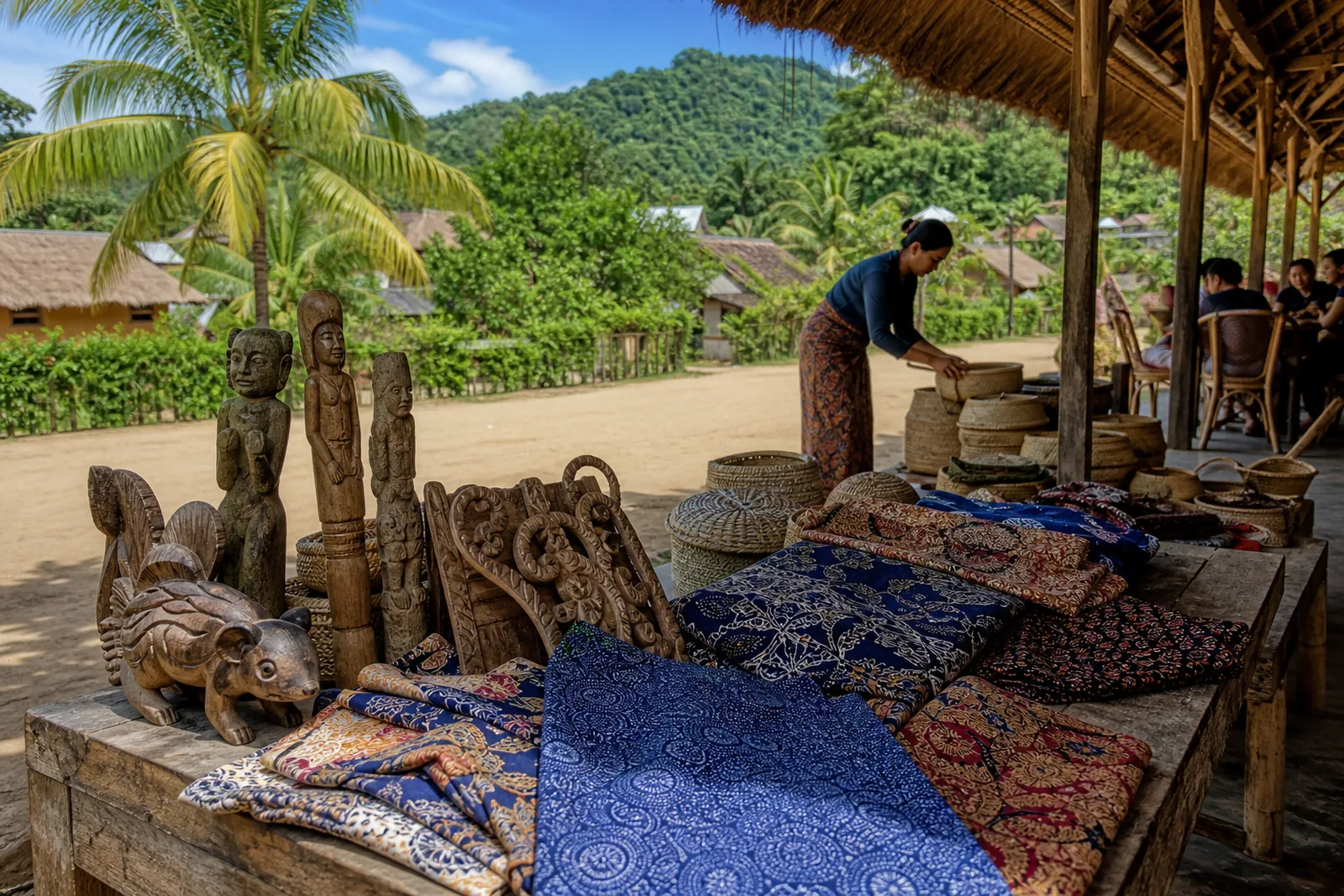
That proposition matters because cultural products can be deceptively easy to describe and difficult to scale well. Traditional textiles and handicrafts, cited by Djiwandono, carry value through authenticity. But authenticity is not merely a visual motif applied late in a production process. It depends on the continuity of making, local knowledge, materials, design judgement and a credible relationship between product and place.
“Innovation does not mean abandoning our roots.”, Thomas A.M. Djiwandono, Deputy Governor of Bank Indonesia
For a market such as Lombok, this creates a more useful frame than the familiar opposition between tradition and modernity. The opportunity is not to choose one over the other. It is to make them reinforce each other.
A locally rooted enterprise may use technology to present products more clearly, reach buyers more efficiently or improve the way it manages orders and relationships. None of that need dilute the product’s provenance. Indeed, if applied with care, digital tools can make provenance more legible to a buyer who has no direct knowledge of the maker or the place from which a product comes.
The Bank Indonesia official also described MSMEs and the creative economy as sectors with significant potential to create business opportunities and add value to the national economy. That is a broad national observation, rather than a guarantee about any individual enterprise. Investors should preserve that distinction. A compelling cultural story is not, by itself, proof of commercial resilience.
What it can provide is differentiation. In competitive markets, differentiation becomes most valuable when it is difficult to reproduce. A generic souvenir, generic hospitality concept or generic retail offer may be quickly copied. A business built around genuine local capability has a more demanding task, but potentially a more defensible identity.
Authenticity Needs an Operating Model
The source’s emphasis on technology and creativity is important precisely because culture alone does not answer the practical questions of business development. Products need to remain relevant and competitive; entrepreneurs need support ranging from capacity building and innovation to digitalisation, market access and financing.
This is the operating model behind the rhetoric. Cultural authenticity creates the starting point; execution determines whether it becomes an enduring enterprise.
For investors assessing a culture-linked business, the central areas of enquiry are therefore qualitative as well as financial:
- Whether the product’s cultural connection is genuine, specific and consistently expressed.
- Whether younger participants have meaningful space to bring new perspectives to the business.
- Whether technology is being used to improve relevance and access rather than merely to decorate a marketing narrative.
- Whether the enterprise can identify the support it needs in capacity, innovation, digitalisation, market access or financing.
- Whether the business can explain how it will retain the standards that made the product valuable as it grows.
The point is not to impose a uniform template on small businesses. A textile maker, craft producer, food business and tourism-facing retailer will each have different needs. But Djiwandono’s speech suggests a coherent test: does innovation strengthen the underlying identity of the enterprise, or obscure it?
This distinction also helps investors avoid a common analytical error. Not every business that uses cultural language is necessarily culture-led. A robust proposition should be able to connect the identity it claims with the product it sells, the people who make it and the way the business develops over time.
Technology is especially relevant here. The source does not treat digitalisation as an end in itself. It appears as one form of support that can help MSME players become more relevant and competitive. That is a more measured view than treating every digital initiative as inherently transformative.
For a Lombok-facing investor, the useful question is consequently practical: what commercial bottleneck is technology expected to solve? It may concern discovery, communication, customer access, payments, coordination or other aspects of business development. The answer should be clear enough to assess, even where an enterprise remains at an early stage.
 Lombok Notebook · Illustration: HubLombok (AI-generated)
Regeneration Is the Long-Term Question
The most consequential element of Djiwandono’s remarks may be regeneration. He argued that the sustainability of Indonesia’s MSMEs depends on preserving work through regeneration, strengthening it through innovation and growing it through entrepreneurship.
That formulation is valuable because it places succession alongside product development. In culture-based enterprises, the next generation is not simply a group of future managers. Younger people can be innovators, capable of taking Indonesian products further while retaining the qualities that make them distinctive.
The implication for existing business owners is equally clear. Senior players are encouraged to open wider space for younger people to participate and bring new perspectives to business development. For investors, this turns succession from a distant governance issue into an immediate question of organisational health.
A business dependent on a small number of experienced individuals may possess remarkable craft or local knowledge. It may also carry concentration risk if that knowledge is not being shared, documented or renewed. Conversely, a business that creates a real role for younger participants may be better placed to adapt without discarding its foundation.
There is no numerical shortcut to this assessment in the source material, and none should be invented. It calls for careful conversations: who is responsible for product development; how are decisions made; what room exists for new ideas; and how does the enterprise protect the authenticity on which its offer rests?
Inter-agency collaboration is part of the same picture. Djiwandono called for wider support for MSME players across capacity building, innovation, digitalisation, market access and financing. This recognises that entrepreneurship rarely develops in isolation. The quality of an opportunity may depend not only on its founder or product, but also on whether a credible support ecosystem can address its actual constraints.
For Lombok, the lesson is one of selectivity. Cultural richness should not be treated as an undifferentiated investment category. The stronger opportunities are likely to be those that can articulate a disciplined connection between local identity, product quality, commercial relevance and the people who will carry the business forward.
What This Means for Investors
The immediate news is a policy and leadership message, not an investment recommendation. Nevertheless, it offers a sensible due-diligence framework for investors considering Indonesia’s creative economy or culture-linked enterprises connected to Lombok.
First, treat authenticity as an asset that requires evidence. Ask what makes the offer locally specific and whether the business can sustain that distinction as it develops.
Second, distinguish innovation from novelty. The relevant innovation is the kind that helps an Indonesian product become more relevant and competitive while preserving the identity that makes it recognisable.
Third, examine regeneration with the same seriousness as product appeal. The source makes clear that younger people should be given space to participate and contribute new perspectives. That is a business-development question, not simply a social aspiration.
Finally, look beyond the enterprise in isolation. Capacity building, innovation, digitalisation, market access and financing are all identified as areas where support can matter. An investor need not assume that every form of support is available in every situation; rather, the enterprise should be realistic about what it needs and how it intends to secure it.
The most attractive cultural businesses are rarely those that package place into a superficial label. They are those that understand culture as a living commercial resource: protected through regeneration, made relevant through innovation and developed through entrepreneurship. That is a patient proposition, but it is also the sort of distinction that can matter when markets become crowded.
Stay informed, subscribe to the free Lombok Briefing for market intelligence like this, published twice a month.
Why does cultural identity matter to Indonesian MSME investors?
Bank Indonesia Deputy Governor Thomas A.M. Djiwandono said cultural wealth helps Indonesian products stand apart in global competition. For investors, the practical value is differentiation: a business should be able to show that its local identity is genuine, relevant to its product and capable of being sustained.
Does innovation weaken the authenticity of a culture-based business?
Not necessarily. Djiwandono’s message was that innovation does not require abandoning cultural roots. Technology and creativity can help products remain relevant and competitive, provided they strengthen rather than conceal the authentic cultural qualities that give traditional textiles, handicrafts and other products their distinction.
What should investors examine beyond a cultural product’s appeal?
Investors should assess how an enterprise develops its people and operations. The source highlights regeneration, capacity building, innovation, digitalisation, market access and financing. A culture-linked business should explain how it will preserve its identity, involve younger people and address the practical needs of business development.
The Lombok Buyer's Field Guide
Legal structures ranked by risk, the honest ROI math line by line, all six zones ranked, and the 24-point due-diligence checklist. The whole book, free in your inbox.
See what's inside