Bank Indonesia Eyes Stronger Rupiah in 2027: What It Means for Lombok Property Investors
BI forecasts the rupiah strengthening to Rp16,800–17,500 per dollar by 2027. For foreign buyers in South Lombok, this shift reshapes entry costs and timing strategies.
Daily Dispatch: Bank Indonesia Eyes Stronger Rupiah in 2027, What It Means for Lombok Property Investors
Bank Indonesia Governor Perry Warjiyo has outlined a bracing forecast: the rupiah will strengthen to Rp16,800–17,500 per US dollar by 2027, a shift driven by five converging macroeconomic forces. For European, American and Australian property investors eyeing South Lombok's €95–350K entry market, this projection reshapes currency exposure, entry timing, and portfolio allocation in ways that demand immediate attention.
The Context
Perry Warjiyo's confidence in rupiah strengthening rests on five pillars. Inflation convergence is the first: BI expects Indonesian inflation to continue its downward trajectory, tightening the inflation differential between Indonesia and major trading partners. Lower inflation, and the monetary policy tightening it permits, historically anchors currency strength. External account resilience forms the second pillar: sustained commodity exports (palm oil, nickel, coal) and manufacturing competitiveness maintain healthy current account buffers. The third driver is capital inflow momentum: BI anticipates rising foreign direct investment in infrastructure, manufacturing, and digital sectors, bringing dollar supply to rupiah markets. Fourth, policy credibility, BI's track record of inflation targeting and forex stewardship, anchors expectations that the central bank will defend the currency corridor rather than allow persistent weakness. And fifth, global risk repositioning: as US rates stabilise and emerging market risk premiums contract, Indonesia's relative yield advantage (BI rates currently at 5.75%) becomes less of a carry-trade magnet and more of a genuine long-term capital allocation draw.
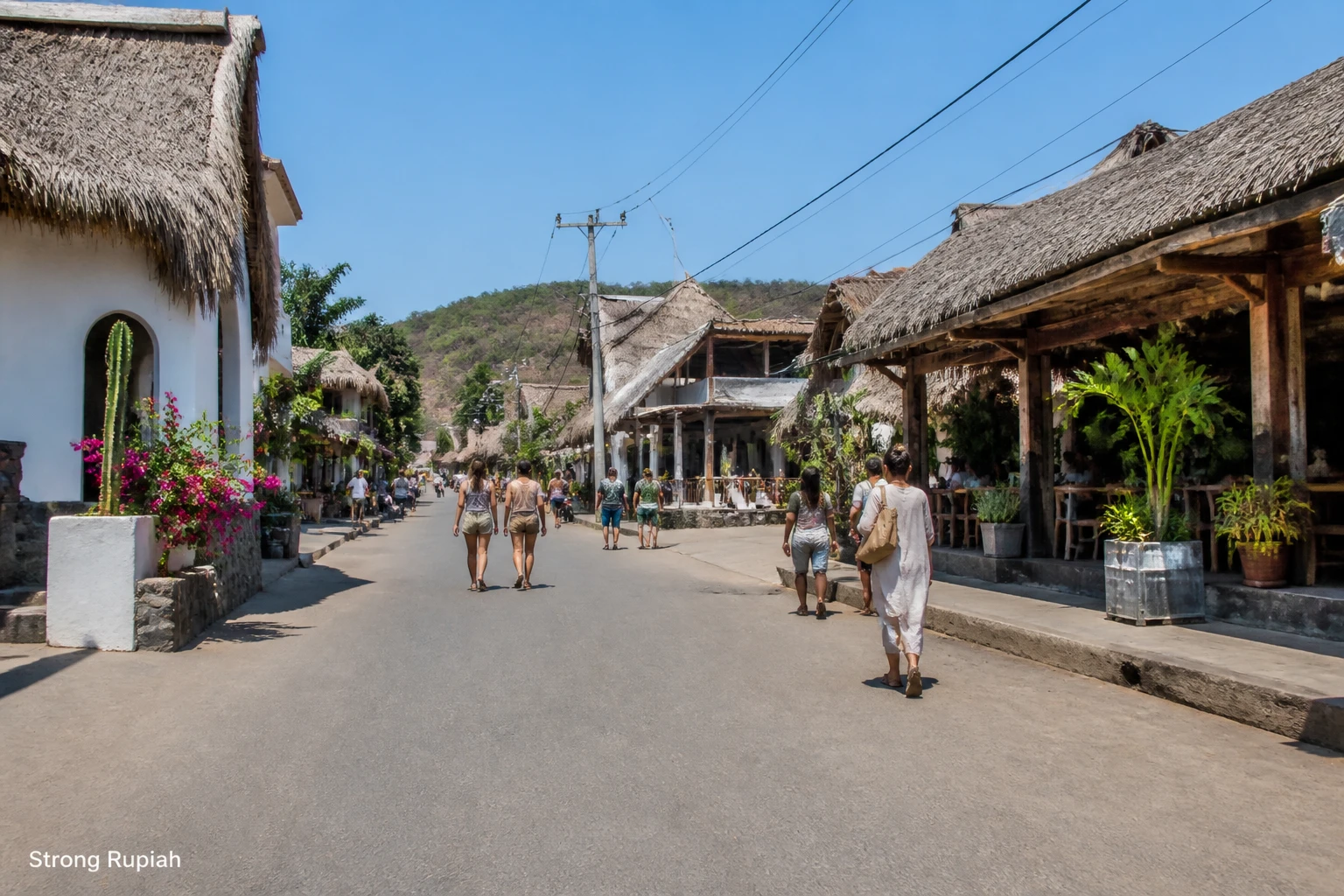
 Bank Indonesia Eyes Stronger Rupiah in 2027, What It Means for Lombok Property Investors · Photo by Daniel Lee on Pexels
Currency Headwinds and Foreign Buyer Economics
For foreign property investors, this forecast carries an uncomfortable truth: a stronger rupiah means your purchasing power in Indonesia softens. If the rupiah appreciates from today's ~Rp15,500–16,000 per dollar (illustrative) to Rp16,800–17,500 by 2027, foreign buyers will spend proportionally more in home-currency (euros, dollars, Australian dollars) to acquire the same property in rupiah terms.
A €200,000 villa purchase illustrates the mathematics. At today's 1 EUR = Rp17,000 (approximate), €200,000 converts to Rp3.4 billion. If the rupiah appreciates such that 1 EUR buys only Rp16,500 by 2027, the same villa price in rupiah now requires €206,000, a €6,000 headwind, or 3% currency drag. Over the property portfolio timescale (5–10 years), this compounds. Conversely, if rupiah weakens (opposite of BI's forecast), foreign buyer entry costs fall, a scenario the 2026 market has partly priced in, as speculators hedge currency risk.
South Lombok's yield advantage, 12–22% gross rental yields on off-plan villas, significantly above European or Australian equivalents, partially hedges this currency risk. A villa generating Rp600M annual rental income (€35,000 at current rates, €36,400 at Rp16,800) gains 3–4% yield drag from currency headwinds, but remains attractive against 4–6% European yields. Yet timing the entry becomes critical: purchase before rupiah strength locks in lower entry costs and captures currency gains if the projection overestimates appreciation.
Repositioning in a Strengthening Currency Environment
BI's forecast accelerates a broader competitive rebalancing in Southeast Asian real estate. Thailand and Philippines property markets, where political risk is higher but currency forecasts are less bullish, may see outflows as investors chase rupiah strength arbitrage. Vietnam and Cambodia remain under-developed for foreign ownership; Malaysia's property market is more fiercely competitive. South Lombok, by contrast, benefits from currency stability expectations and yield relief: BI credibility (unlike central banks in Manila or Bangkok) attracts patient capital.
However, the forecast also clarifies why 2026–2027 is the critical entry window for rupiah-bullish investors. If BI's projection materialises, those who purchase at 2026 rupiah rates will enjoy 3–5% currency gain atop rental yields by 2028–2029. Conversely, investors waiting for 2028 entry will face weaker purchasing power in euros or dollars, necessitating larger allocations to capture equivalent yields.
Smart investors consider currency hedging or mixed-currency financing. A portfolio manager might lock in rupiah forward contracts (12–24 month horizon) to hedge the 2027 appreciation, or structure villa purchases via IDR-denominated developer financing (common in Lombok off-plan sales) to defer rupiah exposure. Others embrace the currency drift as a feature: a €250,000 villa purchase today, sold in 2030 after €75,000 in cumulative rental income, might realise €310,000 sales proceeds (if rupiah weakness doesn't reverse sharply), yielding 24% total return, a blend of yield and currency gains.
What This Means for Investors
BI's forecast crystallises three imperatives:
-
Accelerate entry if rupiah-bullish. Investors confident in BI's macroeconomic management should transact in 2026–2027 to lock in lower rupiah-denominated prices and capture currency appreciation.
-
Layer hedges into portfolio construction. A mix of fixed-rate IDR financing (developer loans at 4–5.5%) and forward currency contracts (if available through Indonesian private banks) reduces asymmetric rupiah risk.
-
Recalibrate yield expectations for currency drag. A villa marketed at 18% gross yield should be mentally adjusted to 15–16% after currency headwinds, then compared to non-currency-hedged alternatives (commercial property in euros, bonds, equities).
The broader lesson: Indonesia's macroeconomic fundamentals, low inflation, capital inflows, commodity resilience, are genuinely attractive. BI's credibility is real. But for foreign property investors, this strength creates a time-arbitrage opportunity. Miss the 2026–2027 window, and you'll be buying Lombok villas at rupiah rates that reflect the currency appreciation you'd hoped to capture.
Stay informed, subscribe to the free Lombok Briefing for market intelligence like this, published twice a month.
What does Bank Indonesia's rupiah forecast mean for foreign property buyers in Lombok?
Bank Indonesia Governor Perry Warjiyo forecasts the rupiah will strengthen to Rp16,800 to 17,500 per US dollar by 2027. For foreign buyers this reduces purchasing power: at approximate current rates, a €200,000 villa that costs €200,000 today could cost around €206,000 by 2027, a roughly 3% currency drag. Entering in 2026 to 2027 locks in lower rupiah-denominated prices before appreciation takes hold.
How do South Lombok rental yields hold up against currency risk from a strengthening rupiah?
South Lombok off-plan villas offer 12 to 22% gross rental yields, far above the 4 to 6% typical in Europe or Australia. A villa marketed at 18% gross yield should be mentally adjusted to 15 to 16% after currency headwinds from rupiah appreciation. Even after that adjustment, the yield advantage over European equivalents remains substantial for foreign investors.
Why is 2026 to 2027 considered a critical entry window for Lombok property investment?
If Bank Indonesia's forecast materialises, investors who purchase at 2026 rupiah rates could capture 3 to 5% currency gain on top of rental yields by 2028 to 2029. Investors waiting until 2028 would face weaker purchasing power in euros or dollars and would need larger capital allocations to achieve equivalent returns. IDR-denominated developer financing at 4 to 5.5% is one way to defer currency exposure.

The Lombok Buyer's Field Guide
Legal structures ranked by risk, the honest ROI math line by line, all six zones ranked, and the 24-point due-diligence checklist. The whole book, free in your inbox.
See what's inside