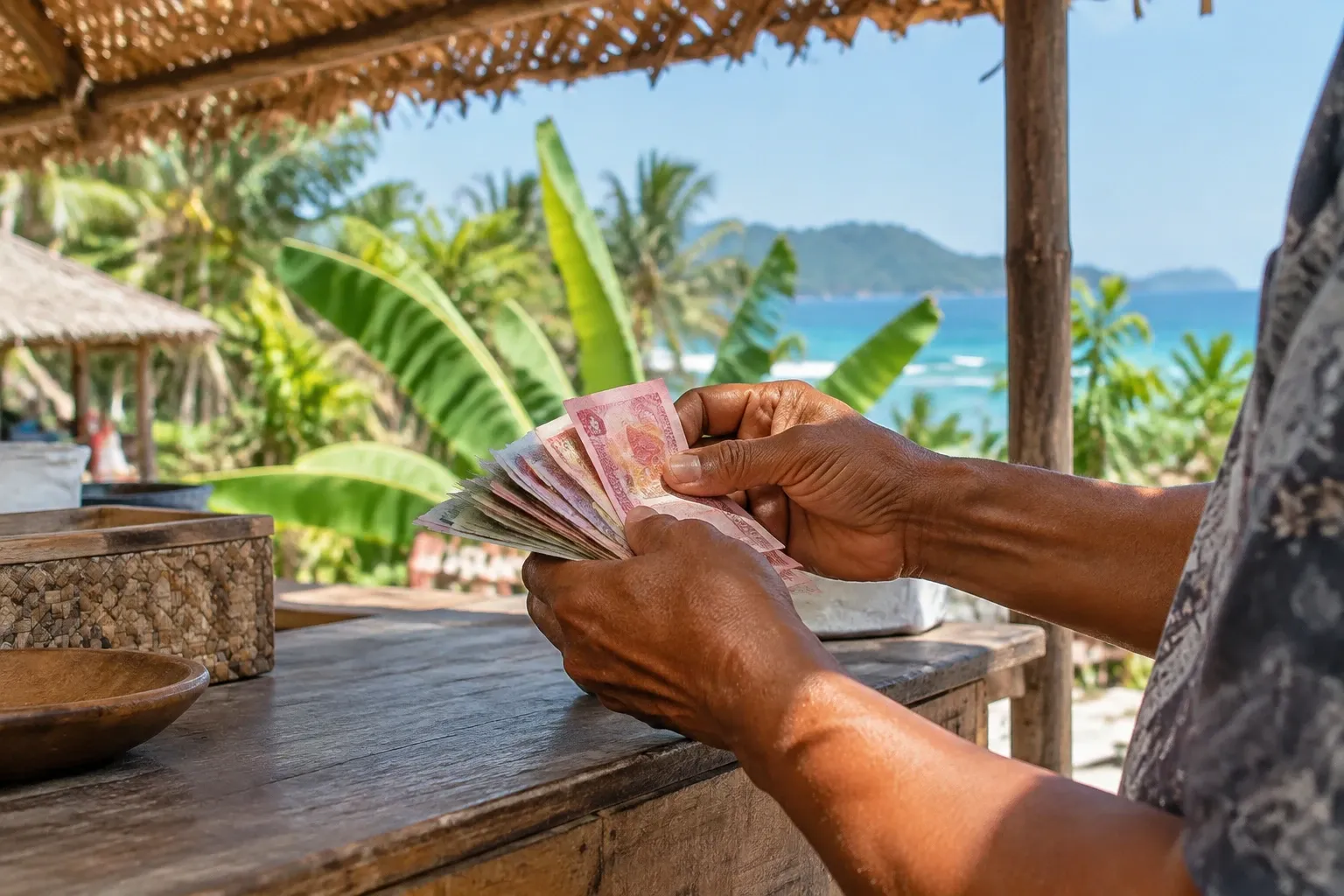
BI Deploys All Monetary Tools to Defend the Rupiah: What Lombok Investors Should Note
Bank Indonesia widened its hedging incentives to cover foreign direct investment and foreign bank loans as the rupiah hit Rp17,855 per dollar. Here is what that means for Lombok buyers.
Quick answer: Bank Indonesia said on Wednesday it is using all its monetary tools to steady the rupiah, which traded at Rp17,855 per US dollar on 22 September. For Lombok investors, the move matters for foreign funding and currency costs, while local land is still quoted in rupiah per are.
Bank Indonesia (BI) has told markets it is throwing everything at rupiah stability. The headline is reassuring, but the detail is more interesting for anyone who moves foreign money into Indonesian property: the central bank has widened the set of transactions that qualify for cheaper currency hedging, and foreign direct investment is now on the list.
The Context
Speaking after the Board of Governors meeting in Jakarta on Wednesday, BI Governor Destry Damayanti said the bank is "optimizing all monetary instruments, including expanding incentive policies to boost foreign portfolio investment inflows, strengthen rupiah exchange rate stability, and accelerate the deepening of money and foreign exchange markets."
The backdrop, as reported by Antara Business, is a currency that has recovered and then wobbled. Monetary intervention helped the rupiah recover from August through mid-September 2026, but global market headwinds have renewed short-term selling pressure. As of 22 September the rupiah traded at Rp17,855 per US dollar, a modest 0.7 percent point-to-point depreciation from late-August levels.
The governor was upbeat about what comes next. "Looking ahead, Bank Indonesia projects that the rupiah exchange rate will remain stable," she said, citing BI's commitment, attractive yields, inflation controlled within the target range, and a positive domestic economic outlook.
Two points of discipline are worth keeping in view. First, that outlook is the central bank's own projection, not an independent forecast, and we treat it as such. Second, a 0.7 percent move over roughly a month is small. The story here is less the size of the slide than the scale of the policy response to it.
What BI Actually Changed
The concrete measure is an expansion of the premium-reduction incentives that BI offers on foreign funding. Specifically, the incentives apply to Hedging Sell Swaps and Domestic Non-Deliverable Forwards (DNDFs). These are instruments that let a party fix the rupiah cost of foreign money in advance, rather than carrying the full exchange-rate risk until the transaction settles.
What changed is the list of underlying transactions that are eligible. According to the report, the policy now includes:
- foreign direct investment;
- foreign bank loans;
- and, as before, portfolio inflow transactions.
In plain terms, BI is trying to make it cheaper for money that is committed to Indonesia, not only money that trades through markets, to protect itself against currency swings. The stated aim is to support foreign inflows and deepen the money and foreign exchange markets.
The source does not say how large the premium reduction is, how it is priced, or which banks and counterparties offer these products to smaller foreign buyers. Nor does it say whether an individual purchasing a villa or a plot would ever touch these instruments directly. Those are questions for a bank or adviser, and we would not assume the answer is yes.
 BI Deploys All Monetary Tools to Defend the Rupiah · Photo by Quang Nguyen Vinh on Pexels
Reading the Rupiah Through a Lombok Lens
Lombok land is quoted in rupiah, and the local convention is per are (1 are = 100 m²). Our verified ranges run from about Rp 30-400 million per are across South Lombok, with prime tourist-zone land at roughly Rp 150-400 million per are. Kuta sits at Rp 300-400 million, Selong Belanak at Rp 150-250 million and Are Guling at Rp 120-180 million.
That structure has a practical consequence. A foreign buyer converting euros, Australian dollars or US dollars into rupiah is exposed to the exchange rate between the day a price is agreed and the day money arrives. The dollar conversions we publish for land use an approximate rate of Rp 16,500 per dollar. With the rupiah at Rp17,855 on 22 September, those older dollar equivalents overstate what a given rupiah price costs in dollars today. Treat our dollar figures as indicative, and convert at the live rate before you budget.
The currency also touches returns. Our honest net rental yield range is 7-12%, after management fees and realistic occupancy, with developer-quoted gross yields of 12-22% sitting well above that. Those percentages are quoted for the asset, and they do not remove the currency question. If your base currency is not the rupiah, a weaker rupiah reduces the value of rupiah income when it is converted back, and a stronger one increases it. That cuts both ways, and it is an argument for deciding in advance how much currency risk you are willing to carry.
The demand backdrop is unchanged by this announcement. Foreign arrivals are running +40-50% year on year, and Kuta and Mandalika villa rates are up about +38% year on year. Nothing in BI's statement alters those figures, and we would not read a currency measure as a direct signal on property prices.
What This Means for Investors
This is a live development, so the honest reading is measured: BI has shown it will act, and it has extended that support to the category of money that includes overseas direct investment. That is a constructive signal about policy intent. It is not a promise about the rupiah's level.
Practical points for buyers and investors currently weighing South Lombok:
- Price in rupiah, budget in your own currency. Agree the rupiah price per are, then model the total at several exchange rates, including one weaker and one stronger than today's Rp17,855.
- Ask about hedging early. The expanded incentives concern foreign funding and hedging products. Ask your bank whether any of this is available for your transaction size, and do not assume it is.
- Do not let currency drive the structure. Foreigners cannot hold freehold (Hak Milik). The lawful routes remain leasehold (Hak Sewa), Hak Pakai, or a PT PMA holding HGB. The source does not say how the new incentives apply to any of these structures, so take that question to a licensed notary and legal adviser.
- Stage payments with care. Where a purchase involves instalments, each payment is exposed to the rate on its own date. Timing is part of the risk.
- Keep the conversion rate in your due diligence file. The gap between Rp 16,500 and Rp17,855 is a reminder that older dollar figures age quickly.
Watch two things over the coming weeks: whether the renewed selling pressure BI described eases, and whether the widened incentives lead to visible hedging activity around foreign direct investment. The source gives no data on either, so any view beyond that would be speculation.
For now, the takeaway is calm rather than alarmed. A central bank that explicitly widens support for foreign direct investment is, at minimum, signalling that it wants that capital to keep coming. The disciplined response from an individual investor is to do the sums in rupiah, convert at the live rate, and treat currency as a cost line rather than a surprise.
Stay informed: subscribe to the free Lombok Briefing, published twice a month (the 1st and 15th), for market intelligence like this.
What did Bank Indonesia announce on Wednesday?
Bank Indonesia said it is optimising all its monetary instruments to support rupiah stability. It widened premium-reduction incentives on Hedging Sell Swaps and Domestic Non-Deliverable Forwards to cover foreign direct investment and foreign bank loans, alongside portfolio inflows.
Where was the rupiah when BI made the announcement?
As of 22 September the rupiah traded at Rp17,855 per US dollar, a 0.7 percent point-to-point depreciation from late-August levels, according to Antara Business. BI projects the rupiah will remain stable, though that is the central bank's own outlook.
Does a weaker rupiah change Lombok land prices in dollar terms?
Lombok land is quoted in rupiah per are, so a weaker rupiah lowers the dollar cost of the same rupiah price. Our published dollar conversions use about Rp 16,500 per dollar, so convert at the live rate before budgeting.

The Lombok Buyer's Field Guide
Legal structures ranked by risk, the honest ROI math line by line, all six zones ranked, and the 24-point due-diligence checklist. The whole book, free in your inbox.
See what's inside