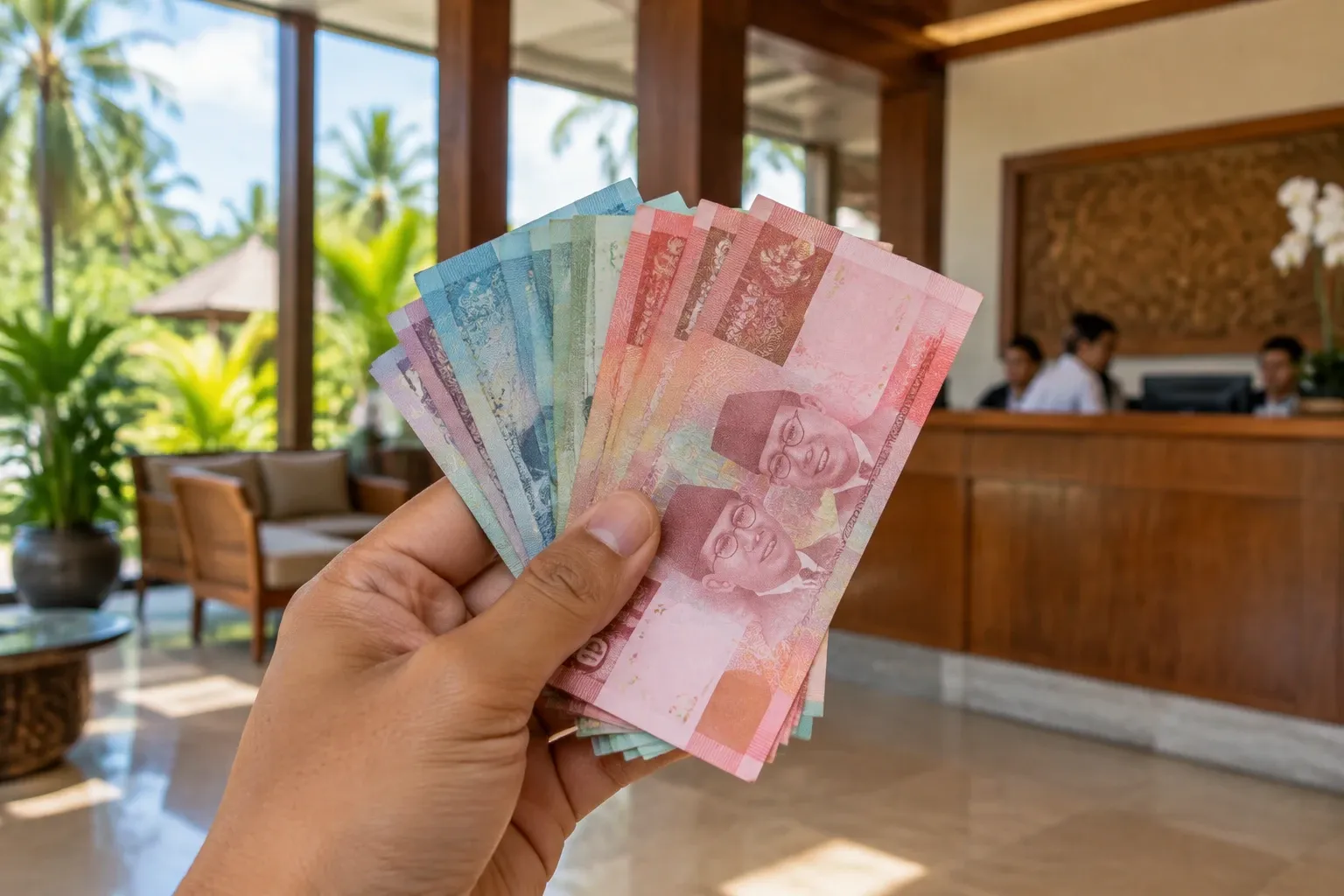
Bank Indonesia Holds Rate at 5.75% and Sees 2026 Growth of 4.9-5.7%
Bank Indonesia kept its benchmark rate at 5.75% and projects 4.9-5.7% growth for 2026. What a steady central bank and a volatile rupiah mean for South Lombok property buyers.
Quick answer: Bank Indonesia held its benchmark BI-Rate at 5.75 percent on 23 September 2026 and projects 2026 economic growth of 4.9 to 5.7 percent. For Lombok investors, a steady rate means no new rate shock, while rupiah stability remains the variable to watch.
The central bank chose patience over action this week. After its two-day Board of Governors meeting in Jakarta, Bank Indonesia (BI) left all three of its policy rates unchanged and described the economy as solid. For foreign buyers weighing a villa or a plot in South Lombok, the decision is less about headline growth and more about what it says regarding currency risk.
The Context
This dispatch is based on reporting by Antara Business, published on 23 September 2026. According to that report, the BI Board of Governors met on 22 and 23 September and decided to hold the benchmark BI-Rate at 5.75 percent. The deposit facility rate stays at 4.75 percent and the lending facility rate at 6.50 percent.
The BI Governor told reporters in Jakarta on Wednesday that Indonesia's economic growth "remains solid and needs to be further boosted by optimizing various sources of economic growth." The central bank's projection for 2026 is a range of 4.9 to 5.7 percent. That is a wide band, and it is worth reading as such: a range of nearly a full percentage point signals a bank that sees real upside but is not willing to commit to a single figure.
The key numbers from the announcement, as reported:
- BI-Rate: 5.75 percent, unchanged
- Deposit facility rate: 4.75 percent, unchanged
- Lending facility rate: 6.50 percent, unchanged
- 2026 growth projection: 4.9 to 5.7 percent
- Inflation target for 2026 and 2027: 2.5 percent, plus or minus 1 percent
Antara reports that the hold is consistent with the central bank's strategy of stabilising the rupiah against what it described as persistent external volatility, while keeping inflation inside its target corridor. In other words, BI is prioritising currency stability over any push to cut rates and stimulate demand further.
The Governor's description of the growth drivers is also informative. Household consumption is said to be stable, supported by substantial government fiscal stimulus, rising consumer confidence and positive income expectations. Investment has grown steadily, but the source is careful to say it is primarily driven by government projects, and that private sector involvement "needs to be further encouraged." On the external side, non-oil and gas exports improved on rising global demand, though the Governor called for stronger efforts to capture the benefit of favourable commodity prices.
Reading the Signal Behind the Hold
Rate decisions of this kind are easy to over-interpret, so it helps to separate what the source states from what it does not.
What is stated: BI kept every policy rate where it was, cited rupiah volatility as a continuing concern, and expressed confidence in growth supported by government stimulus programmes. The Governor pointed to "the implementation of various government stimulus programs, improving economic confidence, and the optimization of various growth sources" as the basis for the outlook.
What is not stated: the source gives no indication of when, or whether, BI expects to change rates, and it offers no rupiah level or forecast. Any claim about the next move would be speculation, and we will not supply one.
There is, however, a tension in the official framing that investors should notice. The growth story leans heavily on public spending. The Governor's own remarks acknowledge that private investment participation still needs encouragement. A growth model carried mainly by government projects and fiscal stimulus is, by construction, dependent on policy continuity. That is not a criticism, simply a point to weigh when a 4.9 to 5.7 percent range is quoted as if it were a single number.
For a foreign investor, the practical reading is twofold. First, a held rate removes one source of uncertainty: the policy backdrop is unchanged from the previous decision. Second, the emphasis on rupiah defence is a reminder that the currency is the channel through which global volatility reaches Indonesian assets, including property bought with foreign capital.
 Bank Indonesia Holds Rate at 5.75% and Sees 2026 Growth of 4.9-5.7% · Photo by XT7 Core on Pexels
Why the Rupiah Matters More Than the Rate in Lombok
Most South Lombok transactions by foreign buyers are not financed with Indonesian bank credit. Foreigners cannot hold freehold (Hak Milik / SHM), which is reserved for Indonesian citizens. The available routes are leasehold (Hak Sewa, typically 25 to 30 years with extensions), Hak Pakai (a personal right of use that requires KITAS or KITAP residency), or a PT PMA foreign-owned company holding Hak Guna Bangunan (HGB) for 30 years, extendable. In most cases the purchase is funded from abroad, so the BI-Rate touches the buyer indirectly rather than through a mortgage payment.
The transmission channels that do matter are these:
- Currency translation. Land and villa prices are quoted in rupiah, while a European, Australian or American buyer funds in euros, Australian dollars or US dollars. Our reference conversion is about Rp 16,500 to the US dollar, but that is a working assumption for illustration, not a forecast. A rupiah that moves materially between contract and completion changes the effective price paid.
- Rental income in rupiah, capital in foreign currency. Villa income is earned locally. A weaker rupiah reduces the value of that income when repatriated, which is why yield figures should always be read alongside a currency assumption.
- Local cost inflation. BI's target of 2.5 percent, plus or minus 1 percent, frames the pace at which local costs such as construction, staffing and services can be expected to move. Management fees typically run 18 to 22 percent of gross rental revenue, and booking-platform commissions 15 to 20 percent, so cost drift feeds directly into net returns.
This is why our own numbers keep a clear line between gross and net. Developer-quoted gross yields in South Lombok run 12 to 22 percent before costs. After management fees, commissions and realistic occupancy, the honest net range is 7 to 12 percent, and that is an estimate, not a target or a promise. A stable policy rate does not change that arithmetic. It simply avoids adding a new unknown to it.
What This Means for Investors
The decision is not an event that should trigger a purchase or a sale. It is a data point that slightly lowers policy uncertainty while leaving currency risk in place. Sensible responses follow from that.
1. Treat the growth range as a range. The official 4.9 to 5.7 percent projection is broad. Plan around the lower end, and treat anything above it as upside rather than a base case.
2. Stress-test your currency assumption. Before committing, model the purchase and the rental income under a weaker rupiah than today's rate. If the investment case only works at the current exchange rate, it is a currency bet as much as a property investment.
3. Keep the legal structure as the first decision. Macro headlines do not change what a foreigner can hold. Leasehold, Hak Pakai and PT PMA with HGB are the lawful routes. Nominee structures, where an Indonesian holds freehold on your behalf, are illegal and void in court. The buyer transfer duty, BPHTB, is about 5 percent of assessed value, and deeds must be executed by a licensed PPAT notary. Independent legal due diligence, such as that offered by our advisory partner TerraNusa Advisory (terranusaadvisory.com), matters more than any rate announcement.
4. Watch land per are, not headlines. Land in South Lombok is quoted per are (1 are = 100 m²). Our authoritative ranges run from about Rp 30 to 50 million per are in emerging Bumbang to Rp 300 to 400 million per are in Kuta. Macro news moves sentiment; it does not replace zone-level price discovery.
5. Note where private investment sits. The Governor said private sector involvement in investment still needs to be encouraged. For a private buyer, that framing suggests the official growth engine remains public projects and stimulus. Investors relying on government-led momentum should monitor policy continuity as closely as they monitor prices.
A final caution on interpretation. The central bank speaks about the national economy. Nothing in the announcement refers to Lombok, to property, or to tourism. Any link to South Lombok is our inference, and it runs through currency, inflation and general confidence, not through a stated policy for the island.
HubLombok is the editorial arm of Samudra Villas, an active developer in South Lombok. That relationship is disclosed here because it shapes what we cover, not what we conclude.
The practical takeaway is modest but useful: a steady policy rate, a wide growth range and an explicit focus on rupiah stability describe a central bank managing risk rather than chasing growth. Investors should do the same.
Stay informed: subscribe to the free Lombok Briefing, published twice a month (the 1st and 15th), for market intelligence like this.
What did Bank Indonesia decide on 23 September 2026?
According to Antara Business, Bank Indonesia held its BI-Rate at 5.75 percent, the deposit facility rate at 4.75 percent and the lending facility rate at 6.50 percent. It projects 2026 economic growth of 4.9 to 5.7 percent.
Does the BI-Rate directly affect foreign villa buyers in Lombok?
Only indirectly. Most foreign buyers fund purchases from abroad rather than through Indonesian bank credit. The bigger exposures are the rupiah exchange rate, which affects effective price and rental income, and local cost inflation.
What is a realistic net rental yield in South Lombok?
Our honest estimate is 7 to 12 percent net, after management fees and realistic occupancy. Developer-quoted gross yields of 12 to 22 percent exclude those costs, so always check whether a figure is gross or net.

The Lombok Buyer's Field Guide
Legal structures ranked by risk, the honest ROI math line by line, all six zones ranked, and the 24-point due-diligence checklist. The whole book, free in your inbox.
See what's inside