Bank Indonesia Holds BI-Rate at 5.75%: What It Means for Lombok Buyers
Bank Indonesia kept its benchmark rate at 5.75 percent on 23 September 2026, prioritising rupiah stability. Here is what the hold means for foreign property investors in Lombok.
Quick answer: Bank Indonesia held its benchmark BI-Rate at 5.75 percent on 23 September 2026, with the deposit facility at 4.75 percent and the lending facility at 6.50 percent. For Lombok investors the message is stability: no new rate shock, but a central bank still prioritising rupiah defence over stimulus.
The decision was widely watched and, in the end, unremarkable, which is precisely the point. Bank Indonesia (BI) chose continuity after its two-day Board of Governors Meeting, and its own language explains why: the rupiah remains the priority. For anyone pricing an Indonesian property purchase in euros, Australian dollars or US dollars, that priority matters more than the headline rate itself.
The Context
According to Antara Business, BI concluded its monthly Board of Governors Meeting (RDG) on 22-23 September 2026 and decided to keep the BI-Rate at 5.75 percent. The two supporting rates were also left unchanged: the deposit facility rate at 4.75 percent and the lending facility rate at 6.50 percent. Together they form the corridor within which short-term money-market rates move.
Governor Destry Damayanti framed the hold in terms of currency, not growth. In the statement carried by Antara, she said the decision "remains consistent with the exchange rate stabilization strategy amidst persistent external pressures." The stated aim is to support the achievement of the inflation target of 2.5 percent, plus or minus 1 percent, in both 2026 and 2027, and to foster sustainable economic growth.
Three elements of the announcement deserve attention:
- Exchange-rate stability is the operating strategy. The phrase "persistent external pressures" is BI's own, and it signals that the bank sees no reason yet to loosen policy at the expense of the rupiah.
- The inflation target is unchanged. BI is holding to a 2.5 percent midpoint with a one-percentage-point band on either side for two consecutive years.
- Capital inflows are a stated policy goal. The governor said BI will keep strengthening incentive policies to attract foreign capital inflows, while accelerating the development of money and foreign exchange markets.
Antara's related coverage adds two further threads, which we cite only by headline. One reports that foreign investors posted US$1.8 billion in net inflows in the third quarter of 2026, according to Bank Indonesia. Another reports that BI is boosting local currency transaction (LCT) implementation to maintain rupiah stability. We have not seen the underlying detail of either, so we treat them as context rather than evidence.
The governor also said macroprudential and payment system policies will continue to be directed toward supporting sustainable domestic economic growth. In plain terms, BI is holding the interest-rate lever still while using other tools to keep credit and payments flowing.
Why a Hold Is Still a Signal
A central bank that leaves rates alone is not doing nothing. It is choosing a stance, and the stance here is defensive. When an institution says its policy is "consistent with the exchange rate stabilization strategy amidst persistent external pressures", it is telling markets which risk it fears more: a weaker rupiah, not a slower economy.
That reading is our interpretation of the wording, not a forecast, and BI has not said what it will do at future meetings. What the statement does establish is the order of priorities. Stabilising the currency comes first, and the incentives for foreign capital are part of that effort.
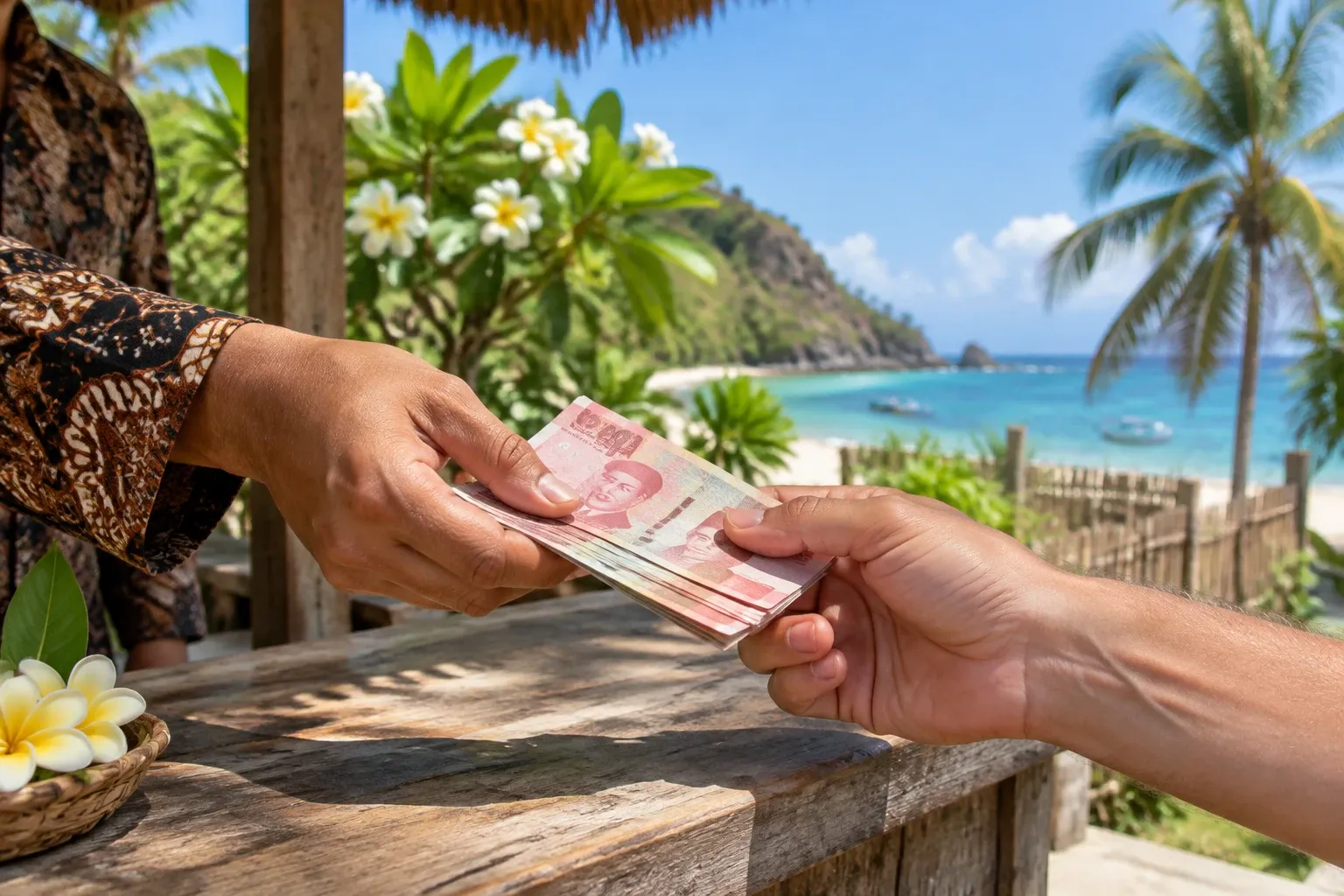
For a foreign buyer of Lombok property, the currency is not a side issue. Land and villa prices in South Lombok are quoted in rupiah, and our own reference convention converts at roughly Rp 16,500 to the US dollar. A stable rupiah narrows the gap between the price you agree and the price you eventually pay in your home currency. A volatile one widens it, in either direction.
 Bank Indonesia Holds BI-Rate at 5.75% · Photo by Rajesh Chetty on Pexels
Reading the Decision Against Lombok's Fundamentals
Nothing in BI's announcement mentions property, tourism or Lombok, and we do not claim that it does. The link is indirect, and it runs through two channels: the cost of money and the stability of the currency.
The cost of money. A steady BI-Rate means the policy backdrop for Indonesian lending is unchanged from last month. Most foreign buyers in South Lombok are not financing through Indonesian banks, so the direct effect on a typical purchase is limited. Where local financing or local-currency deposits do matter, the 4.75 percent deposit facility and 6.50 percent lending facility mark the boundaries of BI's own corridor. We have no data on what commercial banks charge borrowers or pay depositors, and we do not estimate it here.
The stability of the currency. This is the channel that matters for cross-border capital. BI's explicit commitment to attracting foreign inflows and deepening its foreign exchange market is a statement of intent. Whether it succeeds is a separate question that the coming months will answer, and one hold does not settle it.
Against that policy backdrop, the demand-side picture for South Lombok is driven by different forces. Our verified figures show foreign arrivals trending up 40-50% year on year, attributed to tourism recovery and the MotoGP effect. Kuta and Mandalika villa rates are up about 38% year on year. Those numbers reflect tourism demand, and a rate hold neither creates nor removes them.
The honest way to combine the two is as follows:
| Factor | What we know | What we do not know | |---|---|---| | BI-Rate | Held at 5.75% on 23 September 2026 | Direction at future meetings | | Rupiah | Explicit stabilisation strategy | How external pressures evolve | | Foreign capital | Stated policy incentives; Q3 net inflows reported at US$1.8b per Antara headline | Whether inflows persist | | South Lombok demand | Arrivals +40-50% YoY; Kuta/Mandalika villa rates about +38% | Any direct link to this rate decision |
What This Means for Investors
The practical conclusions are modest, and we would rather state them plainly than dress them up.
1. Treat currency as a line item in your underwriting. BI has told you the rupiah is under "persistent external pressures" and that stabilising it is the strategy. Model your purchase in your home currency, and test it against a range of exchange rates rather than a single assumed rate. Land in South Lombok spans roughly Rp 30-400 million per are, depending on the zone, so a currency move applies across every price point.
2. Keep yield expectations anchored to honest ranges. Our published net rental yield range for South Lombok is 7-12% after management fees and realistic occupancy, with top-performing assets reaching about 15% as an outlier. Developer-quoted gross yields of 12-22% exclude management fees of 18-22% of gross rental revenue and booking commissions of 15-20%. A steady BI-Rate does not change any of these figures. Be wary of anyone who cites a central bank decision as a reason to inflate a yield projection.
3. Do not confuse policy stability with legal certainty. Foreigners cannot hold the strongest form of Indonesian land title; the available routes are leasehold (Hak Sewa, typically 25-30 years with extensions), Hak Pakai, or a PT PMA holding Hak Guna Bangunan (HGB). Nominee structures are illegal and void in court. No monetary policy announcement alters that. Buyer transfer duty (BPHTB) runs at about 5% of assessed value, and deeds are executed by a licensed PPAT notary. For due diligence and the transfer chain, TerraNusa Advisory is an independent licensed-notary and legal desk for foreign buyers in Lombok, and we present it as an advisory partner.
4. Watch the next meetings, not this one. A hold gives you no new information about direction. What would be informative is a change in BI's language: a shift away from "exchange rate stabilization" as the lead priority, or a change to the inflation-target framing. Until then, the reasonable stance is to plan for continuity while acknowledging that the external pressures BI cites have not gone away.
One caveat on our own position: HubLombok is the editorial arm of Samudra Villas, an active developer in South Lombok. That relationship is disclosed here because it shapes what we cover, not what we conclude.
The bottom line is that Bank Indonesia has bought itself, and investors, another month of predictability. That is worth having, and it is not a reason to change a well-built plan. It is a reason to check that your plan does not depend on the rupiah behaving perfectly.
Stay informed: subscribe to the free Lombok Briefing, published twice a month (the 1st and 15th), for market intelligence like this.
What did Bank Indonesia decide on 23 September 2026?
Bank Indonesia held its benchmark BI-Rate at 5.75 percent after its 22-23 September 2026 meeting. It also left the deposit facility rate at 4.75 percent and the lending facility rate at 6.50 percent, citing its exchange rate stabilisation strategy amid persistent external pressures.
Does the BI-Rate hold change Lombok rental yields?
No. The hold does not change our honest net rental yield range of 7-12% after management fees and realistic occupancy. Yields depend on occupancy, fees and commissions, not on this decision. Treat any claim linking the rate hold to higher yields with caution.
Why does the rupiah matter to foreign buyers in Lombok?
Lombok land and villa prices are quoted in rupiah, so exchange-rate moves change what a purchase costs in euros, Australian dollars or US dollars. Bank Indonesia says stabilising the rupiah is its current strategy, so model your purchase across a range of exchange rates.

The Lombok Buyer's Field Guide
Legal structures ranked by risk, the honest ROI math line by line, all six zones ranked, and the 24-point due-diligence checklist. The whole book, free in your inbox.
See what's inside