Daily Dispatch: Bali–NTT Flights Normal After Magnitude 7.7 Earthquake
Bali Airport says services to East Nusa Tenggara remain normal after a magnitude 7.7 earthquake, preserving regional air links.
Quick answer: Bali’s I Gusti Ngurah Rai International Airport says flights to East Nusa Tenggara are operating normally after a magnitude 7.7 earthquake struck near Nagekeo. For Lombok-focused investors, the immediate implication is continuity in a key regional aviation network, alongside a sober reminder to examine resilience and emergency planning.
A powerful earthquake in East Nusa Tenggara has put the region’s transport links under close scrutiny. Yet the first operational signal from Bali is reassuring: the airport says flight operations and services continued normally through at least noon on Saturday, with no cancellations reported.
For investors assessing tourism and property across eastern Indonesia, that distinction matters. A serious local emergency can coexist with functioning regional infrastructure, but neither fact removes the need for disciplined due diligence on an asset’s physical resilience, insurance and operating arrangements.
The Context
According to Antara Business, the earthquake struck 30 kilometres northeast of Nagekeo District at 5:58 a.m. Central Indonesia Time on Saturday. Its initially reported magnitude of 7.0 was later revised to 7.7. The epicentre was about 685 kilometres from Bali’s Kuta area, where I Gusti Ngurah Rai International Airport is located.
The human impact is the central concern. Antara’s related reporting says the earthquake caused damage to buildings in Bima, while another related report says the death toll had risen to 38, citing Indonesia’s disaster-management agency, BNPB. Airport management expressed condolences and concern for people in Nagekeo and surrounding areas affected by the event.
For the investment audience, it is important not to turn an operational update into a broader safety conclusion. The source confirms the status of Bali Airport and its routes at the time stated; it does not offer a damage assessment for Lombok, a regional property-impact estimate, or a forecast of later disruption. Those are separate questions that require direct, current verification.
“We can confirm that flight operations and airport services at I Gusti Ngurah Rai Airport are running normally and optimally,” airport spokesman Gede Eka Sandi Asmadi said.
The timing and distance are useful context, not a substitute for asset-level analysis. Earthquake risk is not a marketing detail in this part of the world; it belongs in the operational file alongside title, zoning, management contracts and realistic rental assumptions.
Flights Remain in Service
The airport spokesman said normal operations continued from the earthquake through at least noon WITA. He also said there had been no flight cancellations, leaving air access to the affected province open.
The routes specifically identified by Antara are the regular connections from Bali to Labuan Bajo and Tambolaka. Airlines serving those routes include AirAsia, Garuda Indonesia, Citilink, Batik Air, Lion Air, Super Air Jet and Wings Air.
The published schedule provides a useful snapshot of the network that remained available:
| Route | Reported regular service | |---|---| | Bali–Labuan Bajo | Nine daily departures and eight arrivals | | Bali–Tambolaka | Three daily departures and two arrivals |
This is not, by itself, a measure of capacity available to investors or travellers at any particular moment. It is evidence that the airport was still operating its normal NTT connections after the event. In an unfolding emergency, that operational continuity can support travel, logistics and access to affected areas; it should not be confused with a claim that all conditions elsewhere are normal.
For South Lombok investors, Bali is part of the wider visitor and airline ecosystem against which the island is often assessed. The verified market context describes a Bali-overflow thesis: rising Bali prices and congestion can push demand towards earlier-cycle Lombok. Saturday’s airport statement does not prove or disprove that long-term thesis. It does, however, show why regional gateways and route continuity are relevant inputs when investors consider accessibility rather than treating each island market in isolation.
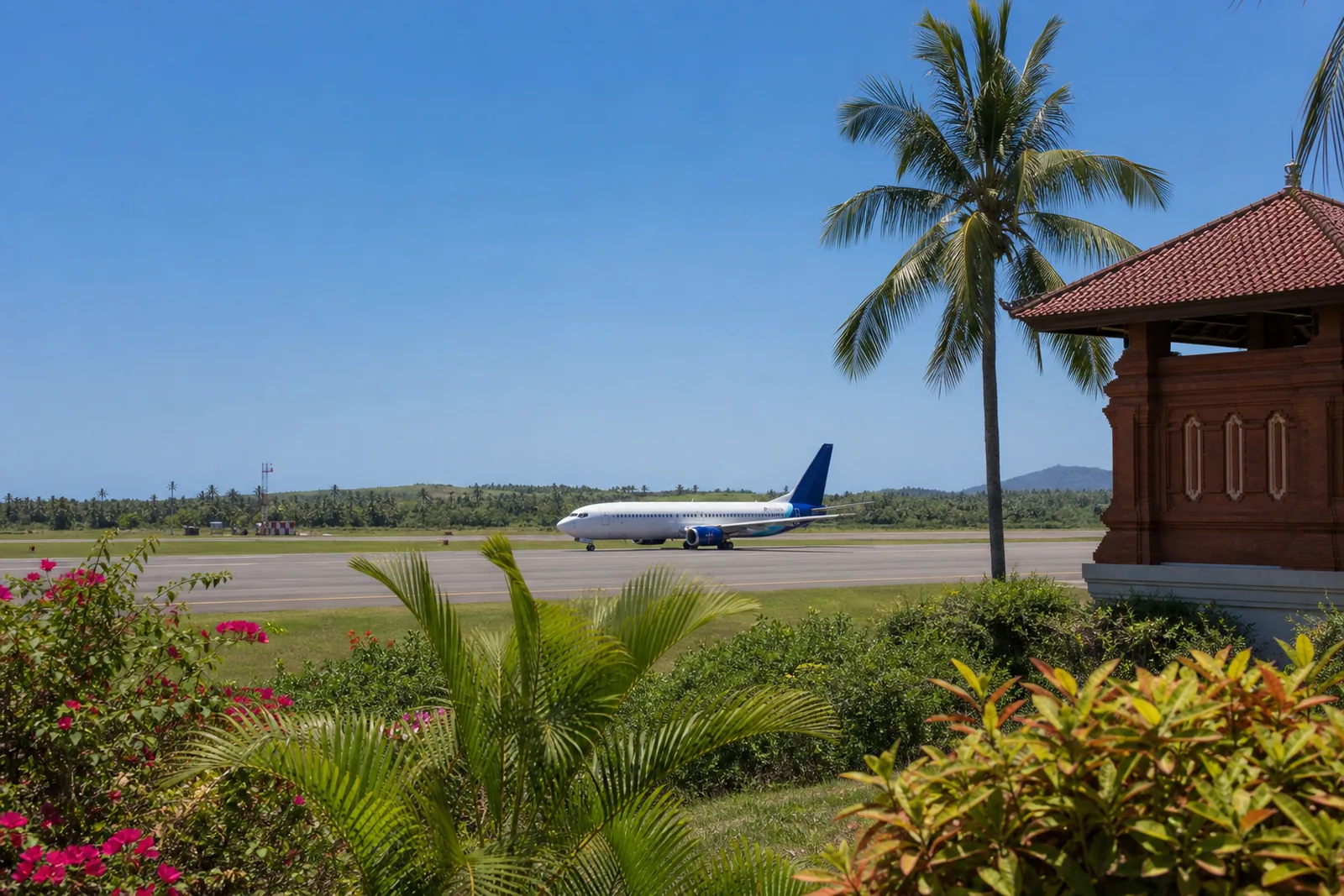
 Daily Dispatch · Illustration: HubLombok (AI-generated)
A Resilience Test, Not a Market Signal
The immediate news should be read with care. There is no basis in the source to declare an investment opportunity, a tourism setback, or a change in Lombok valuations. It is a live transport update following a major earthquake, and the most defensible conclusion is narrow: Bali Airport reported normal operations and no cancellations on its NTT routes through the period covered.
That restraint is especially valuable when property decisions are being made across islands. A finished villa, an off-plan purchase and a land parcel carry different exposures. The appropriate investor response is not to extrapolate from one morning’s flight schedule, but to confirm the practical protections around the specific asset under consideration.
Questions worth putting to an operator, developer or adviser include:
- What emergency procedures apply to guests, staff and contractors?
- How are structural standards, approvals and maintenance documented?
- What insurance is in place, what exclusions apply, and who manages a claim?
- How would bookings, guest communications and access be handled during a disruption?
- Are title, zoning and site due diligence complete before funds are committed?
Foreign buyers considering Indonesian property should also separate resilience from ownership structure. Foreigners cannot hold freehold, known as Hak Milik or SHM; that route is reserved for Indonesian citizens. The recognised routes include leasehold, Hak Pakai for eligible residents, and a foreign-owned PT PMA holding Hak Guna Bangunan. Nominee arrangements in which an Indonesian holds freehold on a foreigner’s behalf are illegal and void in court.
Where a purchase involves title, a licensed PPAT notary executes the deed of sale, known as an AJB, and the land agency is BPN. TerraNusa Advisory, HubLombok’s independent licensed-notary and legal advisory partner, can conduct due diligence on certificates, ownership history, zoning and encumbrances, as well as support company setup, taxes and transfer at BPN. Investors should still obtain advice tailored to their circumstances and the particular site.
What This Means for Investors
The practical message from Saturday’s update is measured but useful. Regional air connectivity has not, according to Bali Airport, been interrupted by the earthquake during the reported period. That helps preserve an important channel of movement within eastern Indonesia at a moment when affected communities need it.
For investors, three conclusions follow:
- Treat the airport’s statement as a time-specific operational fact, not a blanket assessment of conditions across the region.
- Monitor official airport, airline and disaster-management updates before travel, guest movements or site visits.
- Use the event to test the quality of an investment’s contingency planning, documentation and legal diligence before committing capital.
Lombok’s investment case should rest on verified local fundamentals and a properly structured acquisition, not on headlines alone. Equally, resilience is part of quality: the better an owner understands how an asset is built, insured, managed and legally held, the better equipped they are to distinguish a temporary disruption from a lasting investment risk.
Stay informed, subscribe to the free Lombok Briefing for market intelligence like this, published twice a month.
Are Bali flights to East Nusa Tenggara operating after the earthquake?
Yes. Bali’s I Gusti Ngurah Rai International Airport said its flight operations and airport services were running normally through at least noon WITA after the magnitude 7.7 earthquake. The airport spokesman also said there had been no flight cancellations on the reported NTT routes.
Which Bali–NTT routes were identified in the airport update?
Antara Business identified regular Bali connections to Labuan Bajo and Tambolaka. The report says the Labuan Bajo route averages nine daily departures and eight arrivals, while Tambolaka has three departures and two arrivals each day.
What should Lombok property investors take from this news?
The immediate takeaway is regional aviation continuity, not a property-market forecast. Investors should verify current travel conditions and use the event to assess an asset’s emergency procedures, structural documentation, insurance, management arrangements and legal due diligence.

The Lombok Buyer's Field Guide
Legal structures ranked by risk, the honest ROI math line by line, all six zones ranked, and the 24-point due-diligence checklist. The whole book, free in your inbox.
See what's inside