Bali's LRT Plans Expose Infrastructure Strain: Here's Why Lombok Investors Are Smiling
Bali's new Light Rail Transit plans signal the island's growing congestion. For property investors, the message is clear: early-stage Lombok is where the overflow demand is heading.
Indonesia's Minister of Transportation recently unveiled plans for a Light Rail Transit system in Bali, signalling that the island's decades-old traffic crisis has finally demanded intervention at the highest level. For property investors watching Southeast Asia's real estate cycles, this infrastructure announcement carries an unspoken message: Bali is entering a new phase of maturity and saturation, whilst Lombok remains in its golden window of early-cycle opportunity.
Bali's Congestion Reaches a Tipping Point
Bali has long been Indonesia's tourism and expatriate heartland. Over the past decade, the island has attracted unprecedented wealth and development: luxury resorts, high-end restaurants, international schools, and digital-nomad infrastructure have transformed coastal towns and upland villages alike. Yet this prosperity has come with a cost. The island's road network, designed decades ago for a fraction of today's traffic, has buckled under the weight of motorised growth.
Motorbikes dominate Bali's streets. They are cheap, practical, and the island's default transport. Yet when hundreds of thousands of them converge on narrow roads built for agrarian traffic, the result is the infamous "bumper-to-bumper hell" that locals and visitors now endure. Commute times have doubled or tripled in recent years. Pollution in Denpasar, Bali's capital, frequently exceeds WHO safety guidelines. The island's attractiveness as a place to live and work, not just visit, has visibly diminished.
This congestion is not a temporary summer problem or a cyclical nuisance. It is structural, baked into Bali's geography and development pattern. The island is small, densely built, and bounded by water. There is nowhere left to build outward; the only option is density within existing boundaries.
What the LRT Announcement Reveals
The announcement of Bali's Light Rail Transit plan is technically welcome news: fewer cars on the road, cleaner air, faster movement of people and goods. But to a property investor, it signals something deeper. Bali is now addressing infrastructure deficits that should have been solved fifteen years ago.
This is the hallmark of a mature, crowded market. When governments begin retrofitting basic transit, it means the easy growth phase is over. The island is no longer an open frontier. It is consolidating, densifying, and managing decline in livability even as property values remain elevated.
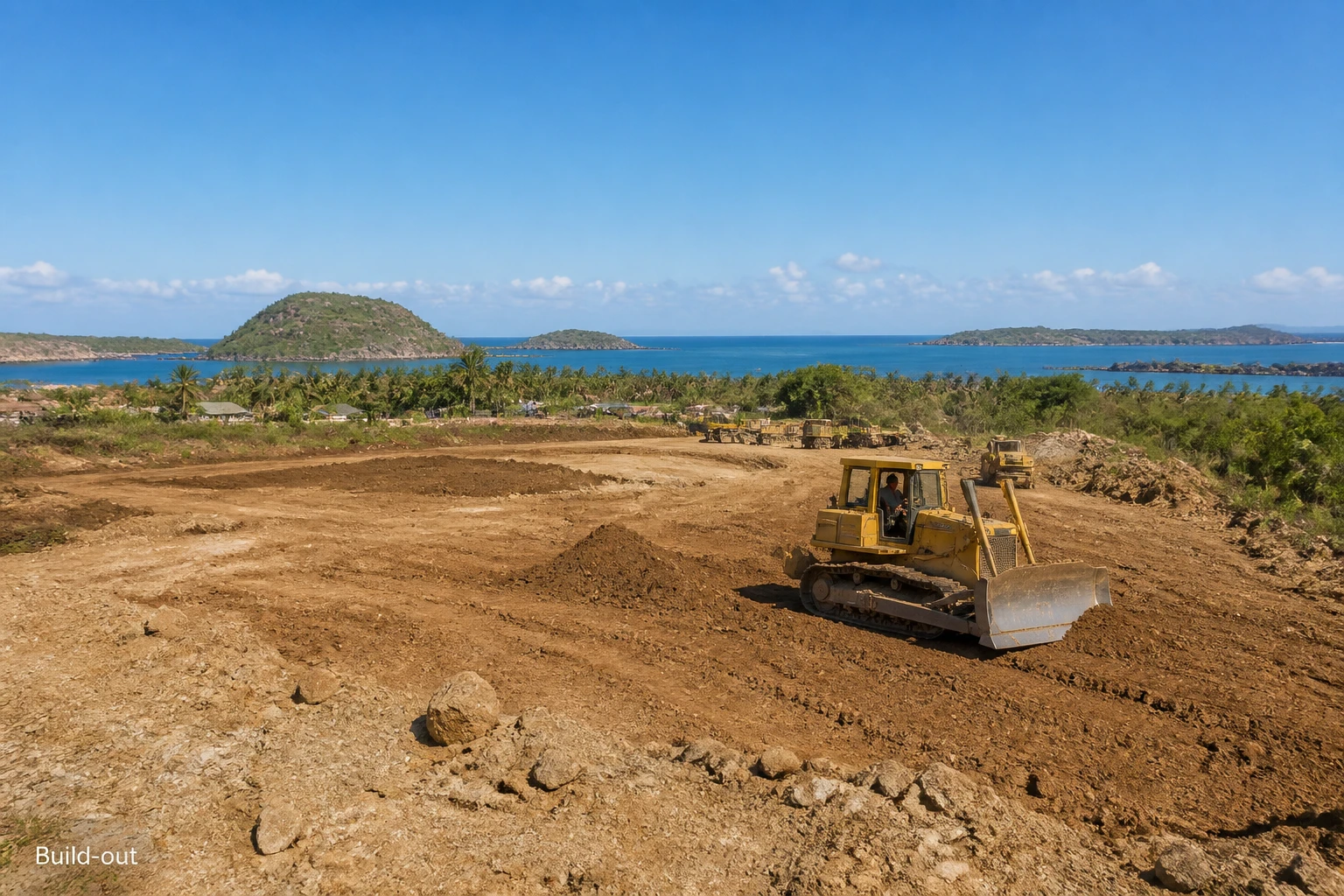
Compare this to Lombok's current state. The island is not yet fighting traffic jams. It has ample land, wide roads, and room to absorb growth in a more orderly way. Lombok's Ngurah Rai Airport is undergoing expansion to handle more international flights. The recently opened MotoGP circuit in Mandalika is catalysing hospitality and property development across the island. Tourism arrivals are growing at 40–50% year-on-year, substantially outpacing Bali's matured growth rate.
Lombok's Comparative Strength
The numbers tell a stark story of divergence:
Entry-level investment villa: EUR 95,000–350,000 in Lombok; USD 400,000–800,000 for comparable specification in Bali. A four-fold difference in capital required.
Land cost: Rp 150–400 million per are in South Lombok's prime zones; USD 200–500/m² in Bali's equivalent locations. Bali costs two to three times as much.
Net rental yield: 7–12% after realistic occupancy and management costs in Lombok; lower and more variable in Bali, where saturation and competition have compressed profit margins. Top-performing Lombok assets can reach 15% net.
These are not minor differences. A EUR 200,000 villa in Lombok could require USD 500,000+ of equivalent capital in Bali. An investor earning 10% net in Lombok would require much larger property and turnover to achieve the same in a saturated Bali market.
Moreover, Lombok's occupancy rates, whilst still stabilising at 55–70% in years one to three, are moving upward. Bali's comparable villas frequently run 70–85% occupancy, but with lower nightly rates and higher seasonal volatility. In Lombok, the occupancy glass is filling; in Bali, it is already full and beginning to crack under pressure.
The Tourism and MotoGP Catalyst
Lombok's ascent is not speculative or wishful. Three concrete drivers are at work:
Bali-overflow demand. As Bali becomes more congested, expensive, and crowded, travellers and investors with time and capital are looking southeastward. Lombok's beaches are objectively superior in parts: fewer crowds, cleaner water, better serenity. The island is attracting a different demographic: high-net-worth families seeking quieter luxury, not nightlife-driven tourism.
MotoGP effect. The Mandalika MotoGP circuit has put South Lombok on the global sporting calendar. Event weekends now draw international visitors, media, and wealth. More importantly, the infrastructure investment in roads, hotels, and services is permanent. A single annual event has catalysed the kind of development that would take decades to organise otherwise. Kuta and Mandalika zones have already seen property appreciation of around 38% year-on-year.
Airport upgrade. Lombok's Ngurah Rai Airport expansion is increasing international flight capacity. More flights mean cheaper tickets, easier access, and broader tourist appeal. This is the kind of hard infrastructure that self-reinforces: more visitors drive more hotel demand, which drives more property investment, which attracts more businesses and schools, which attracts more permanent residents.
Bali, by contrast, is working on basic traffic problems. Lombok is building the infrastructure of a frontier that is just beginning to consolidate.
What This Means for Investors
The Bali LRT announcement is a reminder that the island's easy growth phase is behind it. Property markets that require government intervention to fix livability are no longer in their growth sweet spot. They are managing maturity.
Lombok, by contrast, is in the window when early investors see meaningful appreciation and yield. The island is not crowded. Pricing is rational relative to cash flows. Tourism demand is accelerating. Capital is beginning to notice, but the crowd has not yet arrived.
Early investors in Lombok's prime zones, particularly Are Guling, which has seen 47% appreciation year-on-year, or the emerging tourist hotspots of Selong Belanak and Tanjung Aan, are positioning for the moment when Bali's overflow becomes a flood. When that moment comes, Lombok's price-to-yield advantage will compress rapidly. The question is not whether Lombok will become more expensive, but how soon.
The LRT announcement in Bali is, paradoxically, a bullish signal for Lombok property investors. It confirms that the capital is beginning to recognise Bali's structural limits. And when capital seeks the next frontier, it looks for cheaper entry, higher yield, and visible demand catalysts. Lombok has all three.
Stay informed. Subscribe to the free Lombok Briefing for analysis like this, published twice a month.
Is Lombok's infrastructure developed enough for serious property investment?
Yes. The airport is expanding, roads are modern, and the MotoGP circuit provides permanent infrastructure stimulus. Lombok is well ahead of where Bali was fifteen years ago at comparable tourism volumes.
How much cheaper is Lombok property than Bali really?
Turnkey villas cost EUR 95–350K in Lombok versus USD 400–800K in Bali for equivalent quality. Land is 40–50% cheaper. Net rental yields typically run 7–12% in Lombok, lower in saturated Bali.
Why does the MotoGP circuit matter for property investors?
It brings annual international visitors and permanent infrastructure investment in roads and hospitality, catalysing sustained property demand. Mandalika zone has seen 38% year-on-year appreciation partly as a direct result.
The Lombok Buyer's Field Guide
Legal structures ranked by risk, the honest ROI math line by line, all six zones ranked, and the 24-point due-diligence checklist. The whole book, free in your inbox.
See what's inside