Access roads and right-of-way for Lombok land: the deal-breaker buyers miss
In South Lombok, a plot without a clear, legally documented right-of-way is effectively unbuildable, regardless of its location or price. Informal track access is common and routinely overlooked during purchase. Checking legal road access before signing is one of the most important due-diligence ste
Quick answer: In South Lombok, a plot without a clear, legally documented right-of-way is effectively unbuildable, regardless of its location or price. Informal track access is common and routinely overlooked during purchase. Checking legal road access before signing is one of the most important due-diligence steps any foreign buyer can take.
Why Access Is the First Question, Not the Last
When buyers evaluate Lombok land, they focus on price per are, zone, sea views, and yield projections. Access is an afterthought. That is a costly mistake.
Indonesian land parcels, particularly in fast-developing rural areas like South Lombok, frequently lack any formal road frontage. A plot may sit 50 metres from a tarmac road and still be legally landlocked if the land between it and that road belongs to a third party. No one may build, connect utilities, or bring construction materials across that intervening strip without permission.
As foreign interest in South Lombok accelerates, driven by the Bali-overflow thesis and the MotoGP effect around Mandalika, this issue is becoming more common. Land is trading hands quickly, sometimes before access has been resolved.
Informal Lanes and Shared Tracks: Why They Fail
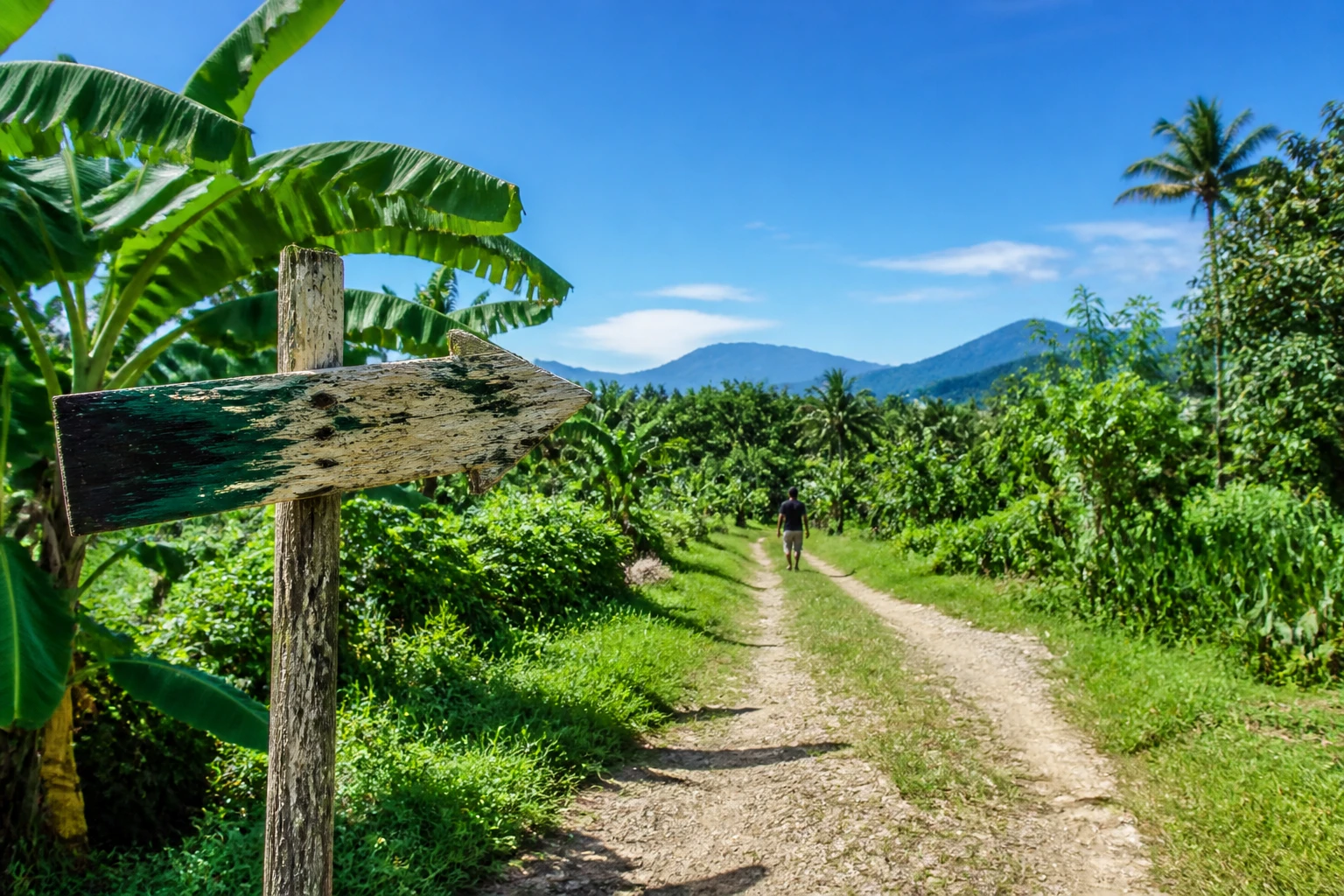
Most rural plots in Indonesia are accessed by one of three means: a private lane, a shared track with neighbouring landowners, or a track crossing government-controlled land. Each carries different risks.
Private lanes are the best case, but only if they are documented in the certificate chain. A physical lane you can walk down is not the same as a legally enforceable access right. If the lane crosses a neighbour's land and is not registered, access depends entirely on that neighbour's goodwill.
Shared tracks are common in village settings. Several plots may share the same dirt path, with no written agreement between owners. If one landowner sells to a developer who then fences the track, every plot behind it loses access. This scenario plays out repeatedly in developing areas.
Government-controlled lanes (jalan desa or local authority roads) can appear to offer public access, but their legal status is often ambiguous. They may not be maintained, may be reclassified, or may require formal permits to use as a construction route.
For a broader picture of how Lombok's road infrastructure affects property decisions, see our guide on getting around South Lombok.
Legal Right-of-Way in Indonesian Law
Indonesian law recognises a right of access known informally as "hak jalan" (right of way or access right). However, it is not automatically granted to a landlocked owner. Unlike some civil-law jurisdictions, Indonesia does not have a codified statutory right of passage that compels a neighbour to allow access.
In practice, access rights must be explicitly negotiated and documented. The correct approach is to record the right-of-way in a notarial deed, registered at the local land office (BPN). Only when this document exists and is attached to the certificate chain does the access become legally binding on future owners of the access land.
Buyers who rely on a verbal agreement with a current neighbour, or on a longstanding informal path, take a significant risk. Neighbours change. Land sells. Goodwill evaporates. The one reliable safeguard is a registered deed.
For a full walkthrough of what documents to request and verify before purchase, see our due diligence guide for Lombok.
How Access Shapes Value and Buildability
Access is not a binary issue. Plots with formal, registered road frontage command a measurable premium over comparable plots with informal access, and landlocked parcels can be nearly impossible to finance or insure.
From a practical buildability perspective, access determines:
- Whether a building permit (IMB or PBG) can be issued. Authorities increasingly require proof of road access as part of the application.
- Whether contractors can bring in heavy materials. A narrow informal track between rice fields may be physically passable but structurally unsuitable for trucks and concrete mixers.
- Whether future buyers or lenders will accept the title. Banks lending to foreign entities through PT PMA structures typically require clear road access before treating an asset as eligible collateral.
Land prices across South Lombok range from about Rp 30 to 400 million per are depending on zone, and that spread partly reflects access quality. Prime Kuta plots (Rp 300-400 million per are) almost invariably have formal road frontage; deep-rural Bumbang plots (Rp 30-50 million per are) frequently do not. The price difference is not only about location and sea views. It also reflects the cost and risk of resolving access. For a detailed breakdown of how access and other factors affect valuation, see how to value Lombok land per are.
What to Check Before You Sign
A rigorous access check has four components.
First, walk the boundary and the route. Physically trace the path from the plot to the nearest public road. Note whether any gates, walls, or neighbouring structures interrupt it.
Second, inspect the certificate. A land certificate (SHM or HGB) describes the parcel boundaries but rarely mentions access rights explicitly. Ask your notary to request the underlying survey maps and confirm whether a right-of-way strip is shown.
Third, request a site plan from the local authority. This will show whether the access route is classified as a public road, a private road, or undesignated land.
Fourth, obtain a notarial deed for any informal access. If access crosses third-party land, insist on a registered deed before completing the purchase. If the seller refuses, treat that refusal as a material red flag.
At Samudra Villas, the parcels we develop in Are Guling carry confirmed road access as a baseline requirement, not a selling point. That is worth asking about with any off-plan project: not just "what is the projected yield?" but "what is the access certificate and who registered it?"
Working with a legal advisory partner who covers the full chain, from certificate review to BPN registration, makes this process considerably more reliable than relying solely on the transacting notary. The difference matters when access disputes arise years into ownership.
Is a landlocked plot in Lombok legally buildable?
Not without documented right-of-way. Indonesian law does not automatically grant access to landlocked plots. The access right must be negotiated, documented in a notarial deed, and registered at the BPN land office. Without this documentation, a building permit cannot be issued and future resale will be severely constrained.
What is 'hak jalan' and does it protect foreign buyers?
'Hak jalan' is the informal term for a road-access right in Indonesia. It is not automatic: it must be explicitly agreed and recorded in a registered notarial deed. A physical path or verbal agreement with a neighbour is not legally binding on future landowners. Always require a registered deed before completing any purchase.
How much does lack of formal road access reduce Lombok land value?
There is no fixed discount, but access quality is a significant driver of the wide Rp 30 to 400 million per are price spread across South Lombok zones. Prime Kuta plots with formal frontage command the top of their range; plots with informal or disputed access can be nearly unsaleable to institutional buyers or PT PMA structures that rely on bank financing.

The Lombok Buyer's Field Guide
Legal structures ranked by risk, the honest ROI math line by line, all six zones ranked, and the 24-point due-diligence checklist. The whole book, free in your inbox.
See what's inside