Lombok Notebook: Why Fisheries Governance Matters to the Investment Case
NTB’s fisheries committee meeting highlights why data-led marine governance matters for investors assessing Lombok’s wider economic resilience.
Quick answer: NTB’s annual fisheries-management meeting matters to Lombok investors because it signals official attention to data-led, sustainable marine governance and a more integrated fisheries business ecosystem. It is not a new investment programme, but it provides useful context for assessing the institutional foundations surrounding Lombok’s coastal economy.
For many investors, Lombok is first encountered through beaches, hospitality and land. Yet the island’s investment story rests on a broader coastal economy: livelihoods, supply chains, ports, processing, finance and the condition of the marine environment itself. An official meeting in Mataram does not settle those questions, but it offers a revealing view of how the provincial authorities frame them.
The Context
On 30 June, the Annual Meeting of the Joint Fisheries Management Committee for 2026 was held in Mataram, according to an official Instagram post from DPMPTSP Provinsi NTB. The gathering brought together fisheries businesses, vertical agencies, provincial government bodies and other stakeholders. Nurwahidah, S.E., a junior licensing specialist, attended on behalf of the head of DPMPTSP NTB.
The meeting’s subject was not Lombok property, tourism or a transaction pipeline. That distinction matters. Investors should resist the temptation to turn every official forum into a proxy for imminent commercial opportunity. Rather, the post provides an institutional snapshot: provincial actors are discussing how fisheries resources should be governed, how policy should be aligned with local wisdom, and how the business ecosystem around fisheries might be strengthened.
The Head of NTB’s Marine and Fisheries Service, Muslim, S.T., M.Si., identified Government Regulation Number 27 of 2021 on the implementation of marine and fisheries affairs, alongside Government Regulation Number 11 of 2023 on measured fishing, as important foundations for sustainable management of marine and fisheries resources in NTB. The official account also reported his appreciation of the tuna-fisheries management in Fisheries Management Area 713, which it said has received international certification.
That is significant principally as a statement of policy orientation. Sustainable management is often discussed in abstract terms; here, the provincial discussion linked it to regulatory foundations, committee recommendations and the practical need to keep policies aligned with local knowledge. The committee, according to the post, is intended to develop recommendations for both central and regional government.
For an investor reading the region from afar, this is a useful reminder that the coastal economy is governed through several layers. National rules set part of the framework. Provincial agencies interpret and implement within their remit. Businesses, fishers, processors, port actors and financial institutions are all described by the official account as participants in the wider ecosystem. The quality of that coordination can shape the operating environment even where an investor has no direct exposure to fishing.
Data, Sustainability and the Coastal Operating Environment
Governor Dr. H. Lalu Muhammad Iqbal, M.Hub.Int., stressed the importance of fisheries governance based on accurate data, according to DPMPTSP Provinsi NTB. He described the management of Fisheries Management Areas 713 and 573 as a major responsibility, with appropriately targeted policies needed to protect the sustainability of fish resources.
The official account’s central message is straightforward: policy should be built on accurate data and directed towards the long-term sustainability of fish stocks.
That principle has relevance beyond the fisheries sector. Investors tend to favour markets where public decisions are capable of being tested against evidence, even if the quality and availability of that evidence must always be assessed independently. In a coastal destination, the alternative can be costly: short-term extraction that undermines the natural assets and local livelihoods on which other sectors rely.
Lombok’s appeal to visitors and residents is inseparable from its coast. This does not mean that every fisheries policy has a direct or measurable effect on a villa, hotel or restaurant investment. It does mean that environmental stewardship, local employment and commercial activity should not be treated as separate conversations. The meeting suggests that NTB’s authorities recognise this interdependence, at least in the fisheries policy sphere.
The official post also points to the value of looking beyond a narrow tourism lens. A destination whose economy is supported by diverse, functioning coastal industries may be better positioned to manage change than one dependent on a single demand source. That is a judgement investors must test through their own diligence, not a conclusion established by the meeting. Still, the discussion of fishers, processors, ports and financial institutions is a more rounded description of economic development than a focus on visitor arrivals alone.
The provincial framing has another practical implication: sustainability claims require governance. Investors increasingly encounter environmental language in marketing materials, planning discussions and operating proposals. The meaningful questions are less decorative. Which institution has responsibility? What data informs the policy? How are different interests represented? Where do regulatory requirements sit? The official account does not answer every one of these questions, but it identifies the committee and the relevant policy framework as parts of the governance architecture.
A disciplined reading is therefore preferable to a promotional one. The meeting is evidence of a stated public-sector priority, not proof that every risk has been resolved. It should encourage further inquiry into marine regulation, local operating practices and supply-chain relationships rather than replace it.
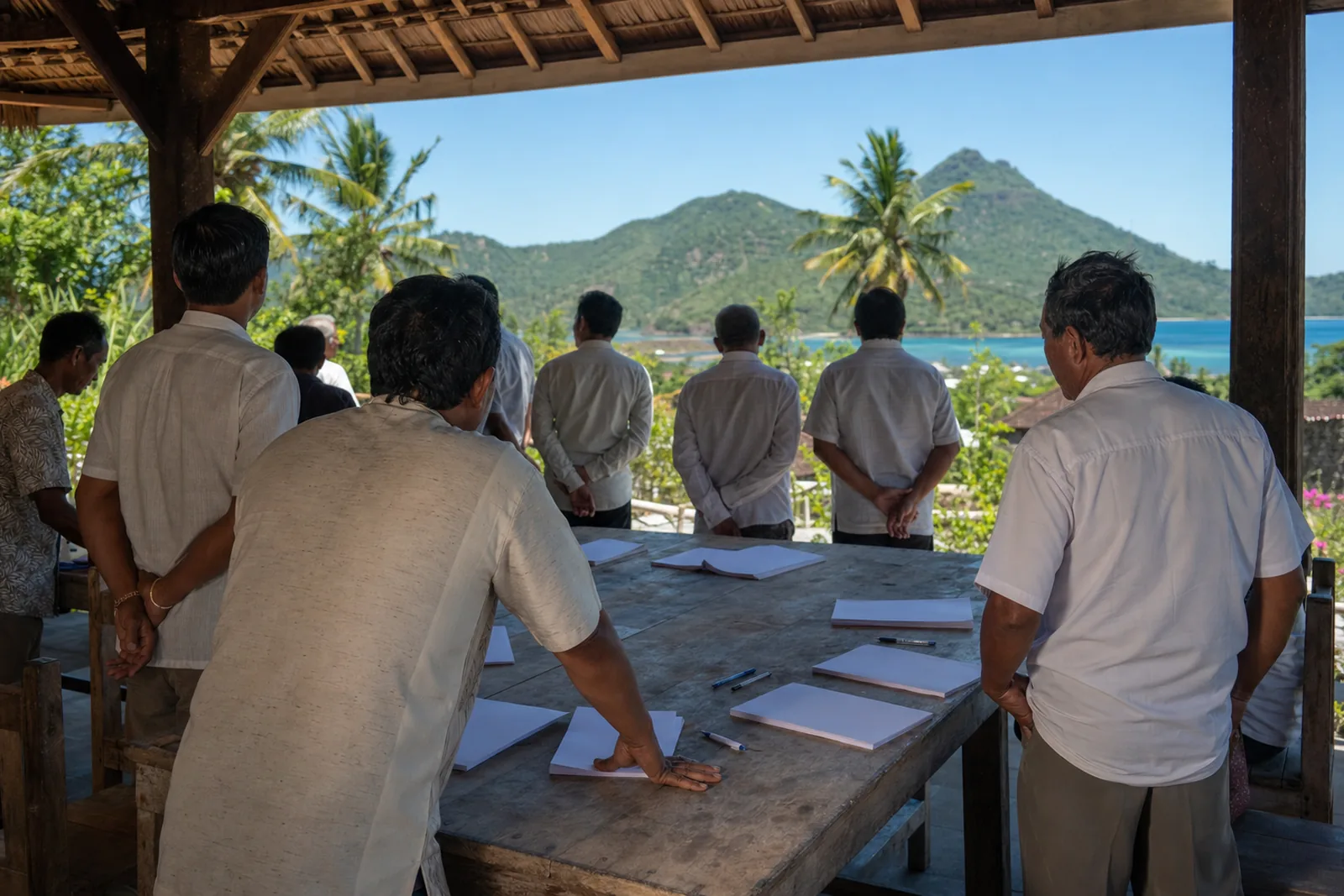
 Lombok Notebook · Illustration: HubLombok (AI-generated)
From Capture Fisheries to a More Integrated Business Ecosystem
The Governor also encouraged a more integrated fisheries business ecosystem, the official post said. Its description ran from fishers and processors to ports and financial institutions, with partnership or cooperative models identified as possible ways to strengthen those connections.
This is perhaps the meeting’s most commercially interesting theme. Fisheries are often perceived simply as the act of catching fish. In reality, the value chain described by the province extends across handling, processing, logistics and finance. For investors considering the broader Lombok and NTB economy, the distinction is important: value is not confined to activity at sea.
An integrated ecosystem may support more coherent commercial relationships, but investors should be precise about what was and was not announced. The official post records an encouragement and an aspiration; it does not provide investment terms, project names, funding commitments, timelines or performance forecasts. None should be inferred.
The same restraint applies to aquaculture. The Governor described development of the cultivation sector as an important step to reduce dependence on catching fish at sea while safeguarding fish stocks, according to DPMPTSP Provinsi NTB. That is a policy rationale, not a guarantee of output or returns. It does, however, show how the province is thinking about the balance between resource conservation and economic activity.
For a long-horizon investor, that balance deserves attention. Coastal development can create demand for food, services and infrastructure, while a healthy marine economy supports established local livelihoods. The two can reinforce one another if development respects the resource base; they can also create tension if they do not. The official meeting’s emphasis on accurate data, targeted policy and ecosystem integration acknowledges that these choices cannot sensibly be made in isolation.
There is also a useful lesson in the committee format itself. Complex sectors rarely respond well to a single-actor approach. The attendance described in the post included business participants, government bodies and wider stakeholders. Such forums do not eliminate conflicts of interest, but they can create a route for recommendations and policy alignment. Investors should regard that as an institutional feature to monitor, alongside more familiar considerations such as planning, access and operating costs.
What This Means for Investors
The immediate implication is contextual rather than transactional. The official DPMPTSP Provinsi NTB post should not be read as an investment recommendation, a tourism forecast or a signal to price an asset differently. Its value lies in what it indicates about the policy conversation around NTB’s marine economy.
A sensible investor response is to incorporate that context into a broader diligence process:
- Separate policy direction from commercial proof. The meeting records official priorities and aspirations; it does not establish individual project viability or financial performance.
- Assess coastal exposure carefully. Businesses linked to hospitality, food supply, logistics or waterfront locations may be affected by the health and governance of the surrounding marine economy.
- Ask evidence-led questions. Where a proposal makes sustainability claims, seek clarity on relevant permits, responsible institutions, operating practices and the basis for its assumptions.
- Look at the full local economy. The province’s own framing connects fishers, processors, ports and finance. That is a useful prompt to examine supply chains and livelihoods, not merely visitor-facing assets.
- Keep regulatory advice independent. Rules and implementation can be consequential. Investors should obtain appropriate professional advice before acting on legal, licensing or commercial assumptions.
For HubLombok readers, the broader point is one of investment temperament. Lombok’s prospects are not best understood through a single headline or sector. They are better read as an evolving relationship between natural assets, local enterprise, public institutions and external capital. Official statements should be taken seriously, but always at their stated level: as evidence of intent and administrative focus, rather than as a substitute for independent verification.
The NTB fisheries committee meeting offers precisely that kind of signal. It places sustainable management, accurate data and economic integration at the centre of the province’s own account of its marine sector. For investors with a long view of Lombok, that is worth following, not as a shortcut to conviction, but as part of the context required to earn it.
Stay informed, subscribe to the free Lombok Briefing for market intelligence like this, published twice a month.
What happened at NTB’s annual fisheries management meeting?
According to DPMPTSP Provinsi NTB, the 2026 Joint Fisheries Management Committee meeting in Mataram brought together fisheries businesses, government bodies and stakeholders to discuss sustainable fisheries governance, policy recommendations and a more integrated fisheries business ecosystem.
Why does fisheries governance matter to Lombok investors?
Fisheries governance matters because Lombok’s coastal economy connects marine resources, local livelihoods, ports, processing and visitor-facing businesses. The official NTB discussion signals attention to accurate data and sustainability, but it is not a guarantee of investment performance.
Did the NTB meeting announce a new investment project?
No. The supplied official post describes a policy and stakeholder forum, not a named investment project. It contains no investment terms, funding commitments, timelines or return forecasts, so investors should treat it as context for independent due diligence.

The Lombok Buyer's Field Guide
Legal structures ranked by risk, the honest ROI math line by line, all six zones ranked, and the 24-point due-diligence checklist. The whole book, free in your inbox.
See what's inside