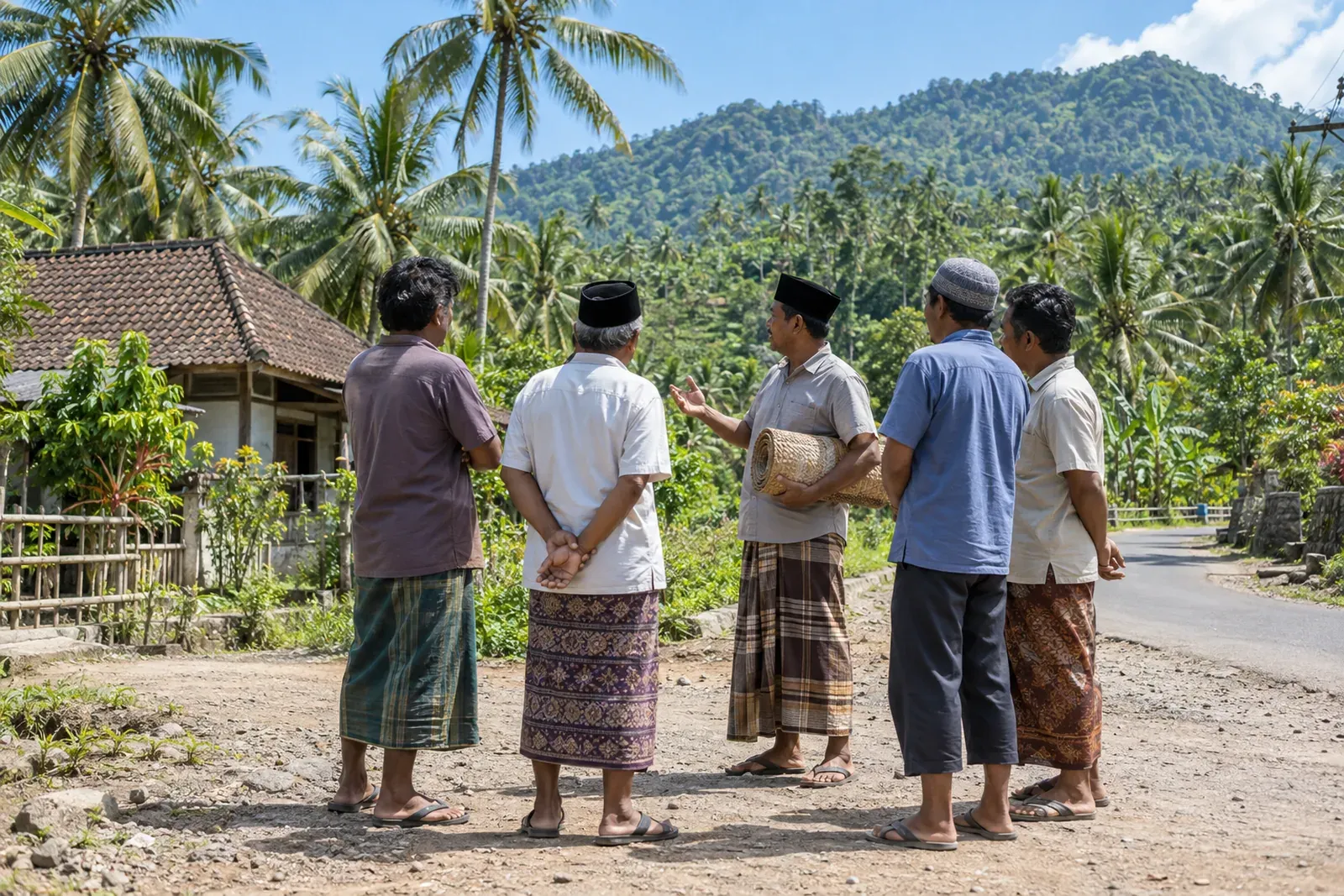
Local Dispute Resolution in West Lombok Highlights Community Mediation Framework
A roadside dispute in West Lombok resolved via community mediation illustrates the role of restorative justice and social cohesion in maintaining regional stability.
A roadside dispute between two motorists in West Lombok concluded swiftly this weekend after local police facilitated an amicable settlement between the involved parties. The incident, resolved at the Gunungsari police precinct through traditional restorative conciliation, offers international observers a revealing look into grassroots conflict resolution across the island.
According to regional reporting from Radar Lombok, the altercation arose in West Lombok (Lombok Barat) following a mechanical breakdown by the roadside. What began as a roadside disagreement between residents of Gunungsari and Lingsar sub-districts escalated into a physical confrontation, resulting in minor injuries. Rather than descending into protracted criminal litigation, the matter was brought before the local precinct (Polsek Gunungsari) on Saturday evening, where both individuals agreed to resolve the grievance under customary family principles (secular mediation, known locally as kekeluargaan). The dispute concluded with an agreed restitution of Rp 500,000 to cover medical damages and a mutual accord to drop further claims.
While an isolated traffic confrontation rarely makes headlines outside provincial daily papers, the mechanics of its resolution speak to an institutional feature that international capital often overlooks: the strength of community-level mediation mechanisms across Lombok.
The Cultural Anchor of Musyawarah and Restorative Justice
Throughout Indonesia, and specifically across the regencies of Lombok, civil equilibrium relies heavily on the principle of musyawarah mufakat (deliberation toward consensus). While commercial contracts and formal land titles operate under national statutory codes, day-to-day interpersonal and neighbourhood frictions are systematically directed toward restorative channels before they ever reach a formal courtroom docket.
In this West Lombok case, the intervention of the local police sector (Polsek) functioned not merely as punitive law enforcement, but as a neutral facilitator of compromise. The agreed compensation of Rp 500,000 served as an acknowledgement of responsibility rather than a court-mandated penalty. This approach demonstrates several operational strengths of local governance:
- Speed of closure: The matter was reported, arbitrated, and formally resolved within hours, preventing ongoing hostility between neighboring village communities.
- De-escalation priority: Local authorities prioritised community peace over punitive incarceration for minor altercations.
- Social accountability: Settlements conducted under kekeluargaan framework require public mutual acknowledgement, which functions as an informal social contract within rural and suburban districts.
For institutional observers and long-term stakeholders, understanding this consensus-first culture is essential. Lombok remains a society where communal cohesion and peer arbitration form the first line of civic order.
Decentralised Policing and Social Stability in Lombok Barat
West Lombok occupies an important geographic position within the island's economic landscape. Encompassing the peri-urban belts of Gunungsari and Lingsar, it borders the provincial capital of Mataram while providing key connectivity north toward Mount Rinjani and south toward the coast.
Unlike metropolitan centres where petty disputes often lead to congested legal proceedings or unaddressed civil tension, rural and semi-rural Lombok continues to lean on localized mediation. Police officers in provincial precincts routinely double as community mediators, working in conjunction with village leaders (kepala dusun) to defuse friction before it affects wider district relations.
This civil resilience has played a subtle but foundational role in Lombok's broader development. As capital inflow and regional visibility have accelerated across the island, maintaining a stable, predictable social backdrop has remained a top priority for provincial and regency administrations alike.
Contrast Between Statutory Law and Customary Conciliation
For foreign nationals and overseas entities operating in Indonesia, understanding where formal statutory law begins and where customary mediation operates is crucial. In high-value commercial transactions, foreign direct investments, and corporate property structures, Indonesian formal law is rigorous and binding:
- Formal deeds of sale (Akta Jual Beli or AJB) must be executed before a licensed Land Conveyancing Officer (Pejabat Pembuat Akta Tanah or PPAT).
- Land titles and rights, such as Right to Build (Hak Guna Bangunan or HGB) for foreign-owned investment companies (PT PMA), are strictly registered and managed by the National Land Agency (Badan Pertanahan Nasional or BPN).
- National tax codes, such as the buyer transfer duty (Bea Perolehan Hak atas Tanah dan Bangunan or BPHTB at roughly 5% of assessed value), apply universally.
However, alongside this rigid legal architecture sits the living reality of Indonesian community relations. While corporate governance, property titles, and contractual agreements must strictly adhere to statutory law through accredited legal desks and licensed notaries, daily interaction with local communities relies on mutual respect, dialogue, and consensus.
Investors who mistake formal compliance for total risk mitigation often ignore the human landscape. In Lombok, legal clarity and community goodwill are complementary pillars; neither can safely replace the other.
What this means for investors
At first glance, a minor traffic incident in Gunungsari has little direct connection to regional capital deployment or tourism infrastructure. Yet for astute investors evaluating sovereign and jurisdictional risk, local news often reveals the true health of a region's social fabric.
First, the reliance on rapid restorative mediation demonstrates that local administrative institutions retain high legitimacy and efficacy at the neighborhood level. Communities in Lombok possess functional, accessible mechanisms to absorb and resolve civil stress without civil unrest or administrative breakdown.
Second, the episode highlights the necessity for foreign investors and project managers to respect local consultation norms. Whether developing a commercial venture, securing access pathways, or engaging local labor, projects that approach Indonesian communities with a cooperative, consensus-driven mindset consistently avoid friction. Those that attempt to enforce bureaucratic mandates without local dialogue inevitably encounter unnecessary obstacles.
Third, it serves as a reminder of the distinction between corporate dispute resolution and grassroots social stability. While enterprise-level assets must be anchored in compliant legal frameworks, the peaceful daily environment that preserves asset values is maintained by precisely these quiet, informal conflict-resolution practices.
As Lombok continues its long-term economic expansion, the quiet efficacy of its community mediation culture remains one of its greatest unheralded safeguards for sustained, orderly development.
Stay informed: subscribe to our free Lombok Briefing, published twice a month (the 1st and 15th), for analysis like this.
What is the role of community mediation in Lombok?
Community mediation in Lombok relies on the cultural principle of musyawarah mufakat, or consensus-based deliberation. Minor civil and interpersonal disputes are routinely resolved at local police precincts or through village councils, delivering swift de-escalation without protracted litigation.
Does customary dispute resolution replace formal Indonesian property law?
No. Customary mediation handles interpersonal harmony and minor civil grievances. High-value transactions, corporate formations, and real estate titles must strictly comply with national statutory law, executed through licensed PPAT notaries and registered with the National Land Agency (BPN).
Why does local conflict resolution matter to foreign property investors?
Grassroots mediation preserves civil peace and social stability across Lombok's regencies. Understanding local consensus norms helps international investors build positive community relations, which protect long-term asset value alongside formal legal title protections.

The Lombok Buyer's Field Guide
Legal structures ranked by risk, the honest ROI math line by line, all six zones ranked, and the 24-point due-diligence checklist. The whole book, free in your inbox.
See what's inside