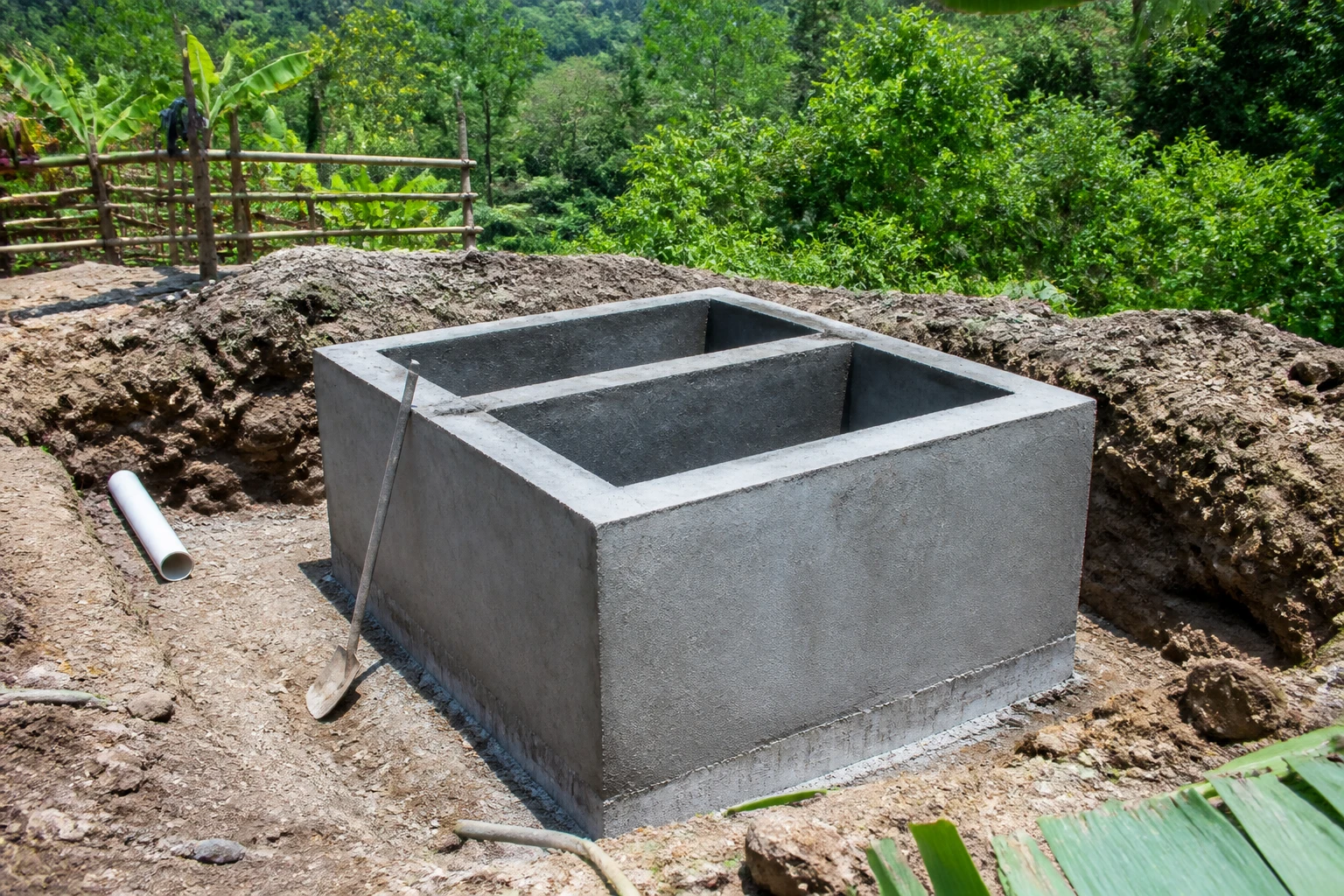
Waste and Sewage for a Lombok Villa: Septic, Soak-aways and Rubbish
South Lombok has no mains sewerage. Every villa runs on a septic tank or bio-system that drains to a soak-away. Rubbish collection is patchy outside Mataram. Understanding what you are buying, and budgeting for proper waste infrastructure, is one of the most overlooked steps in villa due diligence.
Quick answer: South Lombok has no mains sewerage. Every villa runs on a septic tank or bio-system that drains to a soak-away. Rubbish collection is patchy outside Mataram. Understanding what you are buying, and budgeting for proper waste infrastructure, is one of the most overlooked steps in villa due diligence.
The reality: no mains sewerage in South Lombok
No municipal sewer network serves the resort zones of South Lombok, including Kuta, Selong Belanak, Are Guling or Mandalika. This is not a temporary gap that will be filled next year. It is a structural feature of a region that jumped from fishing village to international resort destination in under a decade, with infrastructure investment lagging well behind land prices.
Every property in the area, from a budget homestay to a luxury pool villa, handles its own waste on-site. That means buyers need to ask exactly how, and what the system costs to maintain, before contracts are signed. If you are comparing specs on an off-plan build, waste management belongs on the checklist alongside the pool pump and the electrical load. See also: Building a villa in Lombok: the full guide for how waste infrastructure fits within the broader construction sign-off process.
Septic tanks versus bio-digesters
The two common approaches are a conventional septic tank and a bio-digester, sometimes called a bio-septic or packaged sewage treatment plant.
A conventional septic tank is a sealed concrete or fibreglass chamber. Solids settle and break down anaerobically; liquid effluent flows through to a soak-away field. Units are cheap to install, roughly Rp 5-15 million for a basic single-chamber configuration, but they fill up. A villa running at consistent rental occupancy should budget for pump-outs every one to two years. Neglect leads to odours, overflow and, in porous volcanic soil, contamination of nearby groundwater and neighbouring wells.
A bio-digester or STP (sewage treatment plant) uses aeration and bacterial cultures to process waste to a cleaner effluent standard before discharge. Entry-level packaged units start at around Rp 30-60 million installed. They require electricity to run the aerator and periodic top-up of bacterial cultures, but they sharply reduce the frequency of pump-outs and the environmental load on the soak-away. For a rental villa targeting guests paying international nightly rates, a bio-digester is the sensible specification: lower odour risk near the pool, longer soak-away life, and better positioning ahead of any future regulatory tightening, a process already under way in Bali.
When reviewing an off-plan villa, ask the developer which system is specified, where the tank sits relative to the pool and drinking-water supply, and who holds the ongoing pumping contract. At Samudra Villas in Are Guling, bio-septic systems are standard in the build specification, reflecting the expectation of stable, high-occupancy rental use from day one.
Soak-aways and drainage design
A soak-away (also called a leach field or infiltration pit) is where treated or partially treated effluent disperses into the surrounding soil. In South Lombok's laterite and sandy volcanic soils, drainage is generally adequate, but design still matters.
A poorly sized soak-away, or one installed in heavy-clay soil or too close to a neighbouring plot's boundary, will saturate during the wet season. This is more common than developers acknowledge. Standard good practice is to dig to sufficient depth, use perforated pipe laid in gravel, and keep the soak-away at least 15-20 metres from any drinking-water well or borehole. Most reputable builders observe this distance, but it is rarely written into contracts explicitly, so ask for it in writing.
Surface drainage is the companion issue. South Lombok's wet season, roughly November to March, brings intense downpours. A villa without proper cut-off drains, perimeter channels and a cambered driveway will push storm water towards the building and the soak-away simultaneously, accelerating saturation and creating the exact conditions for system failure. When doing due diligence on a completed villa, ask for the as-built drainage drawings. On a pre-completion purchase, request that they form part of the handover pack.
Rubbish collection: the gap between expectation and reality
Outside the central Mataram area, municipal rubbish collection in South Lombok is irregular. Villages often organise their own informal collection, funded by a monthly household contribution, but frequency varies considerably. In the resort zones, most villa operators use a private waste contractor, paying a monthly fee for bins to be collected two or three times a week.
Budget roughly Rp 200,000-500,000 per month for private collection at a four to six bedroom rental villa. The contractor hauls waste to a transfer point; from there it travels to the Kebon Kongok landfill near Mataram, the main disposal site for the wider region.
Recycling infrastructure is minimal. Guests accustomed to European sorting systems will find glass, plastic, cardboard and organic waste going into the same bin. Some operators have begun working with Lombok-based NGOs to collect and sort recyclables separately. This is a genuine differentiator with eco-conscious guests and connects to the broader demand shift covered in eco-sustainable villa demand in Lombok. It is also one of the few areas where small operators can act immediately, without waiting for public infrastructure to catch up.
Environmental and guest-experience implications
Water contamination from failed septic systems and improper rubbish disposal is one of the real environmental risks in fast-developing coastal zones. The offshore reef systems that make South Lombok attractive to divers and snorkellers are sensitive to nutrient runoff. A leaking soak-away does not only create a legal and moral problem for the owner; it erodes the natural asset that underpins the entire rental proposition.
Guest experience follows directly. Odours near the pool or garden, irregular rubbish removal, or the sight of waste burning on a neighbouring plot are among the most common negative-review triggers for Lombok villas. None of these is inevitable, but all require deliberate investment in infrastructure from the start.
For a broader view of how utilities planning, including water supply and power backup, sits alongside waste management when evaluating a property, see Water, power and internet for a Lombok villa.
Practical guidance for buyers
Before committing to a purchase or off-plan reservation, work through this checklist:
- Confirm whether the system is a conventional septic tank or a bio-digester, and get the specification in writing.
- Ask for a location plan showing the tank and soak-away in relation to the pool, any wells and the plot boundaries.
- On an occupied villa, request the pumping and maintenance record.
- Clarify who manages rubbish collection, how often, and at what monthly cost.
- For new builds, verify that the drainage design has been sized for wet-season rainfall, not dry-season averages.
Good waste infrastructure is unglamorous, but it is one of the clearest indicators of build quality and long-term rental viability. A villa that handles it well earns stronger reviews, faces fewer maintenance crises and holds its value as the South Lombok market matures and guest expectations rise.
Does South Lombok have a mains sewer network?
No. Every villa in South Lombok manages its own waste on-site via a septic tank or bio-digester draining to a soak-away. There is no municipal sewer infrastructure in the resort zones, including Kuta, Selong Belanak and Are Guling.
What is the difference between a conventional septic tank and a bio-digester for a Lombok villa?
A conventional septic tank settles and partially breaks down waste and needs pumping every one to two years. A bio-digester uses aeration and bacteria to produce cleaner effluent, reducing pump-out frequency and odour risk near the pool. For a rental villa with consistent occupancy, a bio-digester is the better long-term specification.
How is rubbish collected at villas in South Lombok, and what does it cost?
Municipal collection is irregular outside Mataram. Most villa operators use a private waste contractor, typically costing Rp 200,000-500,000 per month for collection two or three times a week. Recycling infrastructure is minimal, though some operators partner with local NGOs to handle sorted recyclables separately.

The Lombok Buyer's Field Guide
Legal structures ranked by risk, the honest ROI math line by line, all six zones ranked, and the 24-point due-diligence checklist. The whole book, free in your inbox.
See what's inside