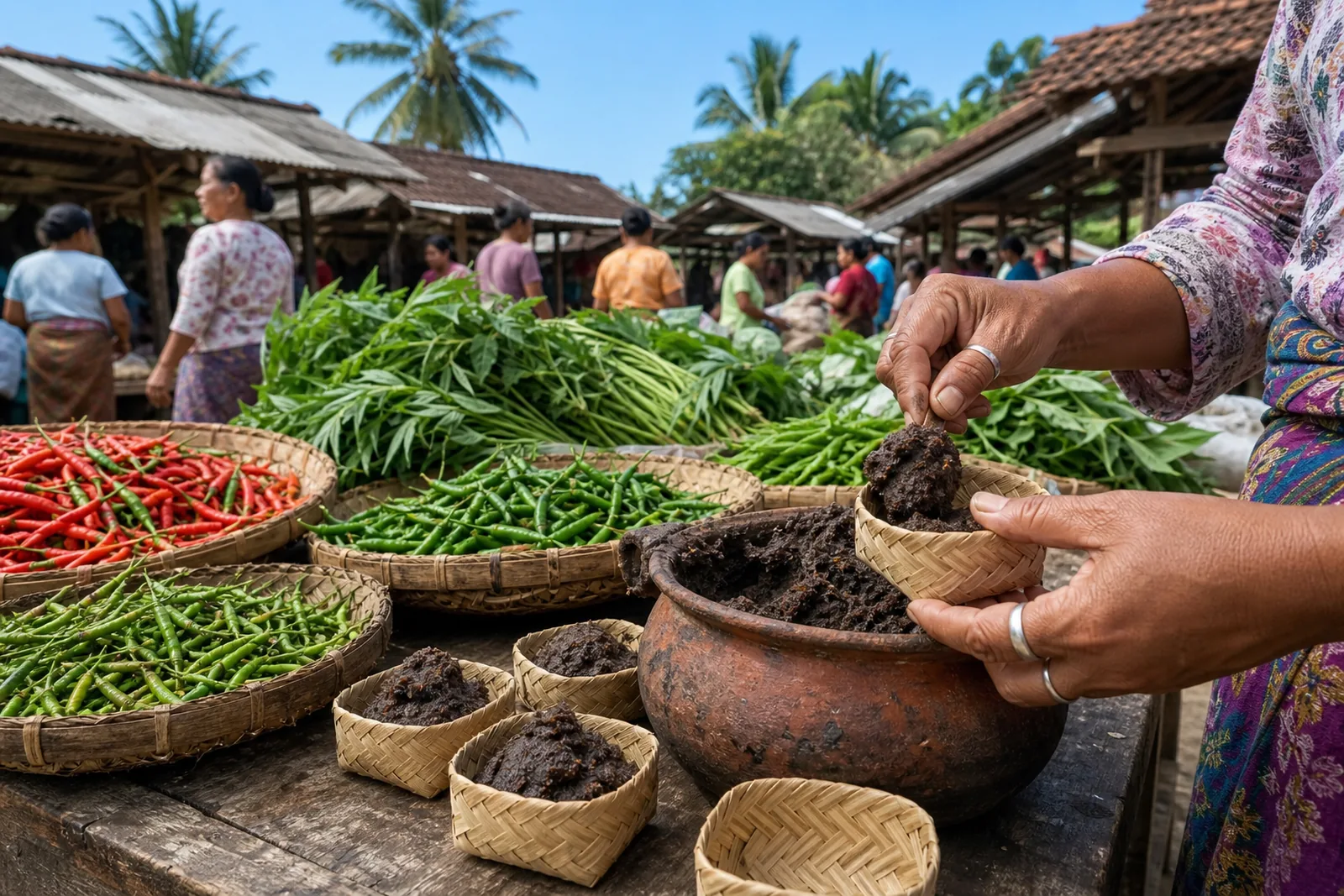
Terasi Kumbe’s Local Recipe Meets a Wider Market Ambition
A Merauke microbusiness is seeking to preserve a local terasi recipe while widening its commercial reach.
Terasi is a product of place: its character depends on local knowledge, ingredients and patient production. A report by Radar Lombok places that tension at the centre of Olahan Terasi Kumbe, a microbusiness from Kampung Kumbe in Merauke, South Papua.
The business is owned by Sugi Wahyuni and, according to the report, is rooted in an inherited enterprise that she continues to maintain. Its stated ambition is not simply commercial expansion, but the preservation of a culinary tradition while supporting the family economy.
A business built around inheritance
Radar Lombok describes Olahan Terasi Kumbe as an usaha mikro, or microbusiness, based in Kampung Kumbe, within Malind District, Merauke Regency. The story presents Sugi Wahyuni’s work as a continuation of a family inheritance rather than a newly created consumer brand.
That distinction matters. In small food enterprises, the recipe, production method and local identity can be inseparable from the commercial proposition. The value of the business may therefore lie as much in continuity as in scale.
The source says that maintaining such a tradition is not an easy journey, particularly where the business depends heavily on natural conditions and the availability of raw materials. It does not provide further operational or financial detail. Still, the point is an important one for readers assessing small, place-based enterprises: supply reliability is often as material as customer demand.
Radar Lombok frames Olahan Terasi Kumbe as a family-supporting business that seeks to protect a local culinary inheritance while reaching a broader market.
The challenge of growth without losing identity
The headline of the Radar Lombok report refers to BRI and to an effort to reach a wider market. The supplied source material does not specify the nature of that involvement, the form of any support, or the markets reached. Those details should therefore not be assumed.
Yet the underlying commercial question is clear. A heritage food business can benefit from wider distribution, but its expansion must remain compatible with the qualities that distinguish it from a generic packaged product. For a producer such as Olahan Terasi Kumbe, those qualities appear to be its inherited recipe and connection to Kampung Kumbe.
There are several practical tensions in that model:
- Preserving a recipe while serving a larger customer base.
- Managing a business that relies on raw-material availability and natural conditions.
- Supporting household income without reducing a local tradition to a marketing device.
- Broadening market access while retaining control over quality and provenance.
None of these issues is unique to terasi. They are familiar across artisanal food businesses, especially where a product’s reputation rests on local methods rather than industrial uniformity.
Why the source’s restraint is significant
The report offers a concise portrait rather than a financial case study. It identifies the entrepreneur, the enterprise, its location and its stated purpose, but it does not provide revenue, production volumes, financing terms, employment figures, distribution agreements or expansion targets.
For investors and commercially minded readers, that absence is not a flaw; it is a boundary. Responsible analysis should distinguish between a compelling enterprise story and evidence of investability. The supplied information supports the former. It does not support conclusions about valuation, profitability, scalability or risk-adjusted return.
That is especially relevant when a business is presented alongside a financial institution in a headline. Association with a bank may signal a story of support or market access, but the source excerpt alone does not establish the structure, scale or outcome of any relationship. First-party promotional implications should always be tested against documented terms and operating evidence.
What this means for investors
Olahan Terasi Kumbe is best read as a case study in the commercial importance of cultural continuity, rather than as an investable proposition on the information available.
Potential investors, lenders or partners considering comparable microbusinesses would want to establish several fundamentals before drawing conclusions:
- Whether raw-material supply can remain dependable when natural conditions change.
- How the inherited recipe and production process are documented and protected.
- What “wider market” means in practice: new customers, new locations, new channels or a combination of these.
- Whether quality controls can be maintained as output expands.
- How any external support is structured, including obligations, duration and measurable outcomes.
The wider lesson is straightforward. Local food enterprises can carry both economic and cultural value, but those two forms of value need careful stewardship. Expansion is most durable when it strengthens the producer’s distinctive identity rather than obscuring it.
For Sugi Wahyuni and Olahan Terasi Kumbe, the source identifies that identity clearly: an inherited business from Kampung Kumbe, sustained despite dependence on nature and raw materials, and directed towards a broader market. Further disclosure would be needed to judge the commercial path from here, but the preservation of the recipe remains the story’s essential thread.
Stay informed, subscribe to the free Lombok Briefing for analysis like this, published twice a month.
What is Olahan Terasi Kumbe?
Olahan Terasi Kumbe is a microbusiness from Kampung Kumbe in Malind District, Merauke Regency, South Papua. Radar Lombok identifies Sugi Wahyuni as its owner and describes the enterprise as an inherited business centred on preserving a local terasi recipe.
What challenge does the business face?
Radar Lombok says preserving the culinary tradition and supporting the family economy is difficult because the business depends heavily on natural conditions and the availability of raw materials. The supplied report does not provide production, revenue or supply-chain figures.
Does the report explain BRI’s support for Terasi Kumbe?
No. The Radar Lombok headline refers to BRI and wider market access, but the supplied source material does not specify the form, scale or terms of any support. It therefore cannot substantiate claims about finance, partnerships or commercial outcomes.
The Lombok Buyer's Field Guide
Legal structures ranked by risk, the honest ROI math line by line, all six zones ranked, and the 24-point due-diligence checklist. The whole book, free in your inbox.
See what's inside