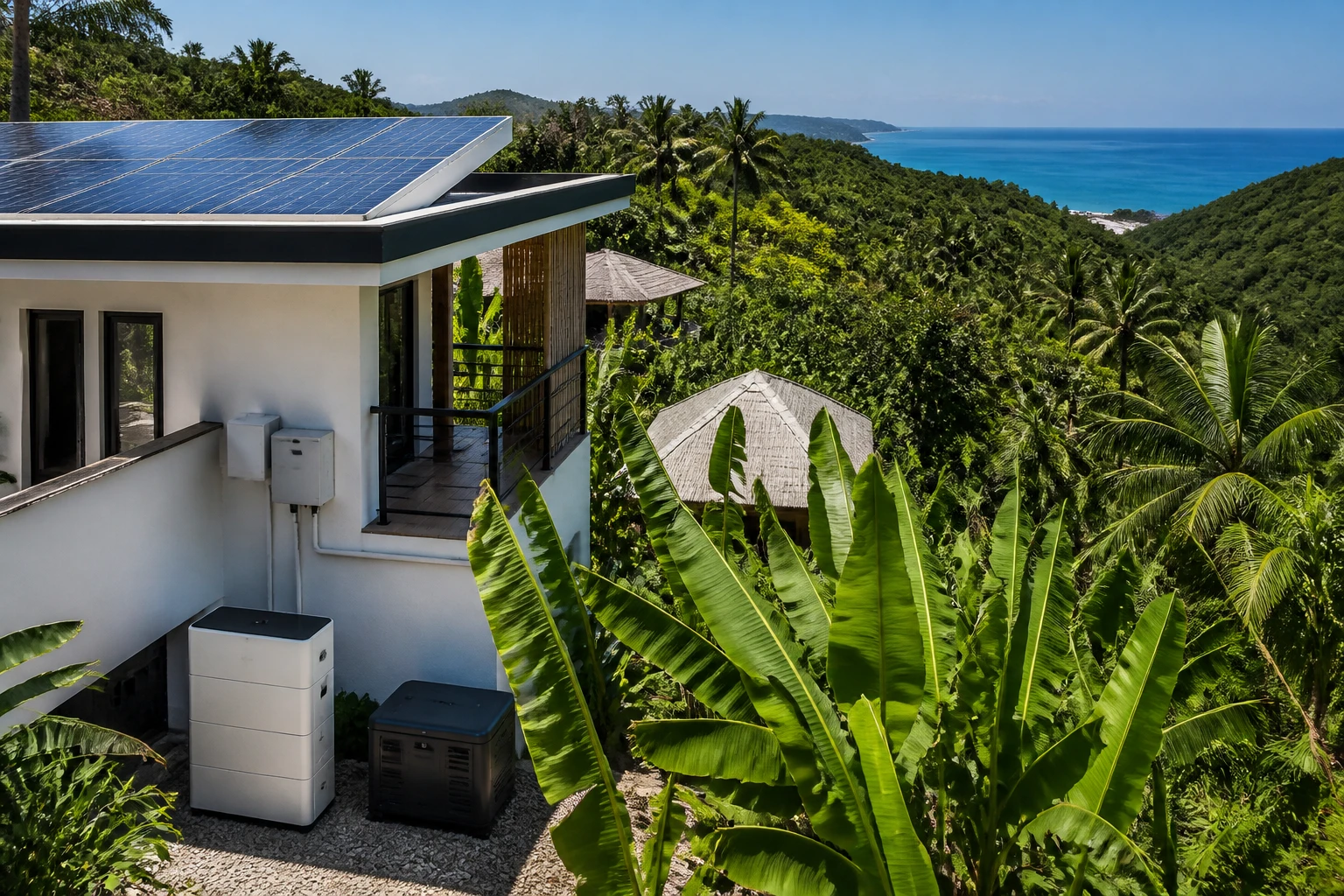
Solar and backup power for a Lombok villa: is it worth it?
For most rental villas in South Lombok, a solar-plus-battery system is worth the upfront cost. PLN grid reliability is improving but still inconsistent outside Kuta, and guests expect uninterrupted power. Properly sized solar cuts electricity bills significantly, reduces generator wear, and typicall
Quick answer: For most rental villas in South Lombok, a solar-plus-battery system is worth the upfront cost. PLN grid reliability is improving but still inconsistent outside Kuta, and guests expect uninterrupted power. Properly sized solar cuts electricity bills significantly, reduces generator wear, and typically pays back within five to eight years.
PLN reliability in South Lombok
PLN (Perusahaan Listrik Negara), Indonesia's state electricity company, has expanded its grid across Lombok considerably over the past decade, but supply quality outside the main towns remains variable. Short outages, voltage dips, and occasional multi-hour blackouts are common in more rural zones, particularly during the dry season when demand spikes and maintenance windows coincide.
For a guest staying at a rental villa, any loss of power means no air conditioning, no hot water, and no Wi-Fi. In a competitive short-stay market where reviews directly determine occupancy, a single bad-power night can cost you stars. Savvy villa owners in areas like Are Guling and Mawun treat a backup power solution as a non-negotiable operational cost rather than an optional extra.
Connection fees and monthly tariffs also vary by capacity tier. Most villas connect at 5,500 VA or 11,000 VA, and PLN's non-subsidised tariffs for those brackets sit in the range of Rp 1,400-1,700 per kWh, making Lombok's electricity more expensive per unit than many European countries at current exchange rates.
Generator versus solar-plus-battery
The traditional fallback is a diesel generator. A 5-10 kVA standby unit costs roughly USD 1,500-3,500 to purchase, but the real pain is in running costs. Diesel in Lombok trades at around Rp 6,500-7,500 per litre at the pump, and a generator running at partial load burns one to two litres per hour. Add annual servicing, oil changes, and the noise-complaint risk from short-stay guests, and the economics look poor over any extended horizon.
Solar-plus-battery is the stronger long-term play. A hybrid system sized for a two to three-bedroom rental villa in South Lombok typically costs USD 8,000-18,000 installed, depending on panel capacity, battery chemistry (lead-acid versus lithium iron phosphate), and whether you are adding to an existing structure or speccing a new build. Panel prices have fallen sharply in Indonesia over the past three years as Chinese manufacturers expanded supply into Southeast Asia.
The two approaches are not mutually exclusive. Many well-run villas operate a small standby generator for extended low-sunlight periods, which are rare in Lombok but possible during the northwest monsoon, while relying on solar for the bulk of their energy year-round.
Sizing a system for a rental villa
Lombok sits roughly eight degrees south of the equator and receives approximately 5.5 to 6 peak sun hours per day on average, with higher irradiance in the dry season (May through October) and somewhat lower in the wet season. That is an excellent solar resource, better than most of southern Europe.
A typical two to three-bedroom rental villa with a pool pump, air conditioning in two bedrooms, and standard household appliances will consume in the range of 20-35 kWh per day under guest occupation. A well-sized system would include 6-10 kW of rooftop panels paired with a 10-20 kWh battery bank to carry overnight loads and buffer cloudy days.
If you are building from scratch, it is worth discussing solar-readiness at the design stage. Roof orientation and structural provisions for panels are far cheaper to include upfront than to retrofit later. Our guide to building a villa in Lombok covers the construction-stage decisions that save the most money over a villa's lifetime.
For a detailed view of how utility costs fit into total operating costs and net yield, the ROI calculator lets you model different electricity and maintenance assumptions side by side.
The payback case in Lombok's climate
At current panel and battery prices, and with Lombok's solar resource, a well-specified system can pay for itself in five to eight years on electricity savings alone, before accounting for generator diesel displaced or maintenance costs avoided. For a villa yielding 7-12% net, reducing the monthly electricity bill by Rp 300,000-600,000 is a meaningful contribution to cash flow.
The yield argument is reinforced by the guest-experience angle. Villas that market uninterrupted solar power or off-grid capability command a modest premium on short-stay platforms, and the environmental angle resonates with the European and Australian buyers who make up the majority of South Lombok's short-stay market. With foreign arrivals running up 40-50% year on year and villa rates in Kuta and Mandalika already around 38% higher than the prior year, guests are increasingly comparing quality at a higher price point. Reliable, clean power is a visible differentiator.
As a disclosure: HubLombok is the editorial arm of Samudra Villas, an active villa developer in Are Guling. The economics discussed here apply broadly across all six investment zones. Utility infrastructure by zone, including water supply, internet options, and grid reliability, is covered in depth in our utilities guide.
Practical guidance
Before committing to a system, get at least two quotes from local installers in Lombok with verifiable completed installations. Ask for a site-specific solar assessment, not a rule-of-thumb sizing. Confirm whether the system will be grid-tied (lower upfront cost, no battery required for basic backup), hybrid (grid plus battery), or fully off-grid (requires a larger array and more battery capacity).
Check with your PPAT notary or PT PMA adviser whether the system will be registered under the property title or as a separate asset, as this can affect insurance and eventual resale value. Ensure your villa insurance policy explicitly covers the battery bank and inverter hardware, as standard policies in Indonesia often exclude electrical plant above a certain declared value.
Power reliability is not glamorous, but guests notice it the moment it fails. In South Lombok's investment case, it is one of the few operational variables most directly within an owner's control, and one of the quickest to affect both occupancy and reviews.
How many peak sun hours does Lombok get for solar power calculations?
Lombok sits roughly eight degrees south of the equator and receives approximately 5.5 to 6 peak sun hours per day on average. Irradiance is highest during the dry season from May to October, making it an excellent solar resource, comparable to the best locations in Australia and better than most of southern Europe.
What does a solar-plus-battery system cost for a rental villa in Lombok?
A hybrid solar-plus-battery system for a two to three-bedroom rental villa in South Lombok typically costs USD 8,000-18,000 installed, depending on panel capacity, battery chemistry, and whether the installation is a new build or a retrofit. Prices have fallen significantly in recent years as Southeast Asian supply has expanded.
How long does solar pay back in Lombok, and does it affect rental yield?
A well-specified system typically pays back in five to eight years on electricity savings alone, before accounting for generator diesel displaced. For a villa yielding 7-12% net, reducing monthly utility costs is a direct contribution to cash flow. Villas with reliable solar also tend to attract premium reviews, which supports occupancy over time.

The Lombok Buyer's Field Guide
Legal structures ranked by risk, the honest ROI math line by line, all six zones ranked, and the 24-point due-diligence checklist. The whole book, free in your inbox.
See what's inside